Info
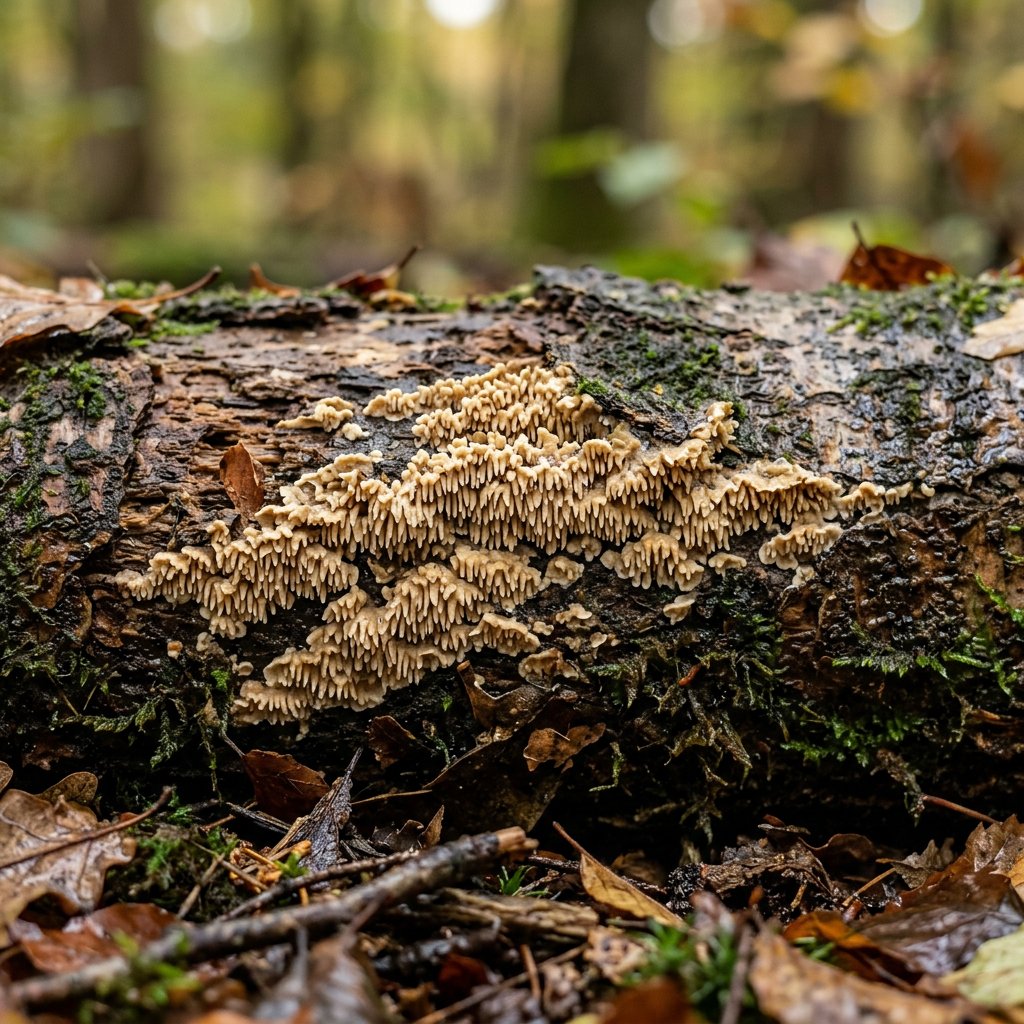
Often overlooked by those searching for giant toadstools, Steccherinum bourdotii is a master of miniature forest architecture. Commonly found clinging to the undersides of fallen branches, it looks like a delicate, frozen waterfall of tiny, cream-colored icicles. In the world of fungi, it belongs to the "hydnoid" group, famous for trading traditional gills for these strange, spikey "teeth."
🔍 How to Identify
- 🦷 The Spines: The most striking feature is the underside, which is covered in tiny, crowded "teeth" (spines) about 1–2mm long. These are usually blunt and can look slightly shaggy under a magnifying glass.
- 🪵 Growth Habit: It is primarily "resupinate," meaning it grows flat against the wood like a crust. However, it may occasionally peel back at the edges to form very small, leathery, shelf-like caps.
- 🎨 Color Palette: The body ranges from a pale cream or ochre to a warm, brownish-pink. These colors often deepen or become more "fleshy" in tone as the fungus matures.
🌲 Habitat & Ecology
- 🌳 Deciduous Host: This fungus is a specialist of deadwood. It is most frequently found on the decaying branches and trunks of broadleaf trees, with a particular fondness for Beech, Oak, and Poplar.
- 🍂 Nutrient Recycler: As a saprobic fungus, it performs the "heavy lifting" of the forest by breaking down tough wood fibers (lignin), turning old logs back into fertile soil for the next generation of trees.
⚠️ Safety & Toxicity
- 🛑 WARNING: While not currently listed as a "poisonous" species in terms of toxins, Steccherinum bourdotii is strictly non-edible.
- 🦷 Texture: The flesh is incredibly tough, leathery, and corky. It is impossible to chew and lacks any culinary value, making it a "look but don't touch" member of the fungi kingdom.
✨ Fun Fact
Evolution is a clever engineer! By growing thousands of tiny spines instead of flat gills, this fungus massively increases its surface area. This allows it to pack millions more "spore-launching" cells into a tiny space, ensuring its offspring have the best chance of catching a breeze to a new log.
More Details







