Info
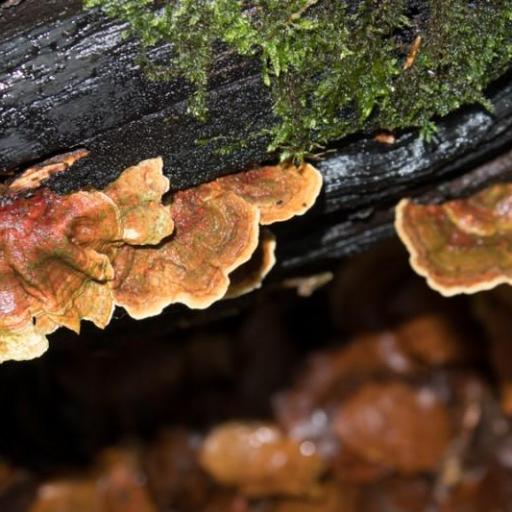
Often called the Yellowing Curtain Crust, this fungus looks like tiny, velvety shelves cascading down old logs. Unlike its "fleshy" cousins that sprout from the ground, this mushroom forms thin, leathery brackets that act as tireless recyclers of the forest floor. In damp woods, its bright golden edges catch the light, creating a beautiful rippled effect against the dark bark of fallen trees.
🔍 How to Identify
- 🧣 The Cap: Fan-shaped and velvety to the touch. It features distinct concentric zones (rings) of color ranging from rusty orange and yellow to greyish-brown.
- 🟡 The "Yellowing" Edge: The growing margin is often pale or white. If you bruise a fresh specimen near the edge, it will slowly stain a distinct yellow—a key clue for identification!
- 🪵 The Underside: Unlike common mushrooms, the bottom is completely smooth or slightly wavy. It lacks gills, teeth, or pores, which distinguishes it from the look-alike "Turkey Tail."
🌲 Habitat & Ecology
- 🌳 Hardwood Specialist: You’ll mostly find it colonizing dead deciduous wood, especially beech, birch, and oak. It is a saprobic fungus, meaning it plays a vital role in breaking down dead timber and returning nutrients to the soil.
- 🌧️ Weather Resilience: These brackets are surprisingly tough. During dry spells, they shrivel and become brittle, only to "reanimate" and become soft and pliable again as soon as the rain returns.
⚠️ Safety & Toxicity
- 🍄 WARNING: While not known to be poisonous, Stereum subtomentosum is strictly inedible.
- 🦷 Texture: Its body is as tough as leather or thick cardboard. It is impossible to chew and provides no culinary value. While it is safe to touch for adults, children, and pets, it should never be ingested.
✨ Fun Fact
Because it looks so similar to other "crust" fungi, mycologists use the "Yellowing Test" like a secret handshake. If the fungus doesn't turn yellow when scratched, it’s likely its cousin, the False Turkey Tail (Stereum ostrea). This simple chemical reaction is a favorite trick for beginner foragers to practice their ID skills!
More Details