Info
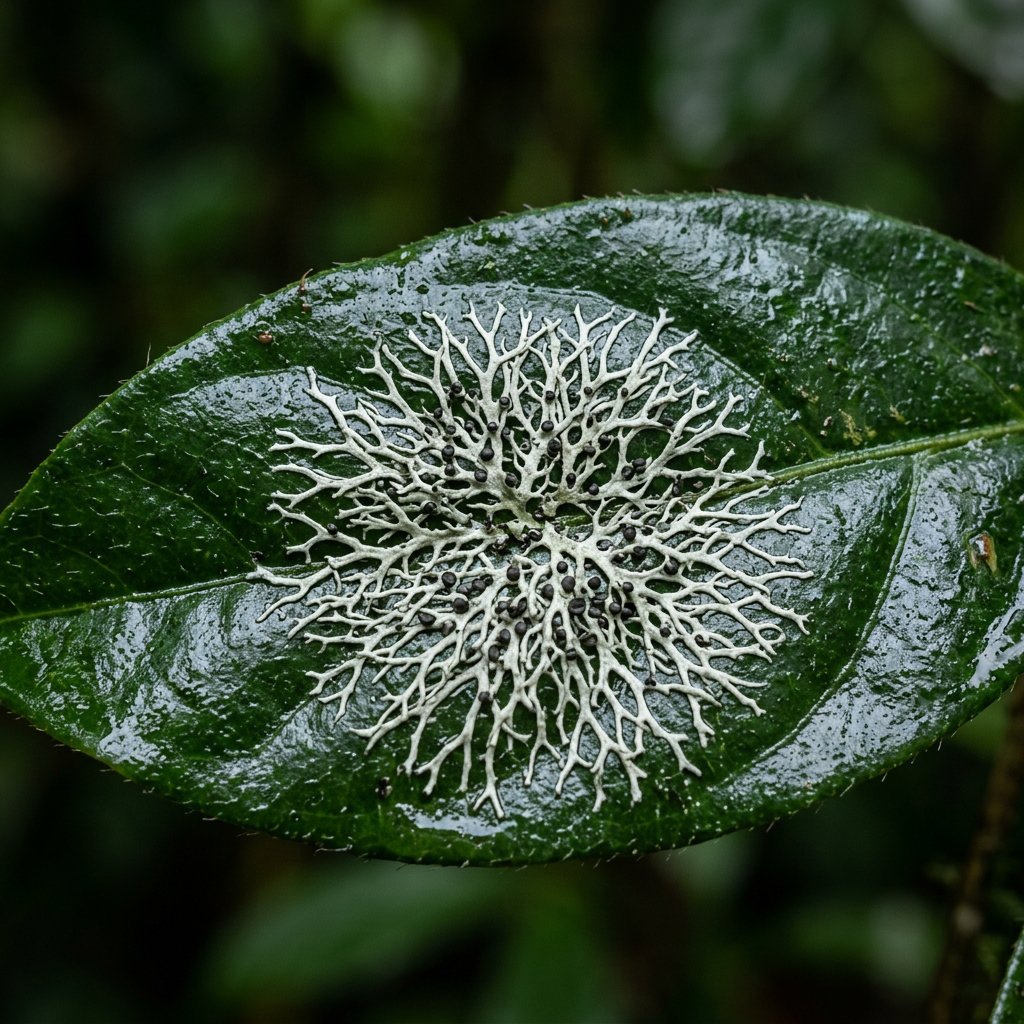
Often referred to as the "Leaf-Dot Lichen," Strigula is a fascinating genus of lichenized fungi that prefers a very specific canvas: the living leaves of tropical and subtropical plants. Unlike most mushrooms that sprout from the soil or rotting logs, Strigula creates tiny, intricate constellations of green and black directly on the foliage of evergreens, looking more like a biological embroidery than a traditional fungus.
🔍 How to Identify
- 🟢 The Body (Thallus): It appears as flat, thin, crust-like patches (crustose) that are typically pale green, grey, or white. It often looks like a tiny splash of dried paint on a leaf.
- ⚫ The Fruit (Perithecia): Look for tiny, raised black dots scattered across the patch. These are the fruiting bodies where the fungus produces its spores.
- 🍃 The Location: You will almost exclusively find it on the upper surface of tough, leathery leaves (like Magnolia or Holly) in humid, shaded environments.
🌲 Habitat & Ecology
- 🤝 The Symbiotic Roommate: Strigula is a lichen, meaning it is a partnership between a fungus and a specific type of algae. It doesn’t "eat" the leaf; it simply uses the leaf's surface as a sunny apartment to perform photosynthesis.
- ☁️ Humidity Indicator: These tiny organisms thrive in "micro-climes" with high humidity and low air pollution. If you see them, it’s a sign that your garden or local forest has very clean, moist air.
⚠️ Safety & Toxicity
- 🟢 Status: Harmless. Strigula is not known to be toxic to humans or pets, nor is it a pathogen that kills the host plant.
- 🛡️ Plant Health: While it is technically "epiphyllous" (growing on leaves), it rarely causes harm unless it covers so much of the leaf that it blocks sunlight. It can be wiped off gently if it becomes an aesthetic concern in your garden.
✨ Fun Fact
Strigula is part of a specialized group called "foliicolous lichens." While most lichens take decades to grow on rocks or trees, Strigula has evolved to grow incredibly fast so it can complete its life cycle before the leaf naturally falls off the tree!
More Details