Info
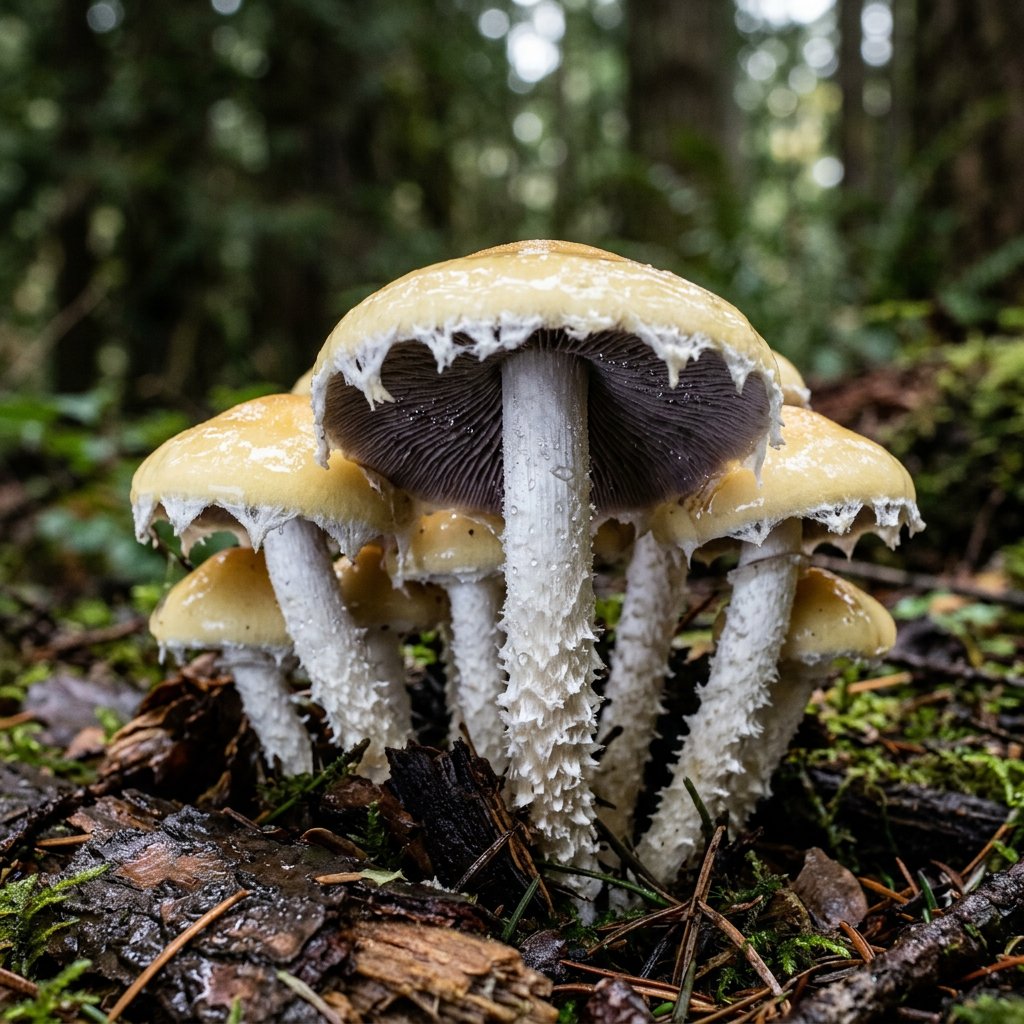
Often called the Questionable Stropharia, this fungus is one of the most elegant sights in a damp woodland or suburban garden. Despite its name, there is nothing shy about its appearance; its large, lemon-yellow cap stands out against dark mulch like a fallen sunbeam. It is famous for the delicate, white lace-like fragments that decorate the edges of its cap, giving it a regal, fringed appearance reminiscent of a Victorian collar.
🔍 How to Identify
- 🎓 The Cap: Broad and bell-shaped when young, flattening out as it matures. It is typically a pale, creamy yellow and has a notably tacky or "slimy" texture when the air is moist.
- 🕸️ The Veil Remnants: Its most distinct feature—white, cottony "teeth" or fluff hanging from the edge of the cap. These are remnants of the partial veil that once protected the developing gills.
- 🌑 The Gills: Underneath, the gills start off pale but quickly turn a dark smoky-gray or purplish-brown as the spores mature.
- ☁️ The Stem: The stalk is long, white, and notably "shaggy" (flocculose), looking as though it has been lightly dusted with tiny, soft snowballs.
🌲 Habitat & Ecology
- 🪵 The Mulch Dweller: This mushroom is a saprobe, meaning it breaks down dead organic matter. You will most frequently find it popping up in garden wood chips, bark mulch, or deep leaf litter along forest edges.
- 🍁 Pacific Beauty: It is a classic cool-weather mushroom, particularly common in the Pacific Northwest. It thrives in the damp, misty conditions of late autumn and early winter.
⚠️ Safety & Toxicity
- 🚫 WARNING: Stropharia ambigua is officially classified as inedible or of unknown edibility.
- 🤢 Details: While it is not considered "deadly" like some of its forest neighbors, it is known to cause gastrointestinal upset in many people. Because it grows in urban areas, it may also soak up toxins from treated wood chips or lawn chemicals. It should be admired for its beauty, but never for a meal.
✨ Fun Fact
The species name ambigua translates to "uncertain" or "doubtful." This wasn't because the mushroom itself was hard to find, but because the early mycologists who discovered it in the late 1800s were "uncertain" about which scientific family it truly belonged to!
More Details
| Hymenium Type | Lamella |
| Stipe Character | Ring Stipe |
| Spore Print Color | Purple-Brown |
| Mushroom Cap Shape | Convex Mushroom Cap |
| Hymenium Attachment | Adnate Hymenium Attachment |
| Mushroom Ecological Type | Saprobiont |







