Info
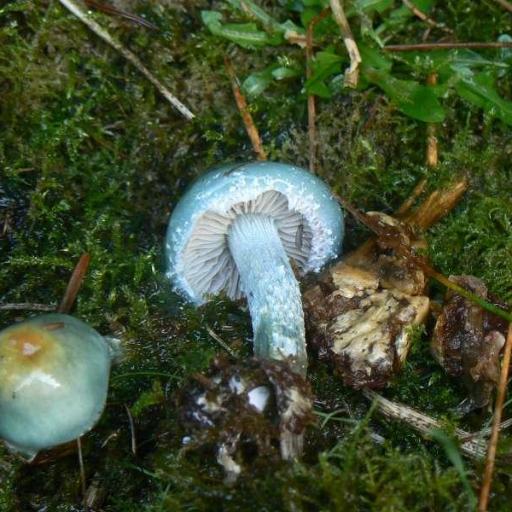
Known as the Blue Roundhead, this mushroom looks like something plucked straight from a fantasy forest or a science fiction film. Its stunning turquoise-teal cap and metallic sheen often stop hikers in their tracks, looking almost too colorful to be real. While it lacks the "magic" properties of its psychedelic relatives, its ethereal beauty makes it one of the most photographed fungi in the woodland.
🔍 How to Identify
- 🍄 The Cap: Smooth and distinctively slimy (viscid) when wet. It starts as a vibrant, deep blue-green but gradually fades to a pale yellowish-cream from the center outward as it matures.
- 🍫 The Gills: These are "adnate" (widely attached to the stem). They begin as a pale grayish-white but eventually turn a dark, purplish-brown as the spores develop.
- ❄️ The Stem: The stalk is often covered in tiny, white shaggy scales below a faint "ring zone." It is typically hollow and shares the same pale blue-green tint as the cap.
🌲 Habitat & Ecology
- 🍂 The Decomposer: This is a saprobic species, meaning it survives by breaking down organic matter. You will often find it growing among woodchips, rich leaf litter, or in disturbed garden soil.
- 🌦️ Cool Weather Friend: The Blue Roundhead prefers the damp, cool air of late summer and autumn. It is particularly common in temperate regions and often pops up in suburban parks and gardens after a heavy rain.
⚠️ Safety & Toxicity
- 🚫 WARNING: The Blue Roundhead is strictly not for the plate. It is generally classified as inedible or potentially toxic depending on the region and individual sensitivity.
- 🤢 Risk Assessment: Ingestion can lead to gastrointestinal upset and nausea. Because it can be easily confused with other "Little Brown Mushrooms" (LBMs) or other Stropharia species that may contain harmful compounds, it is best enjoyed only through a camera lens.
✨ Fun Fact
The striking blue-green color isn't actually in the mushroom's flesh—it is concentrated in the slimy "pellicle" (the skin of the cap). If the slime is washed away by heavy rain or if the skin is peeled off, the mushroom underneath looks like a mundane, yellowish-white fungus!
More Details