Info
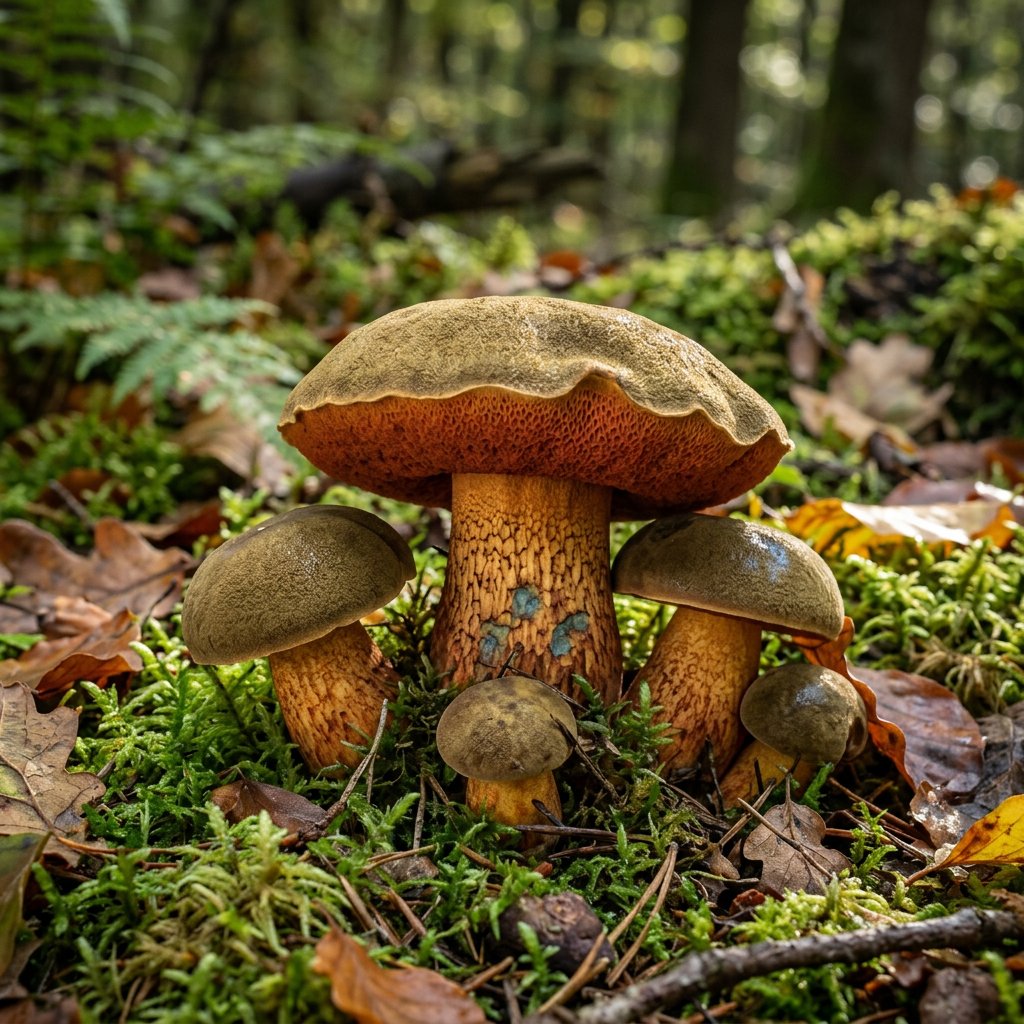
Commonly known as the Lurid Bolete, this mushroom is one of the most dramatic residents of the forest floor. It is famous among foragers and nature enthusiasts for its "magical" transformation—turning an instant, deep indigo blue the moment its flesh is cut or bruised. In historical folklore, these rapid color changes were often whispered to be the work of forest spirits or used as "witch’s ink."
🔍 How to Identify
- 🎨 The Cap: The cap is typically a somber olive-brown or "lurid" ochre, often feeling slightly velvety to the touch when young and expanding up to 20cm in diameter.
- 🩸 The Pores: Instead of gills, the underside features tiny pores that are a vivid, fiery orange to blood-red. These pores will bruise blue-black immediately if touched.
- 🕸️ The Stem: The stalk is stout and yellowish, but its most defining feature is a dark-red, raised network of veins (reticulation) that looks like a delicate mesh or "bloody netting" stretched over the surface.
- 🔵 The Staining: If you slice the mushroom in half, the pale yellow flesh reacts with oxygen to turn a startling dark blue in less than two seconds.
🌲 Habitat & Ecology
- 🌳 Tree Partners: This fungus is mycorrhizal, forming a vital symbiotic relationship with the roots of broadleaf trees. It is most commonly found huddled near the base of Oak, Beech, and Lime (Linden) trees.
- 🌍 Soil Preference: The Lurid Bolete is a bit of a "snob" regarding its environment; it strongly prefers chalky, alkaline soils and is often found in ancient woodlands, parks, or even old churchyards after heavy summer rainfall.
⚠️ Safety & Toxicity
- 🚨 WARNING: Do not eat this mushroom raw. It contains gastric irritants that cause severe stomach upset unless it is thoroughly cooked at high temperatures to neutralize the toxins.
- 🍷 The Alcohol Rule: Even when cooked, some people experience a toxic reaction similar to "Antabuse" (nausea and palpitations) if they consume alcohol alongside this mushroom. It is widely advised to avoid alcohol for 24 hours before and after consumption.
- 🐾 Pets and Children: Due to the risk of gastrointestinal distress and the complexity of its preparation, it should be kept well away from curious pets and children.
✨ Fun Fact
The intense blue reaction isn't magic; it’s chemistry! The mushroom contains a compound called pulvinic acid. When exposed to air, an enzyme quickly oxidizes this acid, turning it into a blue pigment to help protect the damaged mushroom from bacteria and insects.
More Details
| Hymenium Type | Pores |
| Stipe Character | Bare Stipe |
| Spore Print Color | Olive Brown |
| Mushroom Cap Shape | Convex Mushroom Cap |
| Hymenium Attachment | No Hymenium Attachment |
| Mushroom Ecological Type | Mycorrhiza |







