Info
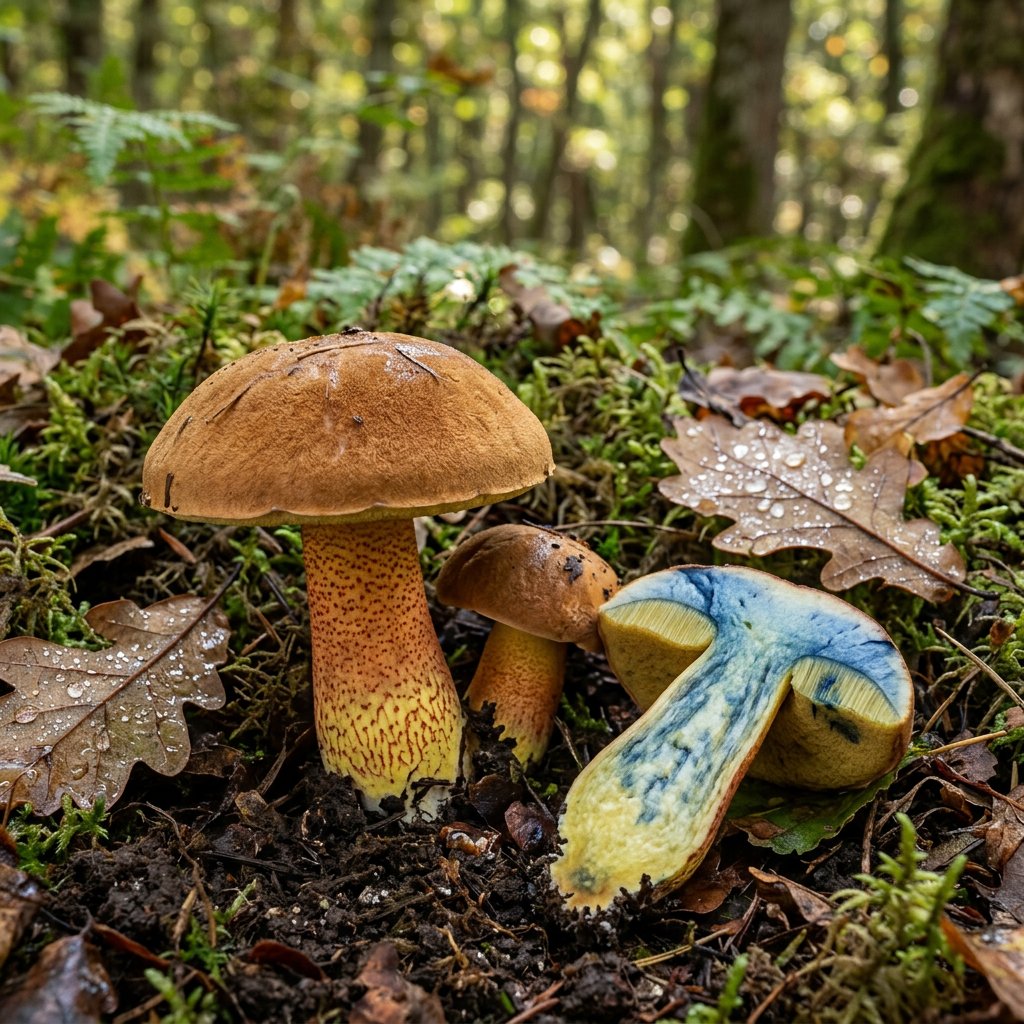
Known as the "Deceiving Bolete," Suillellus queletii is a master of forest floor theatrics. It earns its nickname from its dramatic ability to change color in the blink of an eye, turning from a pale yellow to a deep, moody indigo when bruised or cut. Often found tucked under the shade of ancient oaks, this mushroom is a favorite for foragers who enjoy the "blue-staining" bolete hunt, though its moody colors often scare off the uninitiated.
🔍 How to Identify
- 🍄 The Cap: Usually 5–15 cm wide, the cap surface is dry and velvety. Its color is a complex palette of olive-brown, brick-red, or subtle orange hues.
- 🧽 The Pores: Instead of gills, the underside features tiny pores. These start out yellow but quickly turn orange-red and will bruise dark blue immediately if touched.
- 🍷 The Stem Base: One of the most reliable features is the base of the stem. If you slice it vertically, the very bottom of the stem flesh is a deep, wine-red or "beetroot" red, which does not change to blue.
- 🎨 The "Ink" Effect: The lemon-yellow flesh of the cap and upper stem flashes to a vivid dark blue almost instantly upon exposure to air.
🌲 Habitat & Ecology
- 🌳 Tree Partners: This mushroom is mycorrhizal, meaning it lives in a symbiotic partnership with trees. It specifically favors broadleaf trees like Oak, Beech, and Hornbeam.
- 🌍 Soil Preference: It is a bit of a "snob" regarding its home, almost exclusively popping up in sunny, grassy spots on calcareous (chalky or alkaline) soils.
- ☀️ Seasonality: Look for it during the warm months of summer and early autumn, especially after a heavy rainfall followed by a humid spell.
⚠️ Safety & Toxicity
- 🚨 WARNING: Do not consume this mushroom raw. It contains gastric irritants that cause severe stomach upset unless neutralized by high heat.
- 🍳 Edibility Status: While considered edible by some after very thorough cooking (at least 20 minutes), it is frequently confused with more dangerous species.
- 🚫 The Lookalikes: It can be easily mistaken for the poisonous Rubroboletus satanas (Devil’s Bolete), which has a much paler, silvery-white cap and a distinct, sickening smell when mature.
✨ Fun Fact
This mushroom was named in honor of Lucien Quélet, the founder of the French Mycological Society. He was the first to describe the species in the late 19th century, during a time when scientists were just beginning to understand the chemistry behind the "magic" blue-staining reaction of boletes.
More Details
| Hymenium Type | Pores |
| Stipe Character | Bare Stipe |
| Spore Print Color | Olive |
| Mushroom Cap Shape | Convex Mushroom Cap Or Flat Mushroom Cap |
| Hymenium Attachment | No Hymenium Attachment |
| Mushroom Ecological Type | Mycorrhiza |







