Info
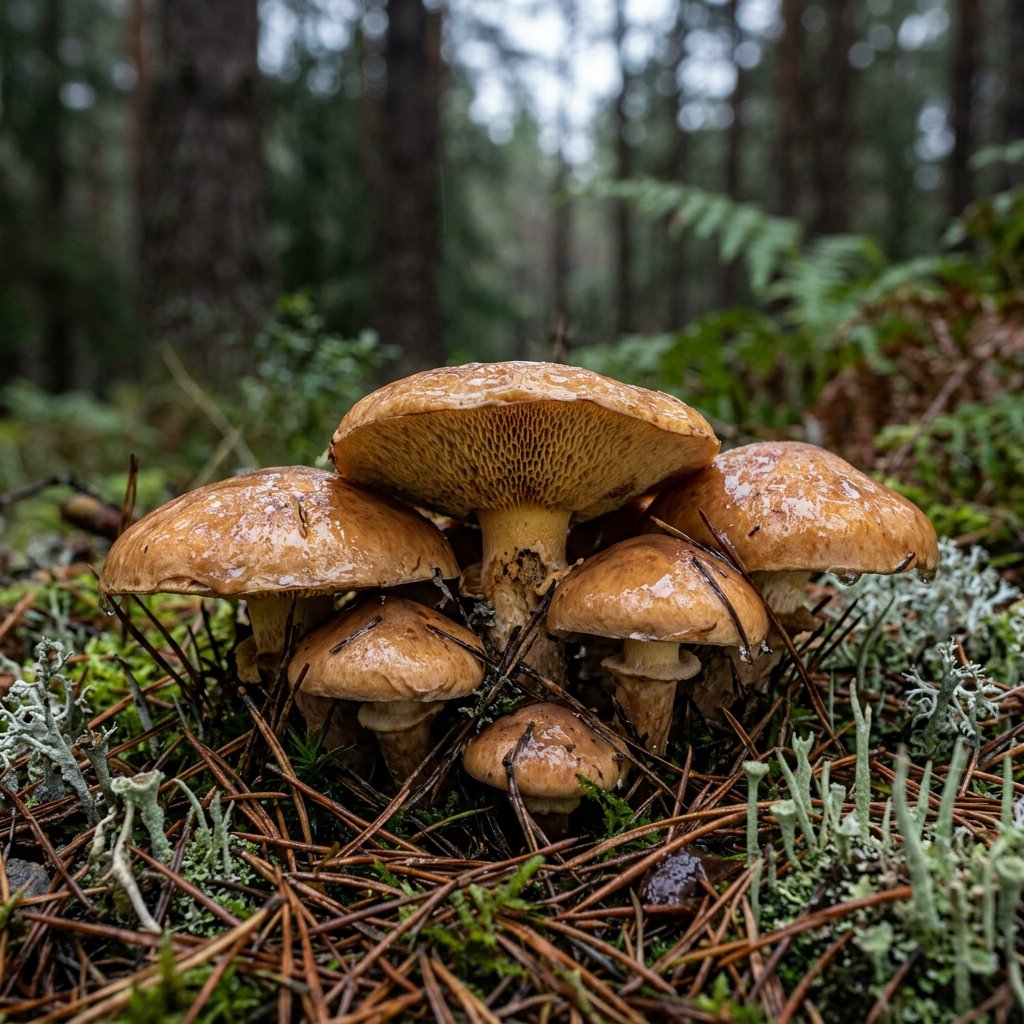
Often called the Bovine Bolete or the Jersey Cow Mushroom, this humble fungus looks remarkably like a sticky, golden-brown bun dropped on the forest floor. Its name comes from a time when it was so abundant in European pastures that it was commonly used as fodder for cattle. While it might not be the "king" of mushrooms, it plays a vital role in the health of pine forests and has a strange, parasitic "best friend" that often follows it around.
🔍 How to Identify
- 🍄 The Cap: Smooth, convex, and distinctly tacky or "slimy" when damp. It ranges from a pale clay color to a rich, ochre-yellow.
- 🧽 The Pores: Unlike many mushrooms with gills, this species has a spongy underside. The pores are large, angular, and "compound" (pores within pores), starting olive-yellow and turning dingy brown with age.
- 🦶 The Stem: Relatively short, tough, and smooth. It lacks the "ring" or "collar" found on some of its close cousins in the Suillus family.
🌲 Habitat & Ecology
- 🌲 Pine Partners: This mushroom is "mycorrhizal," meaning it lives in a symbiotic embrace with the roots of pine trees, particularly the Scots Pine. You’ll rarely find it far from a needle-covered floor.
- 🤝 The Rosy Shadow: Look closely nearby for a small, bright pink mushroom called the Rosy Spike. These two species are almost always found together; the Rosy Spike is actually a parasite that feeds on the mycelium of the Bovine Bolete.
- 🍂 Social Clusters: They rarely grow alone. You will often find them in large, gregarious "troops" or fairy rings during the late summer and autumn.
⚠️ Safety & Toxicity
- 🛑 WARNING: Never consume any wild mushroom unless you have confirmed the identification with a local expert. While Suillus bovinus is generally considered edible, it is often described as having a "rubbery" texture and mediocre flavor.
- 🤢 Digestive Sensitivity: Some individuals experience stomach upset from the slimy skin of the cap. Foragers usually peel the skin off before cooking to avoid a laxative effect.
- 🐾 Pet Safety: While not known to be deadly toxic to dogs, the slimy texture and high fiber content can cause significant gastrointestinal distress if ingested by pets.
✨ Fun Fact
If you decide to cook this yellow-brown mushroom, don't be alarmed by the color change! When heated, the flesh of the Bovine Bolete often turns a surprising bright pink or purple in the pan.
More Details







