Info
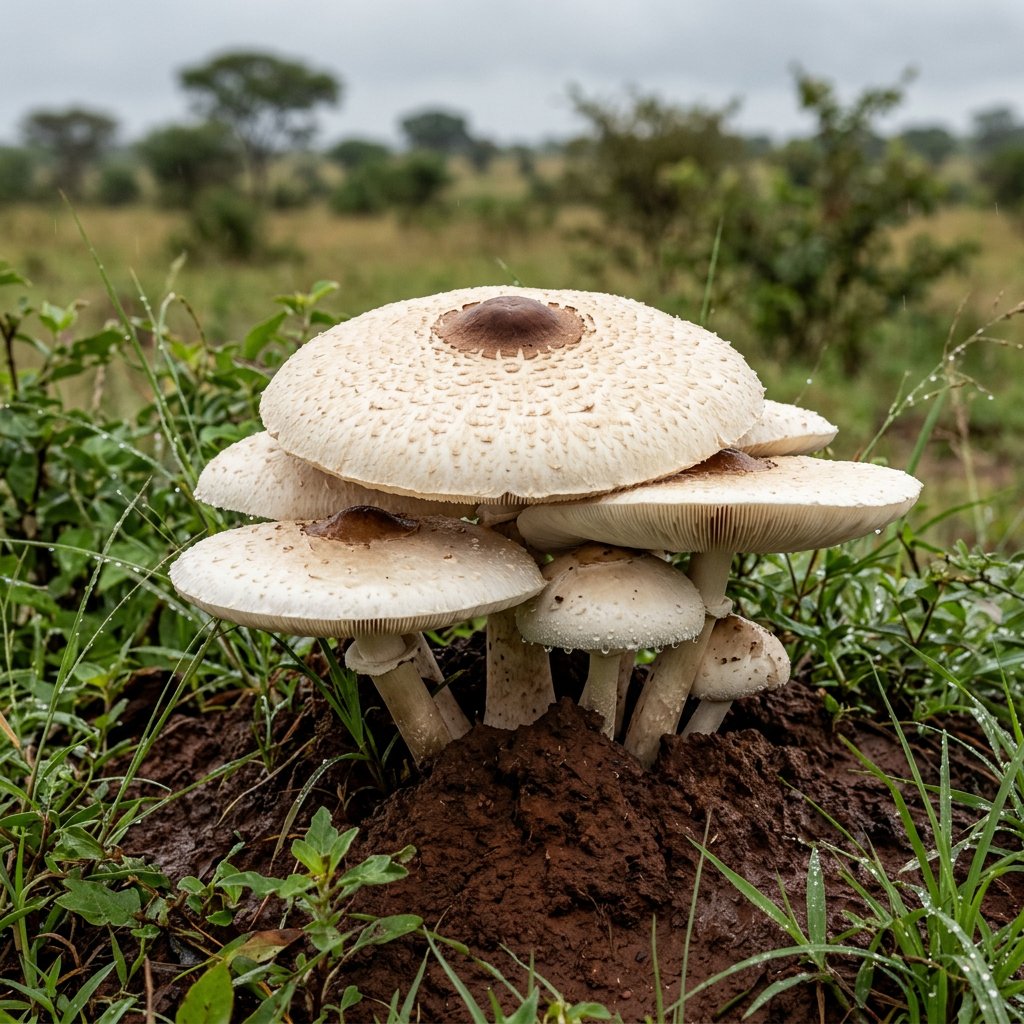
Known as the "Termite Mushroom" or the "Beefsteak of the Savannah," these fungi share one of nature’s most sophisticated partnerships. They do not grow in typical soil; instead, they are literally "farmed" by termites within their massive mounds. For foragers across Africa and Southeast Asia, these mushrooms are considered a seasonal delicacy, often compared to chicken or beef in texture and flavor.
🔍 How to Identify
- 🎓 The Umbo: Most species feature a distinct, hardened point or "bump" at the very center of the cap, which the mushroom uses like a drill to push through the tough, cemented earth of a termite mound.
- 🍄 The Cap: The surface is typically smooth and can range from smoky grey to creamy white, often expanding into a wide, flat disc as it matures.
- 🥕 The Pseudorhiza: This is the "root" of the mushroom. Unlike most fungi, Termitomyces has an incredibly long, tapering underground stem that reaches deep into the heart of the termite nest.
- ☁️ White Gills: Underneath the cap, the gills are crowded and white, eventually turning a slight pinkish-tan as the spores mature.
🌲 Habitat & Ecology
- 🐜 The Ultimate Roommates: These mushrooms have an "obligate" relationship with termites. The termites chew up wood and grass, "seed" it with the fungus, and then eat the nutrient-rich fungal growths. The mushroom only fruits (appears above ground) when the colony is thriving.
- 🌍 Mound Bound: You will almost exclusively find them emerging directly from or at the base of active or abandoned termite mounds in tropical and subtropical regions.
⚠️ Safety & Toxicity
- 🛑 WARNING: While many species in this genus are world-renowned edibles, never consume a wild mushroom unless you have identified it with 100% certainty alongside an expert.
- 🕵️ The Lookalike Risk: To the untrained eye, some white Termitomyces can be confused with deadly Amanita species (like the Destroying Angel). However, Termitomyces lack the "cup" (volva) at the very base of the underground stem.
- 🐾 Pets: While not inherently toxic to animals, the tough fibers can cause gastrointestinal blockage or upset in small dogs if swallowed whole.
✨ Fun Fact
The species Termitomyces titanicus holds the record for the world's largest edible mushroom. Its cap can reach over 3 feet (1 meter) in diameter—enough to feed an entire village for a day!
More Details







