Info
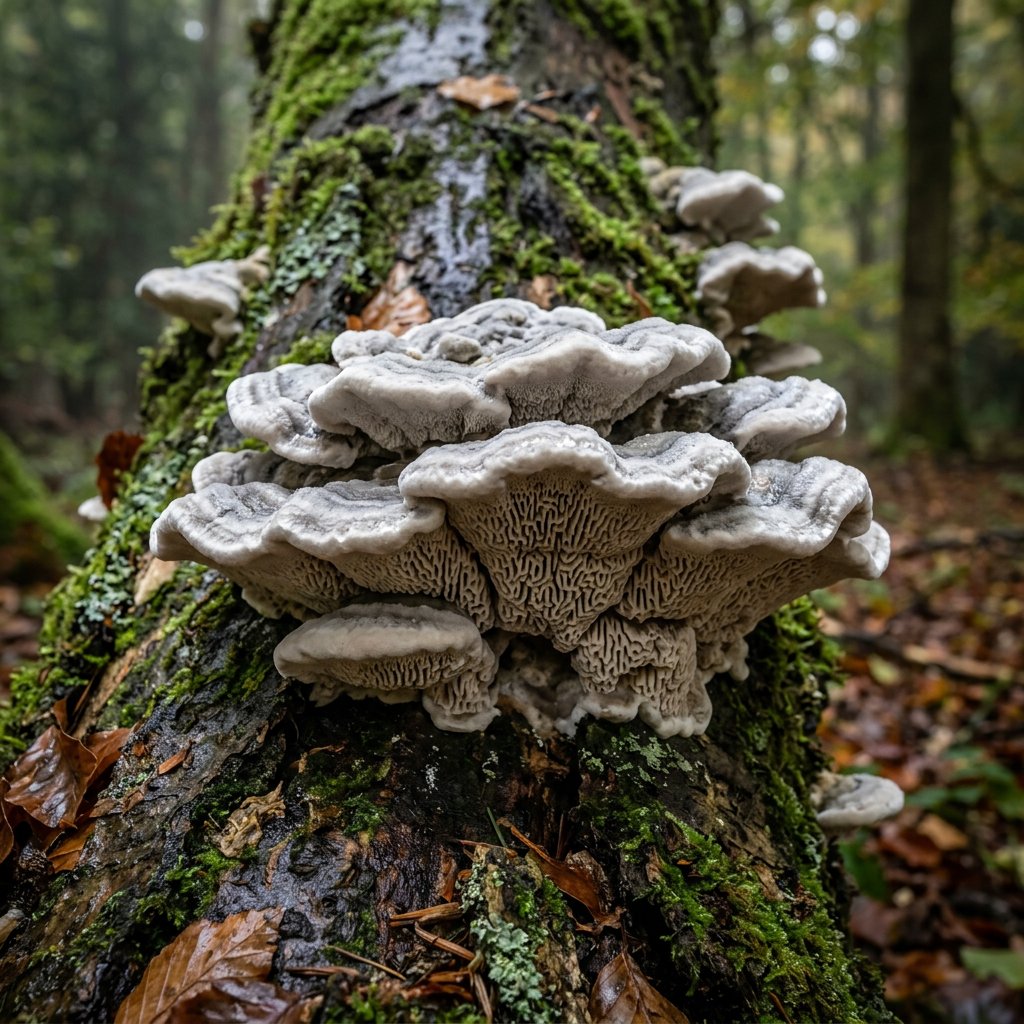
Known commonly as the Lumpy Bracket or the Whitewash Bracket, this fungus is a sturdy, permanent resident of temperate forests. Unlike the soft, fleeting mushrooms that pop up after rain and vanish in days, the Lumpy Bracket is built like a shelf of solid wood. It acts as a master recycler, slowly breaking down fallen beech trees and returning their nutrients to the soil. Over time, it often develops a beautiful, "living" green velvet coat thanks to a unique partnership with forest algae.
🔍 How to Identify
- 🏔️ The Humped Base: The name gibbosa comes from the distinct lumpy, swollen area where the mushroom attaches to the wood, giving it a "hunchbacked" profile.
- 🪵 Maze-Like Pores: If you flip the bracket over, you won't see the usual tiny round holes. Instead, it features radially elongated, slot-like pores that look like a miniature, ivory-colored labyrinth.
- 🌿 Algal Camouflage: While it starts as a creamy white or greyish-white, older specimens are almost always colonised by green algae, making them look like mossy stones protruding from a log.
🌲 Habitat & Ecology
- 🌳 The Beech Specialist: While it occasionally colonizes other hardwoods like Oak or Birch, it has a primary love for Beech trees. Look for it on dead stumps, fallen logs, or the base of decaying trees.
- ♻️ White Rot Recycler: This fungus is a "white rot" specialist. It breaks down the tough lignin in wood, leaving behind soft, white cellulose. This process is essential for forest health, creating habitats for beetles and small insects.
⚠️ Safety & Toxicity
- 🚫 Status: WARNING: Inedible. While the Lumpy Bracket is not considered a "deadly" poisonous mushroom, it is entirely unpalatable for humans.
- 🧱 Physical Risk: The texture of this mushroom is incredibly tough, corky, and woody. Attempting to eat it is like chewing on a piece of dry plywood, and it can cause digestive distress or choking risks if ingested by pets.
✨ Fun Fact
The "green" you see on this mushroom isn't actually part of the fungus! Because the Lumpy Bracket is so long-lived and stays moist, it provides the perfect porous surface for epiphytic algae to grow, creating a tiny, symbiotic "hanging garden" on the forest floor.
More Details







