Info
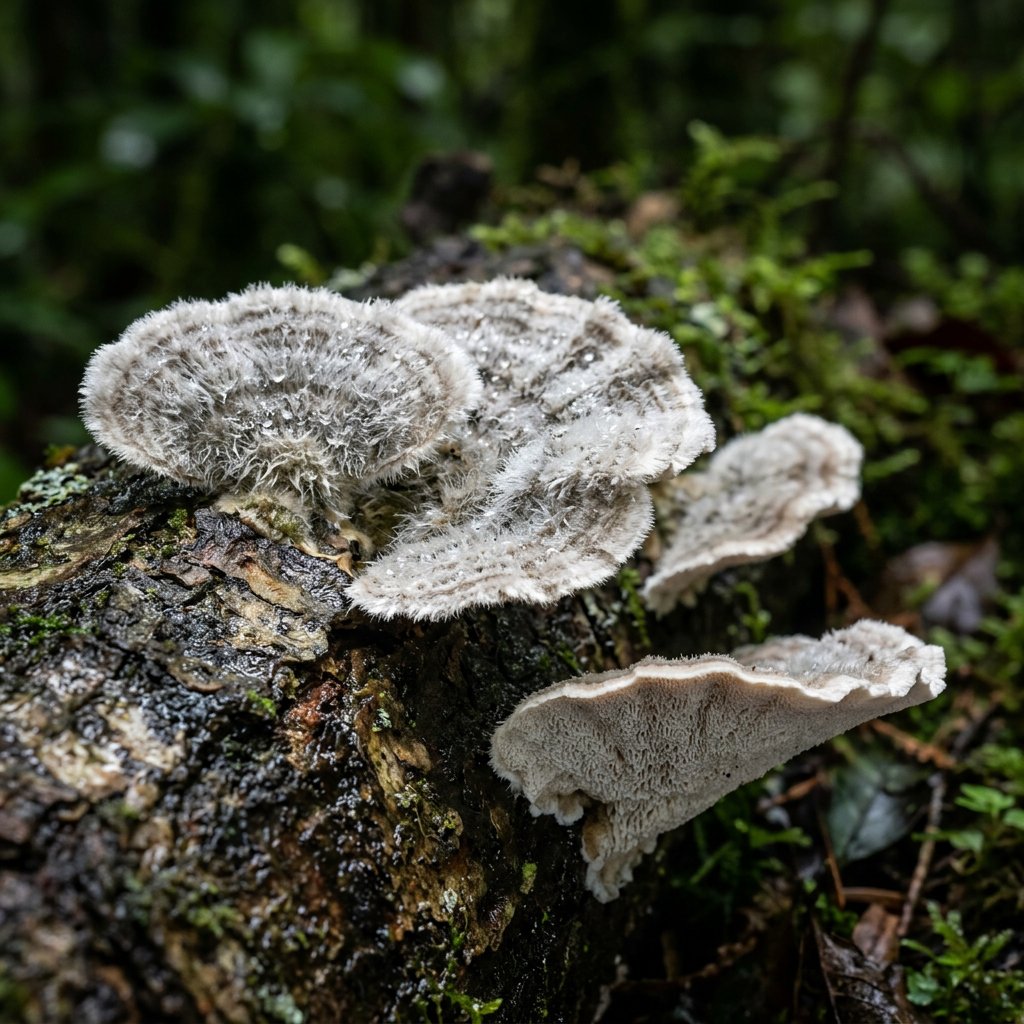
Known as the "Hairy Bracket," Trametes villosa is a velvety architect of the forest floor. Often mistaken for its famous cousin, the Turkey Tail, this mushroom earns its name from the dense, fuzzy layer of fine hairs covering its surface. It acts as one of nature’s most efficient recyclers, turning fallen hardwood into rich soil in warm, humid climates.
🔍 How to Identify
- ☁️ The Surface: The cap is covered in soft, velvety hairs (villose) that give it a fuzzy feel. It usually features concentric zones of white, gray, and pale tan.
- 🦷 The Underside: Unlike common mushrooms with gills, this fungus has a pore surface. The tiny pores are white to creamy-tan and are easily visible to the naked eye.
- 📏 The Shape: These grow as thin, leathery shelves or "brackets." They are often semi-circular or fan-shaped and can grow in overlapping clusters that look like a staircase on a log.
🌲 Habitat & Ecology
- 🪵 Woodland Recycler: You will almost always find it growing on decaying hardwood logs and stumps. It causes "white rot," a process where it breaks down the tough lignin in wood, leaving behind soft, white cellulose.
- ☀️ Warm Climate Lover: While many polypores love the deep woods, Trametes villosa is particularly fond of the heat and humidity found in the Southeastern United States, Central America, and tropical regions.
- 🌿 Algae Association: Older specimens often take on a greenish tint. This isn't their natural color; it’s actually green algae living within the fuzzy "hairs" on the mushroom's surface!
⚠️ Safety & Toxicity
- 🚫 Status: Inedible. While not known to be dangerously toxic, Trametes villosa is far too leathery and "woody" to be consumed. Eating it would be similar to chewing on a piece of fuzzy cardboard.
- 🧼 General Caution: Always wash your hands after handling wild fungi. While this species is safe to touch, it shares its habitat with more toxic species, and cross-contamination can occur.
✨ Fun Fact
The specific epithet villosa comes from the Latin word for "shaggy" or "hairy." This is the same root word used in biology for "villi"—the tiny, hair-like structures found in the human intestine!
More Details