Info
Known affectionately as the Celery Mushroom, Tricholoma apium is a robust, stocky inhabitant of coniferous forests. It is famous among seasoned foragers not just for its appearance, but for a fragrance that can permeate the air around it—a savory, herbal scent reminiscent of fresh celery or lovage. While it lacks the colorful folklore of red-capped toadstools, it is considered a "hidden gem" of the pine woods for those who appreciate the aromatic wonders of the fungal kingdom.
🔍 How to Identify
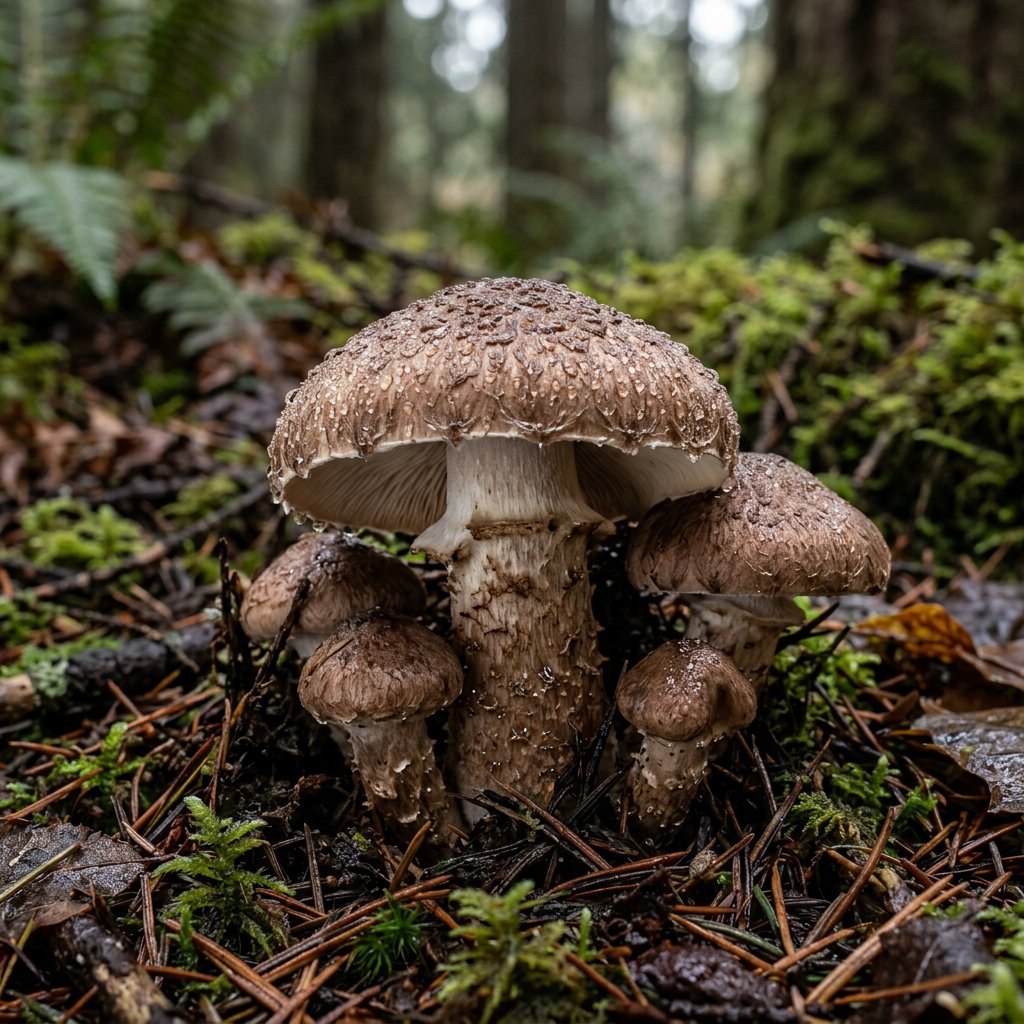
- 👒 The Cap: Broad, meaty, and usually measuring 5–15 cm across. It starts convex but flattens with age, featuring a creamy-white to pale ochre surface often dusted with brownish, scale-like fibers toward the center.
- 🥢 The Gills: The gills are crowded and "notched" (sinuate) where they meet the stem. They typically remain white or develop a pale yellowish tint as the mushroom matures.
- 👃 The Scent: This is the ultimate identification key. If you bruise the flesh or gills, it releases a powerful, unmistakable aroma of fresh celery, bouillon, or lovage.
- ⚖️ The Stem: The stalk is thick, solid, and cylindrical, often slightly swollen at the base. It lacks a ring or a volva, maintaining a clean, sturdy appearance.
🌲 Habitat & Ecology
- 🌲 Pine Partners: This mushroom is ectomycorrhizal, meaning it lives in a symbiotic relationship with tree roots. It is almost exclusively found near pine trees (Pinus), particularly in sandy or nutrient-poor soils.
- 🍃 Mossy Hiding Spots: It often grows partially buried under a thick layer of pine needles or moss. Foragers often have to look for "mush-rumps"—slight bulges in the forest floor—to find them before they fully emerge.
⚠️ Safety & Toxicity
- 🚨 WARNING: Identifying mushrooms in the Tricholoma genus (the "Knights") is notoriously difficult for hobbyists. While T. apium is traditionally considered edible in some regions, it is easily confused with toxic relatives.
- 🤢 Digestive Risks: Some people may experience localized allergic reactions or gastrointestinal upset. Furthermore, several yellowish "Knights" are known to be toxic, causing severe stomach distress.
- 🛑 Expert Only: Never consume this mushroom unless its identity is confirmed by a professional mycologist. The risk of confusing it with the toxic Tricholoma equestre (Yellow Knight) or other lookalikes is high.
✨ Fun Fact
- 🌱 Latin Roots: The species name apium is the Latin word for celery. It is one of the rare instances where a mushroom is named specifically for its olfactory resemblance to a common kitchen vegetable!
More Details