Info
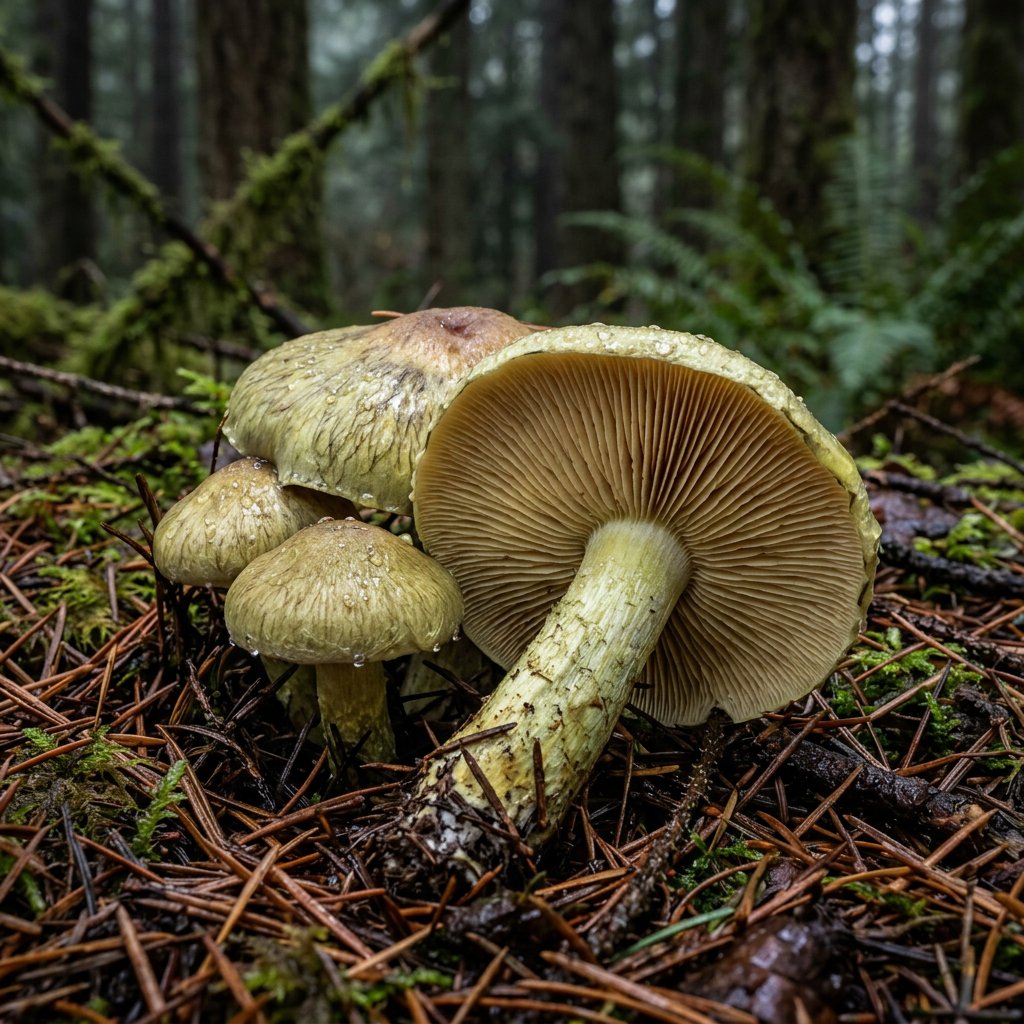
Often referred to as a variation of the "Green-Yellow Knight," this mushroom is a master of camouflage amidst the mossy floor. It belongs to a complex group of mushrooms known for their sturdy, "knightly" appearance and subtle, earthy colors. While it lacks the fame of the bright red Toadstool, its elegant olive hues make it a prized find for forest hikers and amateur mycologists.
🔍 How to Identify
- 🍄 The Cap: Usually 3–8 cm wide, the cap is distinctively yellow-green with fine, dark radiating fibers (fibrils). It starts bell-shaped and flattens out as it matures, often staying slightly sticky when damp.
- ☁️ The Gills: The gills are white to pale lemon-yellow, crowded closely together, and "notched" right before they meet the stem—a classic trait of the Tricholoma family.
- 🪵 The Stem: It features a solid, cylindrical stem that is typically white but may be brushed with faint yellow streaks. Unlike some other mushrooms, it has no ring (annulus) or cup (volva) at the base.
🌲 Habitat & Ecology
- 🤝 The Mycorrhizal Bond: This mushroom is a "team player." it forms a symbiotic relationship with the roots of trees—most commonly pines and oaks—exchanging soil nutrients for tree sugars.
- 🍂 Forest Floor: You will typically find it peeking through leaf litter or mossy patches in temperate forests during the late summer and autumn months.
⚠️ Safety & Toxicity
- 🛑 WARNING: Do not eat this mushroom. The edibility of Tricholoma viridilutescens is officially "suspect." Many species in this genus cause severe gastrointestinal upset.
- 🎭 The Great Mimic: It looks strikingly similar to several other yellow-green Tricholoma species, some of which are known to be mildly toxic. Because field identification is extremely difficult even for experts, it should be treated as inedible.
✨ Fun Fact
The name is a literal color palette: in Latin, viridis means "green" and lutescens means "becoming yellow." Its name perfectly captures the way its cap looks like a watercolor painting where two colors are slowly bleeding into one another!
More Details







