Info
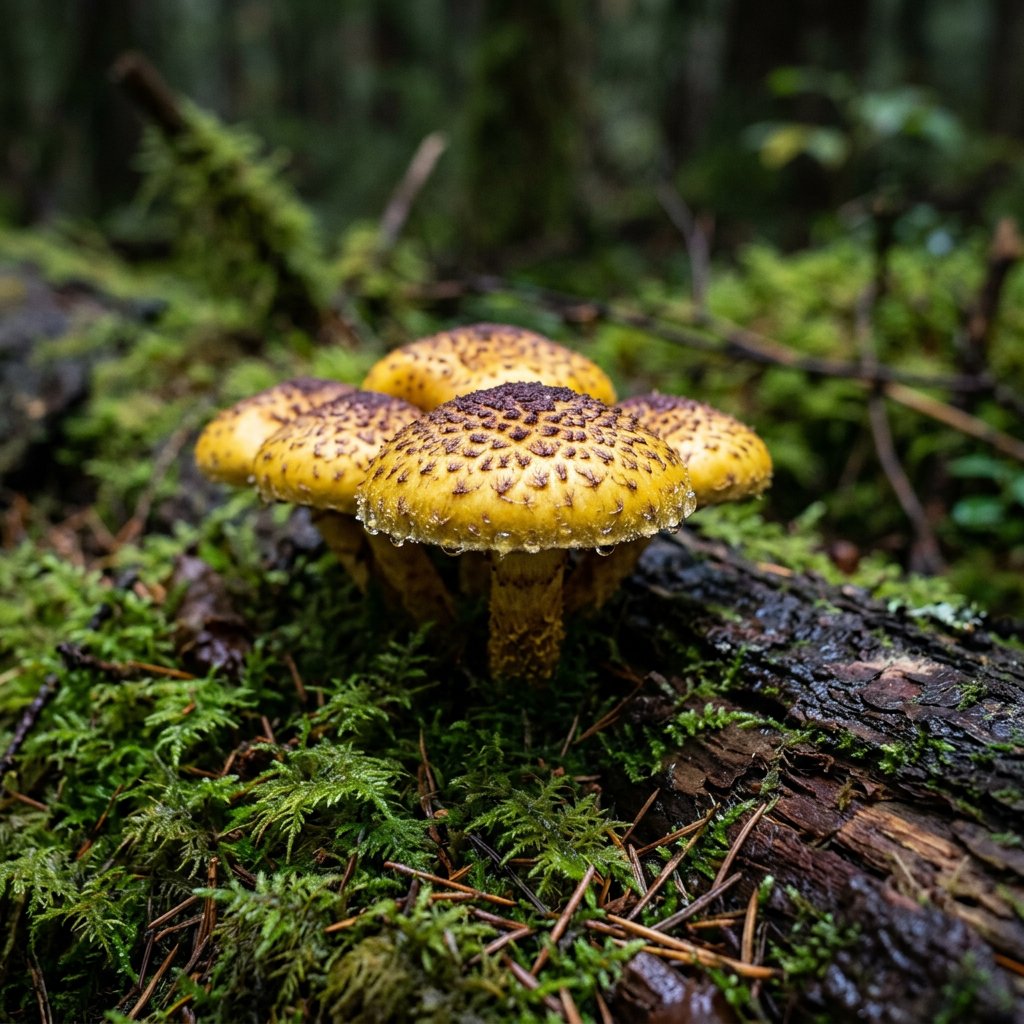
Known affectionately by the whimsical nickname "Prunes and Custard," this mushroom is a striking find for any forest explorer. Its vibrant golden-yellow body topped with dark, tiny scales creates a visual contrast that looks like a gourmet dessert dropped onto a rotting log. While it belongs to a genus often overlooked, its "decorated" appearance makes it a favorite for nature photographers.
🔍 How to Identify
- 🍄 The Cap: A brilliant custard-yellow base heavily dusted with fine, dark olive or brownish scales (the "prunes"). It starts convex and flattens out with age, often reaching 4-10 cm across.
- 🟡 The Gills: Bright, sunny yellow and closely packed. They are "adnexed," meaning they reach the stem but are not broadly attached to it.
- 🥢 The Stem: Typically yellow and often curved or off-center because it grows directly out of wood. It is fibrous and may have some light scaling near the top.
🌲 Habitat & Ecology
- 🪵 Wood Dweller: Unlike many mushrooms that grow from the soil, this species is saprobic, meaning it eats dead wood. You’ll almost exclusively find it growing on well-decayed conifer logs or stumps, particularly spruce and pine.
- 🍂 Seasonal Sightings: It prefers the cooling air of late summer and autumn. It is often found solitary or in small, scattered groups rather than large clusters.
⚠️ Safety & Toxicity
- 🚫 WARNING: Do not consume. While its nickname sounds delicious, Tricholomopsis decora is generally classified as inedible.
- 🤢 Toxicity: Some reports suggest it contains minor toxins that can cause gastrointestinal distress (nausea and cramping). It also lacks a pleasant flavor, often described as bitter or "rubbery."
- 🐾 Pets: Keep dogs away from decaying logs where these grow, as the ingestion of wild "LBMs" (Little Brown Mushrooms) or yellow wood-rotters can lead to unpredictable stomach upset in animals.
✨ Fun Fact
The Latin name decora translates to "elegant" or "beautiful." Despite its lack of culinary value, it is considered a "bioindicator" for mature coniferous forests with high amounts of fallen deadwood, signaling a healthy, decomposing ecosystem.
More Details







