Info
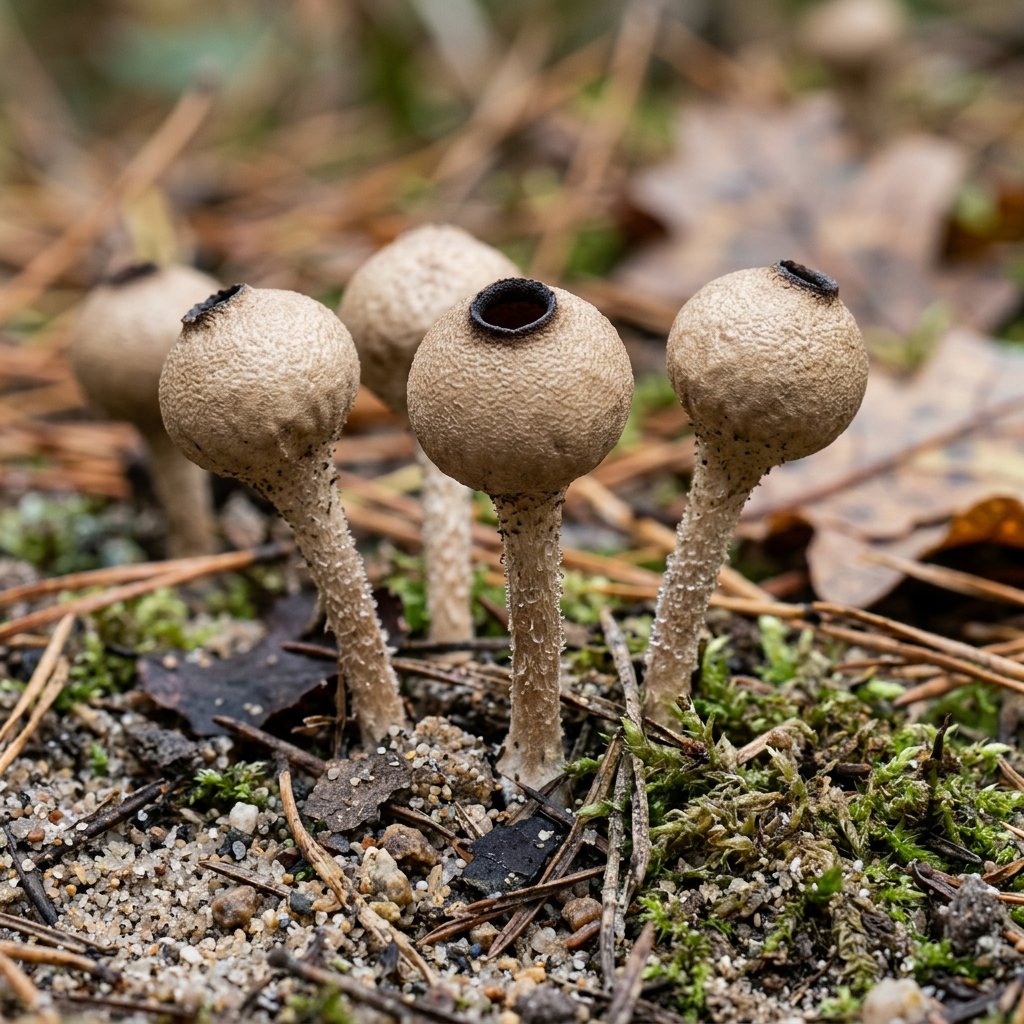
Often called the Scaly-stalked Puffball, this curious fungus looks like a miniature periscope emerging from the sand. Unlike typical puffballs that sit directly on the ground, Tulostoma melanocyclum has evolved a woody "leg" to elevate its spore sac, ensuring its genetic legacy is carried away by even the slightest breeze. It is a specialist of dry, sun-drenched places, often found standing guard in dunes or among sparse mosses.
🔍 How to Identify
- 🍄 The Spore Sac: A small, globe-shaped head (about 1–2 cm) that sits atop the stem. It is usually a pale tan or parchment color, becoming papery as it matures.
- 🕳️ The Mouth (Peristome): This is the most distinct feature; the small hole at the top is surrounded by a dark, almost black, circular "collar" or ring, which gives the species its name.
- 🪵 The Stalk: A slender, tough, and fibrous stem that is noticeably darker than the head. It is covered in tiny, brownish scales or fibrils, making it look slightly shaggy compared to its smoother relatives.
🌲 Habitat & Ecology
- ⏳ Sandy Specialist: You won’t find this in a deep, damp forest. It thrives in well-drained, sandy soils, coastal dunes, and dry, calcareous (lime-rich) grasslands.
- 🌬️ Wind Power: By lifting its spore sac off the ground, the mushroom utilizes "bellows" mechanics. When raindrops hit the papery sac, a puff of spores is ejected through the dark-ringed mouth into the air currents.
- 🌿 Mossy Neighbors: It is frequently found growing among Tortula mosses, which help stabilize the sandy soil just enough for the puffball to take root.
⚠️ Safety & Toxicity
- 🚫 WARNING: Inedible. This mushroom is not considered a food source.
- 🦴 Texture: Due to its woody, fibrous stem and dry, spore-filled interior, it has no culinary value.
- 🐕 General Safety: While not known to be highly toxic to touch, all "little brown mushrooms" (LBMs) should be treated with caution around pets and small children, as many similar-looking species can be dangerous if ingested.
✨ Fun Fact
The genus name Tulostoma comes from the Greek words for "callus" and "mouth," referring to the distinct, often thickened opening at the top of the puffball through which it "breathes" out its spores.
More Details







