Info
Known as the "Bitter Bolete" or the "Gall of the Earth," this mushroom is nature’s ultimate practical joke. It mimics the prized King Bolete (Porcini) so perfectly that even experienced foragers are often fooled until they take their first bite. Its name felleus is derived from the Latin word for "gall" or "bile," a nod to its legendary, mouth-puckering bitterness.
🔍 How to Identify
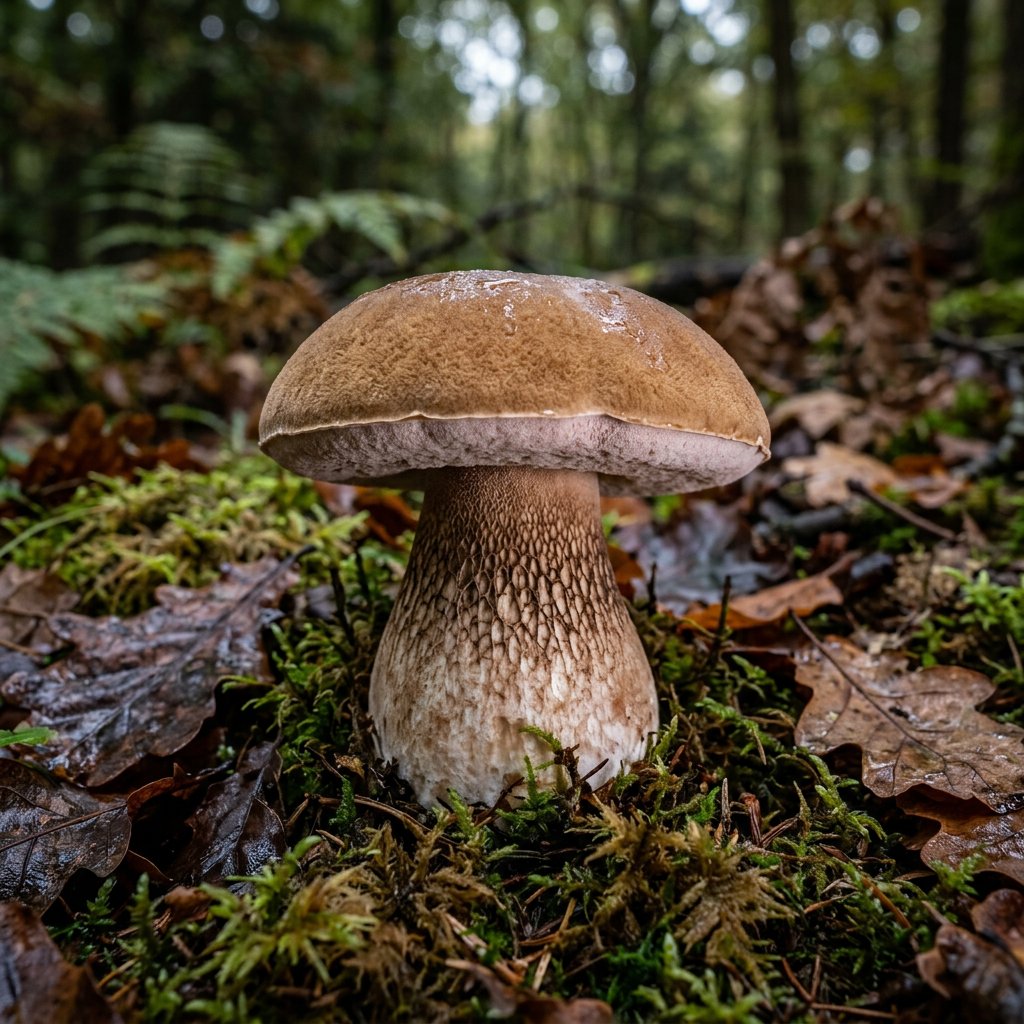
- 🍄 The Cap: Features a smooth, suede-like texture that ranges from light tan to a warm chestnut brown. It starts convex and can grow quite large and heavy.
- 🌸 The Pores: This is the "tell." While most boletes have yellow or olive pores, these start white and turn a distinct dirty pink or rose color as the mushroom matures.
- 🕸️ The Stem: The stalk is thick and bulbous, covered in a very prominent, dark brown raised "netting" (reticulation) that looks like a coarse mesh.
🌲 Habitat & Ecology
- 🤝 Tree Partners: It is a mycorrhizal fungus, meaning it lives in a symbiotic relationship with trees. You’ll most often find it patrolling the roots of oaks, pines, and hemlocks.
- 🍃 Solitary Growth: While it can grow in small groups, it is frequently found standing alone in mossy areas or near well-rotted, buried wood in both coniferous and deciduous forests.
⚠️ Safety & Toxicity
- 🚫 WARNING: Tylopilus felleus is not considered a poisonous mushroom in the sense that it will cause organ failure, but it is strictly inedible due to its flavor.
- 🍳 The Kitchen Spoiler: Even a single small piece of this mushroom added to a pot can ruin an entire meal, turning a delicious stew into something tastes like concentrated aspirin.
- 👅 Field Test: Expert foragers often perform a "nibble and spit" test (never swallowing) to check for bitterness if they are unsure if they’ve found a Porcini or a Bitter Bolete.
✨ Fun Fact
In some European folk traditions, the Bitter Bolete was so notoriously foul-tasting that it was used as a pedagogical tool or a "bitter herb" in various cultural rituals to represent hardship and disappointment!
More Details
| Hymenium Type | Pores |
| Stipe Character | Bare Stipe |
| Spore Print Color | Buff |
| Mushroom Cap Shape | Convex Mushroom Cap Or Semi-Spherical Mushroom Cap |
| Hymenium Attachment | Adnate Hymenium Attachment |
| Mushroom Ecological Type | Mycorrhiza |







