Info
Known as the Stubble Rosegill or the Big Sheath Mushroom, this species is a bold urban pioneer of the fungal world. It is a "heavyweight" mushroom that often surprises gardeners by popping up overnight in compost piles or freshly mulched flower beds. Its scientific name, gloiocephalus, literally translates to "sticky-headed," perfectly describing the glistening, slimy cap that defines its youthful look.
🔍 How to Identify
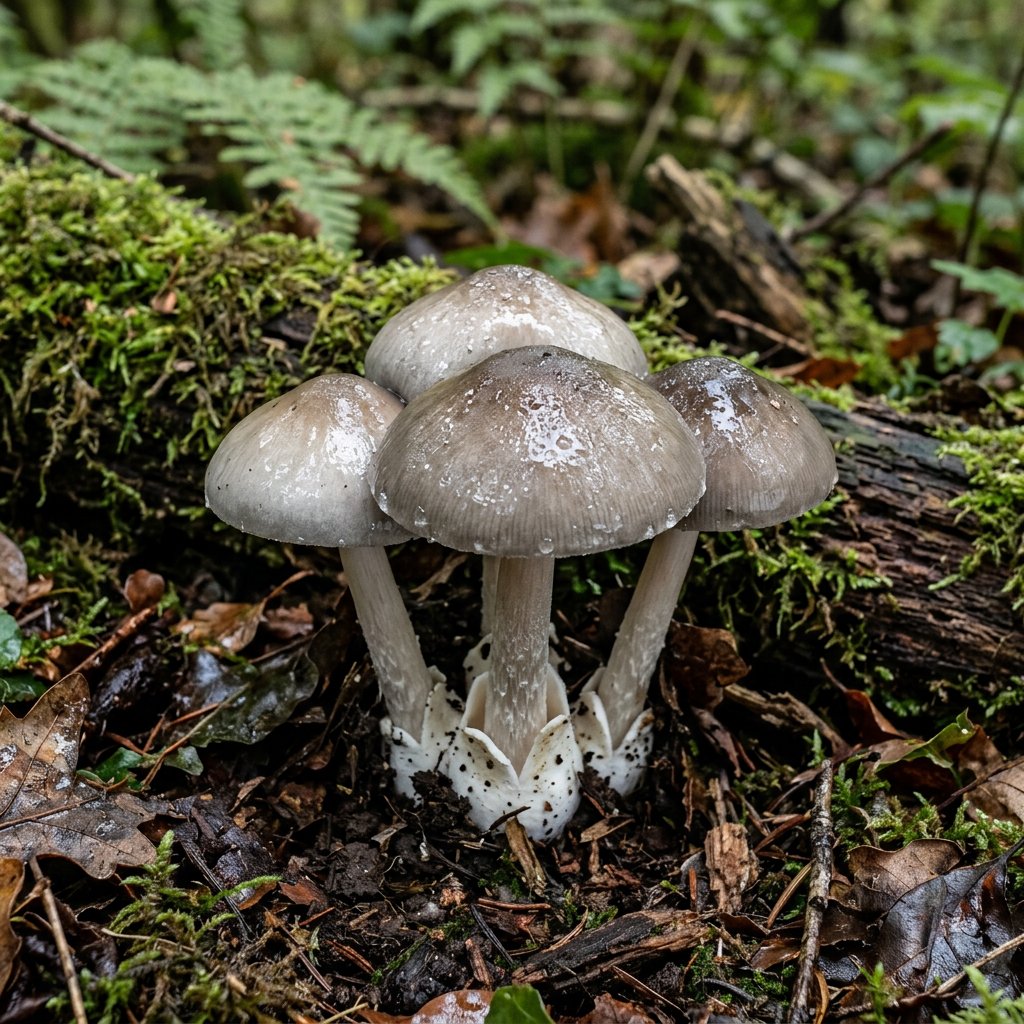
- 🍳 The "Egg" Cap: It begins as a small, white, egg-like nub before expanding into a large, broad umbrella. When wet, the surface is notably slimy or viscid, appearing in shades of silvery-grey, smoky brown, or ivory.
- 🌸 Changing Gills: The gills underneath are "free" (they do not touch the stem). They start out pure white but turn a distinct salmon-pink as the mushroom matures and releases its spores.
- 🎒 The Base Volva: At the very bottom of the stem, the mushroom sits in a prominent, papery, sack-like cup called a volva. Unlike many of its look-alikes, this mushroom never has a ring (annulus) on its stem.
🌲 Habitat & Ecology
- 🚜 Disturbed Ground: This mushroom loves nitrogen-rich environments. You are more likely to find it in a vegetable garden, a heap of rotting straw, or an agricultural field than in a deep, untouched forest.
- 🍂 The Recycler: It is a saprobic species, meaning it survives by breaking down dead organic matter. It plays a vital role in turning your garden mulch or compost back into nutrient-rich soil.
⚠️ Safety & Toxicity
- 🛑 WARNING: While often listed as edible in guidebooks, the Stubble Rosegill is a high-risk species for foragers. It bears a terrifying resemblance to the deadly Amanita family, including the "Death Cap."
- 🧪 The Spore Test: The primary difference is the spore color; Volvopluteus has pink spores, while the deadly Amanita species have white spores. Because a mistake can be fatal, this mushroom should never be consumed unless identified by a professional mycologist.
- 🐾 Pets and Kids: While not considered toxic to touch, keep curious pets and toddlers away, as any mushroom growing in a yard should be treated as "look but don't touch."
✨ Fun Fact
The Stubble Rosegill is a bit of a taxonomic rebel. For over a century, it was classified in a different group, but recent DNA sequencing proved it was unique enough to deserve its own genus, Volvopluteus, which it shares with only a handful of other mushrooms worldwide!
More Details







