Info
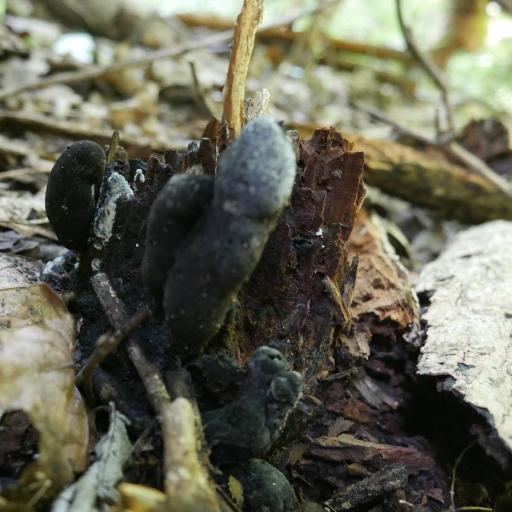
Imagine walking through a misty forest and spotting a cluster of swollen, blackened fingers reaching out from the mossy ground. This is Xylaria polymorpha, better known by its spine-chilling nickname, Dead Man’s Fingers. While it looks like a prop from a horror movie, it is actually a vital decomposer playing a quiet, eerie role in the forest's lifecycle by recycling dead wood back into the earth.
🔍 How to Identify
- 🖐️ Appearance: It grows in upright, club-shaped "fingers," typically 3 to 10 centimeters tall. They often appear in clusters of 3 to 6, mimicking the look of a human hand.
- 🌑 Color: When young, the fungus is covered in a pale, dusty grey coating of asexual spores. As it matures, it turns charcoal black and develops a wrinkled, "mummified" skin.
- 🪵 Texture: Unlike soft, fleshy mushrooms, these are incredibly tough, woody, and cork-like. If you were to snap one open, the interior is stark, solid white.
🌲 Habitat & Ecology
- 🌳 The Clean-Up Crew: This fungus is saprobic, meaning it feeds exclusively on dead organic matter. It is a specialist at breaking down the tough polysaccharides in hardwood trees like Beech, Oak, and Elm.
- 🍄 Substrate: You will almost always find it at the base of rotting stumps or emerging from buried wood. Because the wood is often underground, the fingers appear to be "crawling" directly out of the soil.
- ⏳ Persistence: Unlike many mushrooms that disappear in a few days, Xylaria polymorpha is persistent and can survive for several months in its blackened, woody state.
⚠️ Safety & Toxicity
- 🚫 Status: WARNING: Dead Man’s Fingers are strictly inedible. They are not considered a food source in any culture due to their texture and chemical makeup.
- 🧪 Details: The body of the fungus is as hard as a twig, making it impossible to chew or digest. While not known for high-level "deadly" toxins like some mushrooms, they contain various compounds that can cause severe gastrointestinal distress if ingested.
✨ Fun Fact
- 🎻 Musical Wood: This fungus causes what is known as "soft rot." Some researchers have experimented with using Xylaria to treat wood for violins; by partially decaying the wood cells, it can actually improve the acoustic resonance of the instrument, potentially mimicking the sound of a rare Stradivarius!
More Details