Plant Overview
Known as the "Lovely Fir," the Abies amabilis lives up to its name with its remarkably symmetrical, spire-like form and lush, dark foliage. It is a true child of the misty Pacific Northwest mountains, where it blankets high-elevation slopes in a coat of deep green. While it might look like a classic Christmas tree, its distinctive silvery underside gives it a shimmering, ethereal appearance when caught in a mountain breeze.
🔍 How to Identify
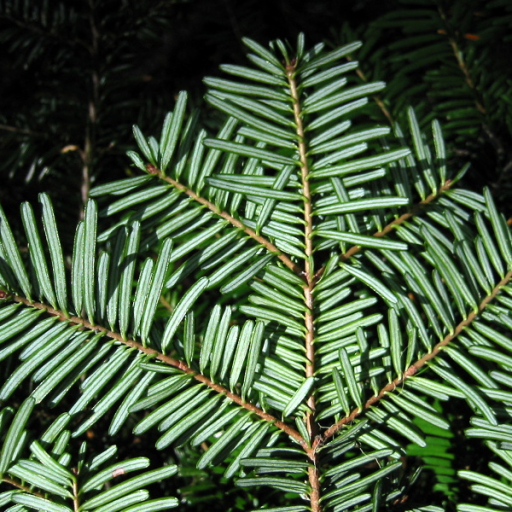
- 🌲 The Foliage: The needles are flat and flexible, uniquely arranged so they appear "brushed forward" along the twig, almost completely hiding the stem from view.
- 🥈 Silvery Flash: While the top of the needle is a rich, glossy green, the underside features two striking white bands (stomata) that create a metallic silver glow when the branches are turned.
- 💜 Upright Cones: Unlike pines or spruces whose cones hang down, these cones stand straight up like candles. They start as a beautiful deep purple or lead-gray before maturing.
🏡 In Your Garden
- ☁️ Climate Lovers: This isn't a tree for the heat; it thrives in cool, humid environments with plenty of moisture. It is particularly fond of areas that experience heavy winter snow, which protects its roots from deep freezes.
- 🧊 Root Sensitivity: It prefers deep, well-drained, and slightly acidic soils. Because it has a relatively shallow root system, it can be sensitive to soil compaction, so avoid planting it near high-traffic walkways or heavy construction.
⚠️ Safety & Toxicity
- 🌿 Safe Status: The Pacific Silver Fir is generally considered non-toxic to humans, cats, and dogs.
- 💧 Resin & Texture: Young trees often have small "blisters" of resin on the bark. While not poisonous, this sap is incredibly sticky and can cause mild skin irritation or an allergic rash in sensitive individuals if handled frequently.
✨ Fun Fact
The Latin name amabilis literally translates to "lovely" or "worthy of love." It was named by the famous botanist David Douglas, who was so struck by the tree's elegant proportions that he felt no other name would suit it.

Detailed Care Instructions
Abies amabilis, commonly known as Pacific silver fir or amabilis fir, is a coniferous tree native to the Pacific Northwest of North America. Growing this tree can be rewarding if you follow the right steps and create the appropriate conditions. Here’s a detailed guide on how to grow Abies amabilis:
1. Site Selection
- Climate: Abies amabilis thrives in cool, moist climates typical of its native range. It prefers areas with high humidity and consistent rainfall.
- Elevation: It commonly grows at elevations ranging from sea level to around 1500 meters (4900 feet).
- Sunlight: This tree prefers partial shade to full sunlight. It can tolerate shaded conditions, particularly when young.
2. Soil Requirements
- Type: Prefers deep, well-drained, acidic soils. Sandy loam or silty loam is ideal.
- pH Level: Soil pH should be slightly acidic to neutral, around 5.0 to 6.5.
- Moisture: Requires consistently moist soil but should not be waterlogged. Ensure good drainage.
3. Planting
- Timing: The best time to plant Abies amabilis is in early spring or late fall when the tree is dormant.
- Seed: If growing from seed, stratify seeds by placing them in a moist, cold environment (4°C/39°F) for about 1-2 months before planting.
- Saplings: Young saplings can also be planted. Make sure to source them from a reputable nursery.
Steps for Planting
- Prepare the Site:
- Clear weeds and grasses.
- Dig a hole twice as wide and slightly deeper than the root ball.
- Clear weeds and grasses.
- Plant the Tree:
- Place the tree in the hole, making sure the root collar (where the roots meet the trunk) is level with or slightly above the ground surface.
- Fill in with the original soil, gently firming it around the base.
- Place the tree in the hole, making sure the root collar (where the roots meet the trunk) is level with or slightly above the ground surface.
- Watering:
- Water thoroughly after planting.
- Keep the soil moist but not waterlogged.
4. Care and Maintenance
- Water thoroughly after planting.
- Watering: Water regularly, especially in the first 2-3 years. Mulch around the base to retain moisture.
- Mulching: Apply a layer of organic mulch (e.g., wood chips, bark) around the tree to conserve moisture and suppress weeds.
- Fertilizing: Generally not necessary if planted in rich, organic soil. If growth is slow, a balanced, slow-release fertilizer can be applied in early spring.
- Pruning: Minimal pruning is needed. Remove any dead, diseased, or damaged branches to maintain tree health.
5. Pest and Disease Management
- Pests: Watch for pests like aphids, adelgids, or fir engraver beetles. Use appropriate insecticidal soaps or chemicals if needed.
- Disease: Common diseases include root rot and needle cast. Ensure good air circulation and avoid excessive moisture around the roots.
6. Protection
- Wildlife: Young trees may need protection from deer or rodents, which can damage the bark and lower branches.
- Weather: In areas with heavy snowfall, protect young trees from damage by supporting them or creating barriers to prevent snow accumulation on branches.
Final Tips
- Patience is Key: Abies amabilis grows slowly, especially in the early years. Be patient and provide consistent care.
- Sustainable Practices: Always follow sustainable and environmentally friendly gardening practices to protect the ecosystem.
By providing the right conditions and careful maintenance, you'll be able to successfully grow a healthy Abies amabilis tree.

Place in a window with dappled sun or a spot in the middle of a room. Or directly in a window facing west or east.

To water this plant, you should first observe the soil around the base of the plant. If the soil is dry to the touch, you should apply water until the soil is moist, but not soaked. Be sure to avoid spraying water directly onto the foliage, as this can increase the risk of disease and damage the needles. Instead, aim to water the area around the base of the plant, using a watering can or a hose with low pressure. During the hot and dry summer months, you may need to water more frequently to ensure that the plant stays healthy and hydrated. Regular watering is especially important during the first few years after planting, as the plant is still establishing its root system. With proper watering and care, this plant can grow to be a beautiful and healthy addition to your garden.
Here are the fertilizing instructions for Abies amabilis:
- Timing: The best time to fertilize Abies amabilis is in early spring, just before the new growth starts. Avoid fertilizing in late summer or fall, as this can stimulate new growth that may not harden off before winter.
- Type of Fertilizer: Use a balanced, slow-release fertilizer with a ratio like 10-10-10 or 14-14-14. Organic options such as composted manure or well-decomposed compost can also be effective.
- Application:
- Granular Fertilizer: Spread the fertilizer evenly under the canopy of the tree, extending a little beyond the drip line (the area directly below the outer circumference of the tree branches). Follow the manufacturer's instructions for the amount to apply, as this can vary depending on the product.
- Liquid Fertilizer: If you use a liquid fertilizer, dilute it according to the product instructions and apply it to the soil around the base of the tree, ensuring even distribution.
- Granular Fertilizer: Spread the fertilizer evenly under the canopy of the tree, extending a little beyond the drip line (the area directly below the outer circumference of the tree branches). Follow the manufacturer's instructions for the amount to apply, as this can vary depending on the product.
- Watering: After applying the fertilizer, water the area thoroughly. This helps to activate the fertilizer and ensures that it reaches the root zone where it can be absorbed.
- Soil Condition: Ensure that the soil has good drainage and is slightly acidic to neutral. Abies amabilis prefers a soil pH between 5.0 and 6.5. Conduct a soil test if you're unsure about the pH and nutrient levels of your soil.
- Mulching: Apply a layer of organic mulch, such as pine needles, bark chips, or compost, around the base of the tree. This helps to conserve moisture, regulate soil temperature, and slowly release nutrients as the mulch decomposes. Keep the mulch a few inches away from the trunk to prevent rot.
- Monitoring: Observe the tree for signs of nutrient deficiencies, such as yellowing needles or poor growth. These signs may indicate the need for additional fertilization or soil amendments.
By following these steps, you can ensure that your Abies amabilis receives the nutrients it needs to thrive.
The Abies Amabilis plant prefers well-drained, acidic soil with a pH range between 5.0 to 6.5. It thrives in soil that is rich in organic matter and has good moisture-retaining capabilities. The texture of the soil should be loamy or sandy loam with good drainage to prevent waterlogging. It is essential to avoid heavy clay soils with poor drainage as they can cause root rot. The plant also benefits from a layer of organic mulch, which helps to conserve moisture and regulate soil temperature. When planting, it is recommended to amend the soil with compost or other organic matter to improve its fertility.
Propagating Abies amabilis, also known as Pacific silver fir, can be a rewarding task. There are mainly two methods to propagate this species: seed propagation and vegetative propagation through cuttings. Below, I provide details about both methods:
Seed Propagation
- Seed Collection:
- Collect seeds from mature cones in the fall, typically in September or October.
- Cones should be picked when they begin to turn brown and are still closed, as they will release seeds when they further dry and open.
- Collect seeds from mature cones in the fall, typically in September or October.
- Seed Cleaning:
- Extract seeds from the cones by placing them in a warm, dry area until they open.
- Remove any debris and wings attached to the seeds by gently rubbing them.
- Extract seeds from the cones by placing them in a warm, dry area until they open.
- Stratification:
- To break dormancy, seeds require cold stratification.
- Place seeds in a moist medium like sand or peat moss, then store them in a refrigerator at about 1 to 3°C (about 34 to 37°F) for 60 to 90 days.
- To break dormancy, seeds require cold stratification.
- Sowing:
- After stratification, sow seeds in a well-draining seed-starting mix.
- Bury seeds to a depth of about 1/4 inch (6 mm) and lightly cover with soil.
- Maintain a temperature of about 18-21°C (64-70°F) and keep the soil consistently moist but not waterlogged.
- After stratification, sow seeds in a well-draining seed-starting mix.
- Germination:
- Germination can take several weeks to a few months. Be patient and keep conditions stable.
- Germination can take several weeks to a few months. Be patient and keep conditions stable.
- Transplanting:
- Once seedlings are large enough to handle, usually when they have developed their second set of true leaves, transplant them into individual pots.
- Gradually acclimate them to outdoor conditions before planting in the ground.
Vegetative Propagation via Cuttings
- Once seedlings are large enough to handle, usually when they have developed their second set of true leaves, transplant them into individual pots.
- Timing:
- The best time to take cuttings is in late summer to early autumn, specifically from new growth that has partially hardened.
- The best time to take cuttings is in late summer to early autumn, specifically from new growth that has partially hardened.
- Selection and Preparation:
- Choose healthy, vigorous stems from the current year’s growth.
- Cut 4-6 inch (10-15 cm) long sections just below a node (the point where a leaf or branch attaches to the stem).
- Choose healthy, vigorous stems from the current year’s growth.
- Hormone Treatment:
- Dip the cut ends into rooting hormone to encourage root development. Using a powder or liquid specifically designed for woody plants is recommended.
- Dip the cut ends into rooting hormone to encourage root development. Using a powder or liquid specifically designed for woody plants is recommended.
- Planting the Cuttings:
- Insert the treated cuttings into a moist rooting medium, such as a mixture of peat and perlite.
- Plant about 1-2 inches deep (2.5-5 cm) ensuring nodes are buried below the surface where roots will form.
- Insert the treated cuttings into a moist rooting medium, such as a mixture of peat and perlite.
- Creating a Humid Environment:
- Cover the cuttings with a plastic dome or a clear plastic bag to maintain high humidity.
- Place the container in bright, indirect light and keep the medium consistently moist.
- Cover the cuttings with a plastic dome or a clear plastic bag to maintain high humidity.
- Rooting and Transplanting:
- Roots typically develop over a few months. Gently check for root formation after about 6-12 weeks.
- Once a strong root system has developed, transplant the new plants into larger pots or directly into the ground.
Remember, both methods of propagation may require patience and care to ensure successful establishment. Good luck with your cultivation!
- Roots typically develop over a few months. Gently check for root formation after about 6-12 weeks.








