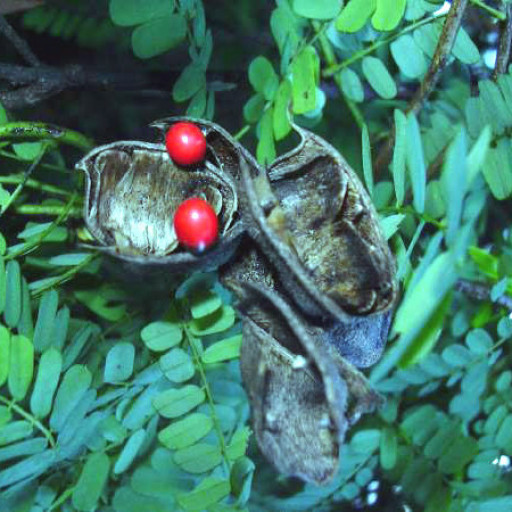
Plant Overview
Known as the Rosary Pea, Crab’s Eye, or Jequirity, this delicate-looking vine is a master of deception. Native to tropical Asia and Africa, it has traveled the globe as an ornamental plant and a source for traditional beadwork. While its vibrant red seeds are undeniably beautiful, they hide a dark secret: they contain one of the most potent toxins found in nature.
🔍 How to Identify
- 🌿 The Foliage: Delicate, feathery green leaves that resemble a fern or a mimosa, consisting of 5 to 15 pairs of small, oblong leaflets.
- 🌸 The Flowers: Clusters of small, pea-like blossoms that range in color from pale violet to pink or white, emerging from the leaf axils.
- 🔴 The Seeds: The most iconic feature—glossy, hard, bright scarlet seeds with a singular, jet-black spot at the base, appearing after the seed pods dry and crack open.
🏡 In Your Garden
- 🪜 Vigorous Climber: This is a high-climbing woody vine that uses its stems to twine around fences, trellises, or other trees. It can quickly reach heights of 10–20 feet if left unchecked.
- 🌱 Invasive Potential: Because it is incredibly hardy and produces seeds that survive for years in the soil, it is considered a Category I invasive species in regions like Florida and Hawaii. If you find it in your garden, it is often best to remove it before the pods can burst.
⚠️ Safety & Toxicity
- 🚫 Lethal Warning: The seeds contain Abrin, an extremely toxic protein. If the seed coat is broken (chewed or crushed), it is one of the most poisonous substances on Earth.
- 🐾 High Risk: The plant is a major hazard for children and pets who might be attracted to the "candy-like" appearance of the seeds. Even handling the seeds for jewelry-making is risky, as the toxin can enter the bloodstream through small cuts on the fingers.
✨ Fun Fact
In ancient times, these seeds were so remarkably uniform in weight that they were used as the standard unit for weighing gold and gemstones in India—a tradition that eventually helped define the "carat" weight system used today!

Detailed Care Instructions
To grow Abrus precatorius, also known as the rosary pea or jequirity bean plant, follow these steps:
- Obtain seeds: Purchase seeds from a reliable source or collect them from mature pods of an existing plant. Note that this plant is toxic, so handle the seeds with care and keep them away from children and pets.
- Prepare soil: Abrus precatorius prefers well-draining soil with a pH level of 6 to 8. Mix organic matter, such as compost, into the soil to improve its fertility. Ensure that the planting location receives partial shade to protect the plant from direct sunlight.
- Soak seeds: Before planting, soak the seeds overnight in water. This process helps soften the seed coat and promotes germination.
- Plant seeds: After soaking, plant the seeds about 1/4 inch deep in the prepared soil. Space the seeds 4 to 6 inches apart if planting multiple seeds. If planting indoors, use pots with good drainage holes.
- Watering: Keep the soil moist but not waterlogged. Water the plants regularly, especially during dry periods. Avoid overwatering as it can cause root rot.
- Provide support: Abrus precatorius is a vine plant that requires support for its growth. Install a trellis or provide a structure for the plant to climb onto.
- Pruning: Regularly prune the plant to control its growth and shape it. Remove any dead or damaged parts to maintain its health.
- Fertilization: Apply an all-purpose, balanced fertilizer according to the manufacturer's instructions. Fertilize the plant once every 2-3 months during the growing season.
- Pest and disease control: Monitor the plant for any signs of pests or diseases, such as aphids or fungal infections. Treat the plant promptly using organic pest control methods or consult a professional if necessary.
- Harvesting: The seeds of Abrus precatorius are ready for harvesting when the pods turn brown and start to dry. Open the pods carefully to collect the seeds. Remember to handle them with caution due to their toxicity.
Note: Abrus precatorius contains a toxic compound called abrin. It can be dangerous if ingested or if its seeds or parts enter the bloodstream through cuts or abrasions. Exercise caution when handling the plant and keep it away from children and pets.

Place in a bright room that is sun drenched almost all day. Or directly in a south-facing window.

To properly water the Abrus Precatorius plant, it is important to ensure that the soil is evenly moist but not waterlogged. This can be achieved by watering the plant thoroughly once or twice a week, depending on the humidity and temperature in the growing environment. The soil should be allowed to slightly dry out between watering to ensure proper drainage and prevent root rot. When watering, it is important to avoid getting water on the foliage or flowers, as this can lead to fungal diseases. Additionally, it is important to use room temperature water and to avoid watering during the hottest part of the day. This will help prevent shock to the plant and reduce the risk of water stress.
To fertilize the Abrus Precatorius plant, it is recommended to use a balanced fertilizer with equal parts of nitrogen, phosphorus, and potassium. Fertilize the plant once per month during the growing season, which is typically from spring to fall. Avoid over-fertilizing, as this can cause the plant to become spindly and weak. Water the plant thoroughly after fertilizing to prevent fertilizer burn.
The ideal soil for Abrus Precatorius plant is a well-draining and fertile soil that is well-aerated. The pH of the soil should range between slightly acidic to neutral (between 6.0 to 7.5). The soil should be rich in organic matter and should have good water-holding capacity. It is recommended to add compost or organic fertilizers to the soil before planting, as this will improve the soil's nutrient content and structure. The plant can tolerate both full sun and partial shade, hence the soil must be able to support both conditions adequately. Additionally, the soil should not be waterlogged as the plant is susceptible to root rot.
To propagate this plant, obtain seeds from a mature plant and prepare a suitable planting site. The site should consist of well-draining soil with access to partial sunlight. Once the site is prepared, scarify the seed coat to increase germination rates. This can be done by gently scraping the seed coat with sandpaper or a scalpel. After scarification, soak the seeds in water overnight to imitate the plant's natural conditions.
Next, plant the seeds about 1-2 inches deep in the soil and water the site regularly to keep the soil moist until germination occurs. Once the seedlings have sprouted, gradually reduce watering to allow the plant to acclimate to normal watering conditions. The Abrus Precatorius plant is also propagated through stem cuttings in some areas. Cut a stem from a mature plant and remove the leaves from the lower half. Dip the cut end in rooting hormone and plant the stem in well-draining soil. Water regularly and in a few weeks, the stem should begin to grow roots and leaves.








