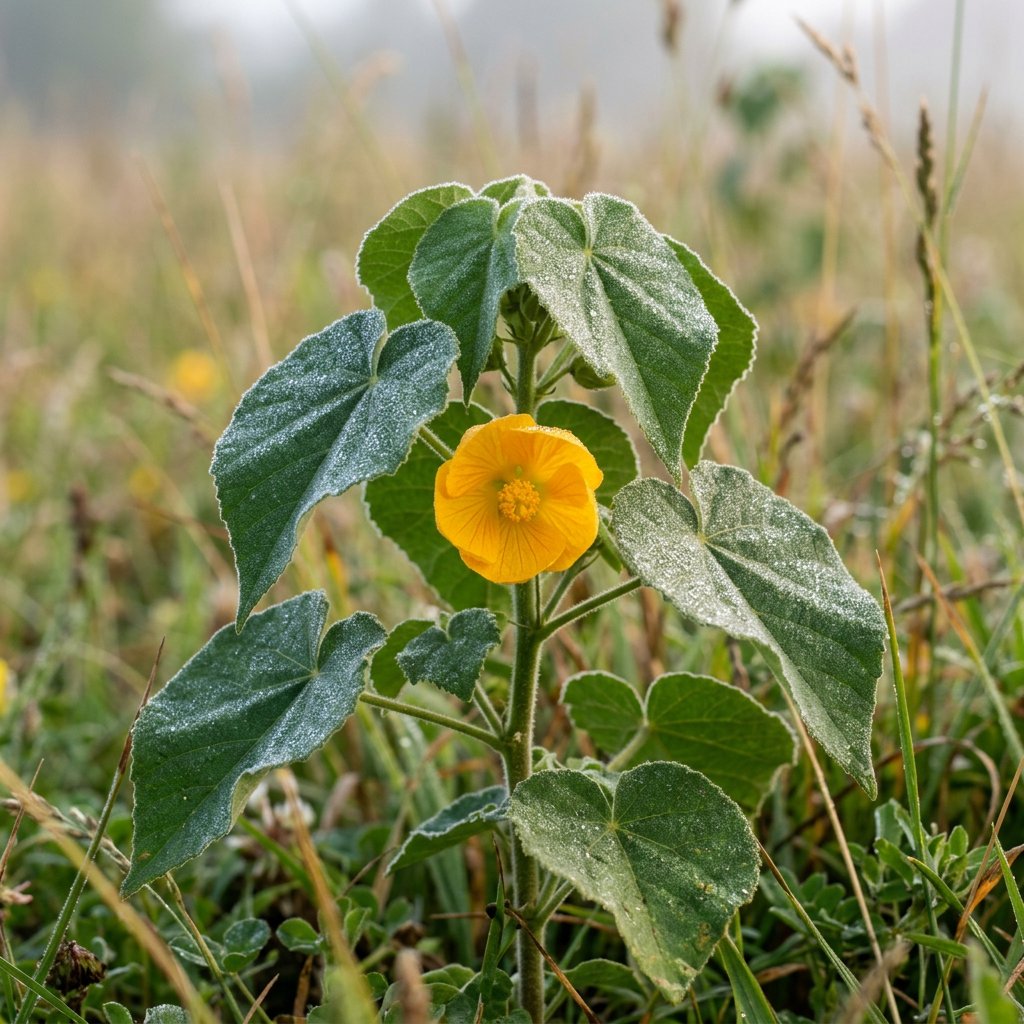
Plant Overview
Known affectionately as Velvetleaf or the "Pie-marker," this plant is famous for its incredibly soft, suede-like foliage and its distinctive seed pods. Originally native to Southern Asia, it was historically prized as a fiber crop for making rope and paper (often called "China Jute"). Today, it is more commonly recognized as a persistent and hardy traveler that can be found popping up in gardens and fields across the globe.
🔍 How to Identify
- 🍃 The Foliage: The leaves are large, heart-shaped, and covered in a dense layer of soft, fine hairs. Touching them feels exactly like stroking a piece of high-quality green velvet.
- 🌼 The Flowers: It produces modest, five-petaled yellow to orange-yellow flowers that bloom in the late summer, tucked away where the leaf meets the stem.
- 🥧 The Seed Pod: The most iconic feature is the woody, circular seed head. It consists of a ring of "flutes" that resemble a miniature scalloped pie crust or an old-fashioned button.
🏡 In Your Garden
- 🌱 Growth & Competition: Velvetleaf is a "heavy feeder," meaning it aggressively sucks up nutrients and water from the soil. In a garden setting, it can quickly tower over smaller flowers, potentially stealing the resources they need to thrive.
- ☀️ Sun-Seeker: This plant is an opportunist that loves disturbed soil and full sunlight. It will often appear suddenly in areas where the ground has been recently dug up or moved.
- 🚜 Management: If you aren't growing it for its unique look, it’s best to remove it before the "pie" pods turn brown. Once those pods open, they drop hundreds of seeds that are notoriously difficult to manage.
⚠️ Safety & Toxicity
- ✅ Status: Generally non-toxic to humans, cats, and dogs.
- 🖐️ Skin Sensitivity: While not poisonous, the dense hairs on the leaves and stems can trap dust or pollen, which might cause very mild skin irritation or "itchiness" for sensitive gardeners.
- 🌾 Invasive Potential: In many regions, it is considered a noxious weed because it can significantly reduce crop yields in agricultural settings.
✨ Fun Fact
Velvetleaf seeds are the ultimate "time travelers" of the plant world. They have a hard, protective coat that allows them to remain dormant in the soil for over 50 to 60 years, waiting patiently for the perfect conditions to finally sprout!

Detailed Care Instructions
To grow Abutilon Theophrasti, also known as velvetleaf or butterprint, follow these steps:
- Choose the right location: Abutilon Theophrasti prefers full sun but can tolerate some shade. Select a location with well-draining soil. The pH of the soil should be slightly acidic to neutral (pH 6.0-7.0).
- Prepare the soil: Loosen the soil to a depth of about 8-10 inches and remove any weeds or rocks. Add organic matter like compost or well-rotted manure to improve the soil's fertility and moisture retention.
- Sow the seeds: Either sow the seeds directly outdoors or start them indoors 4-6 weeks before the last frost date in your area. If starting indoors, use individual pots or seed trays filled with seed starting mix. Sow the seeds at a depth of about 1/4 inch, and then lightly cover them with soil.
- Watering and care: Keep the soil consistently moist but avoid overwatering, as overly wet conditions can lead to root rot. Once established, Abutilon Theophrasti can tolerate some drought. Watering should be done at the base of the plant to avoid wetting the leaves, as this can encourage diseases.
- Fertilization: Use a balanced, slow-release fertilizer or apply a general-purpose organic fertilizer according to the package instructions. Fertilize at the beginning of the growing season and occasionally during the season to promote healthy growth.
- Mulching: Apply a layer of organic mulch around the plant to help conserve moisture, prevent weed growth, and maintain a more stable soil temperature.
- Pruning: Abutilon Theophrasti doesn't require much pruning unless you want to shape the plant or remove any dead or diseased branches. Prune in early spring or late winter before new growth begins.
- Pest and disease control: Monitor the plant for any signs of pest or disease infestations. Common pests include aphids, whiteflies, and spider mites. If needed, use appropriate insecticides or organic pest control methods to manage infestations.
- Harvesting: Velvetleaf produces small yellow flowers and seed pods. If you want to harvest the seeds for future planting, allow the seed pods to fully mature and dry on the plant. Then, collect the pods, and remove the seeds by hand.
By following these guidelines, you can successfully grow Abutilon Theophrasti. Remember to check your local regulations, as velvetleaf is considered an invasive weed in some areas.

Place in a window with dappled sun or a spot in the middle of a room. Or directly in a window facing west or east.

Abutilon Theophrasti plant can be watered by gently pouring water around the base of the plant, taking care not to wet the leaves or flowers. It is important to check the soil moisture level before watering. One can do this by sticking their finger about an inch deep into the soil. If it feels dry, it's time to water. The plant needs watering regularly, but one should avoid over-watering as this can lead to root rot. Typically, the plant should be watered two to three times a week during the growing season, and less frequently during the dormant period. One should also make sure that the plant pot has adequate drainage to prevent water from accumulating in the soil.
- Choose a balanced, slow-release fertilizer with equal parts of nitrogen, phosphorus, and potassium.
- Apply the fertilizer in early spring when the plant starts to emerge from dormancy.
- Use 1/4 to 1/2 cup of fertilizer per plant depending on its size.
- Apply the fertilizer evenly around the base of the plant, taking care not to get it on the leaves or flowers.
- Water the plant well after fertilizing to help the nutrients seep into the soil.
- Repeat the application of fertilizer every four to six weeks during the growing season or as recommended by the fertilizer manufacturer.
- Stop fertilizing in early fall to allow the plant to go dormant for winter.
The ideal soil for Abutilon Theophrasti plant should be well-draining and rich in organic matter. It should have a pH level between 5.5 and 7.5. The soil should be loose and loamy, with good drainage and aeration. Clay soils should be avoided, as they retain too much moisture and can lead to root rot. A soil mix containing a combination of sand, peat moss, and perlite is recommended for optimal growth. When planting, it is important to ensure that the soil is moist but not waterlogged to prevent waterlogging or suffocation of the roots. The soil should also be kept consistently moist throughout the growing season but not over-watered. Proper soil preparation is crucial for the health and growth of the plant.
Abutilon Theophrasti plant can be propagated through seed or stem cuttings. To propagate through seed, collect seeds from mature, dry seed pods. Sow the seeds in a well-draining soil mixture and maintain a constant moisture level. Germination can take up to two weeks.
To propagate through stem cuttings, select a healthy stem and take a cutting that is approximately 4-6 inches long. Remove the lower leaves from the stem and dip the cut end in rooting hormone. Plant the cutting in a well-draining soil mixture and keep the soil moist. Place the cutting in a warm, bright area but avoid direct sunlight. The cutting should root in approximately 4-6 weeks.
Both methods of propagation require regular maintenance and attention to ensure the success of the plant.
Common pests of the velvetleaf include Spider mites, aphids, thrips. Make a habit of checking your velvetleaf frequently for pests so that any infestations can be caught and managed early.








