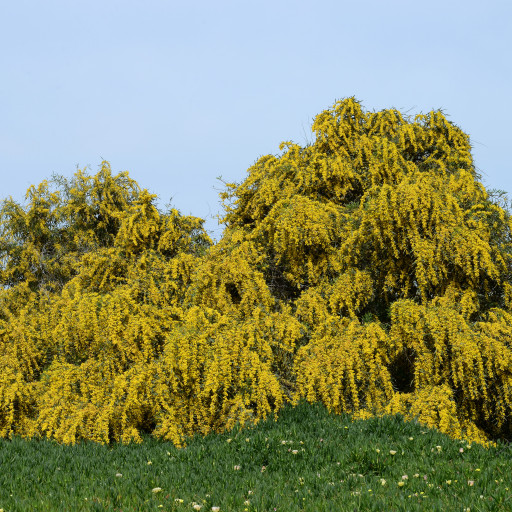
Plant Overview
Often called the Golden Wreath Wattle, Acacia saligna is a burst of Australian sunshine that has traveled the globe. While it is celebrated for its weeping branches and honey-scented blossoms, it is a botanical powerhouse known for its rapid growth and ability to thrive in the toughest coastal sands. It acts as a "pioneer species," often being the first to reclaim land after a disturbance.
🔍 How to Identify
- 🍃 The "False" Leaves: Interestingly, this tree doesn't have true leaves. Instead, it features "phyllodes"—flattened, leaf-like stems that are long, narrow, and often a beautiful blue-green or silvery hue.
- 🟡 Golden Orbs: In late winter and spring, the tree is draped in dense, globular clusters of bright yellow to deep orange flowers that look like miniature fluffy pom-poms.
- 🌳 The Silhouette: It typically grows as a small, multi-stemmed tree or large shrub with a distinct weeping habit, where the heavy flowering branches arch gracefully toward the ground.
🏡 In Your Garden
- 💪 A Tough Pioneer: This plant is a "nitrogen-fixer," meaning it works with specialized soil bacteria to pull nitrogen from the air and enrich the earth around it. This makes it an excellent choice for rehabilitating nutrient-poor soil.
- 🏃♂️ Fast and Furious: It grows incredibly quickly, making it a popular choice for a fast privacy screen or windbreak. However, growers should be mindful: its speed and heavy seed production mean it can become invasive in Mediterranean climates if not carefully managed.
⚠️ Safety & Toxicity
- 🐾 Pet & Livestock Safety: While generally considered non-toxic and even used as emergency fodder for sheep and goats, the seed pods are high in tannins and should not be consumed by humans or pets.
- 🤧 Allergy Alert: Like many Acacia species, its heavy pollen production during the peak of spring can be a trigger for gardeners who suffer from seasonal allergies or hay fever.
✨ Fun Fact
In various parts of the world, Acacia saligna is nicknamed the "Famine Tree." Because it stays vibrant and green even during extreme droughts when all other vegetation has withered, it has historically been used as a vital food source for livestock during environmental crises.

Detailed Care Instructions
| Humidity | Dry |
| Lighting | Shade |
| Difficulty | Easy |
| Hibernation | Cold Period |
| Hardiness Zones | Max 11 |
To grow Acacia saligna plants, also known as blue leaf wattle or orange wattle, you can follow these steps:
- Select a suitable location: Acacia saligna prefers a sunny spot with well-draining soil.
- Prepare the soil: Ensure the soil is loose, fertile, and has good drainage. If necessary, amend the soil with organic matter like compost.
- Sow the seeds: Acacia saligna can be grown from seeds. Scarify the seeds by rubbing them with sandpaper or soak them in hot water overnight to improve germination. Sow the seeds in the prepared soil, just below the surface, and lightly cover them with soil.
- Watering: Keep the soil consistently moist but not waterlogged. Water the plants regularly, especially during the growing season. Acacia saligna is drought-tolerant but will benefit from regular watering.
- Fertilization: Apply a balanced fertilizer once or twice during the growing season to provide essential nutrients for healthy growth.
- Pruning: Acacia saligna may require occasional pruning to maintain its shape and promote bushier growth. Prune dead or damaged branches and thin out crowded areas if necessary.
- Protection from frost: If you live in an area with cold winters, consider providing protection from frost, especially when the plant is young and vulnerable.
- Mulching: Apply a layer of organic mulch around the base of the plant to retain moisture, suppress weeds, and regulate soil temperature.
- Pest and disease control: Acacia saligna is generally resistant to pests and diseases. However, monitor the plants for any signs of damage or infestation and use appropriate control methods, such as organic insecticidal soap or neem oil, if necessary.
- Propagation: Acacia saligna can also be propagated through cuttings or layering. Follow the appropriate techniques for each method if you want to propagate the plant.
Remember to check local regulations and invasive species lists, as Acacia saligna can be considered an invasive species in some regions.

Place in a bright room that is sun drenched almost all day. Or directly in a south-facing window.

To water this plant, you will need to provide it with a sufficient amount of water, but be careful not to overwater it. Check the soil regularly to ensure it is not too dry or too wet, as too much or too little water can harm the plant. When watering, aim for the soil around the base of the plant rather than getting the leaves wet. Use a watering can or hose and allow the water to soak in slowly rather than pouring it on quickly. Water when the top inch of soil feels dry to the touch. In addition, be sure to adjust your watering schedule based on the weather conditions and season.
To fertilize this plant, apply a balanced fertilizer with equal amounts of nitrogen, phosphorus, and potassium. Apply the fertilizer around the base of the plant, avoiding getting it on the foliage. Water the plant after fertilizing to help the nutrients soak into the soil. Fertilize once a month during the growing season, which is typically spring and summer. Avoid fertilizing in the fall and winter when the plant is dormant.
The soil that should be used with this plant should be well-draining and slightly acidic. It should contain a mixture of sand, clay, and organic matter to provide a balanced growing medium for the plant. The soil should also be able to retain moisture but not become too waterlogged, as this can lead to root rot. It is recommended to use a soil that is specifically formulated for woody plants or one that is designed for Australian native plants. It is important to avoid using soil that is too high in nutrients, as this can cause excessive growth, which could lead to the plant becoming weak and susceptible to disease or pests.
Acacia Saligna plant can be propagated through various methods such as seed propagation, cutting propagation, and layering propagation.
Seed propagation involves harvesting the seeds from the plant during the fall season. The seeds need to be dried and stored in a cool place until the spring season. Before planting the seeds, the outer seed coat should be nicked or filed slightly to make it easier for the seeds to germinate. The best time to plant the seeds is during early spring in a well-draining soil mix. The seeds need to be watered frequently until they germinate. Once they start growing, they need to be transplanted into pots or containers.
Cutting propagation is another method where cuttings are taken from the plant during the spring season. The cuttings should be about 4-6 inches long and should have a few leaves attached to them. The bottom of the cuttings should be dipped in a hormone rooting powder and planted in a potting mix. The cuttings should be watered regularly until they start rooting and new growth appears.
Layering propagation involves bending a stem of the plant and burying it in the soil. The branch should be bent and pinned to the soil with a wire. Once the stem has developed roots, it can be removed from the parent plant and planted in a potting mix.
Regardless of the method used, the plants need to be kept in a warm, humid, and partially shaded environment until they are well established. Once the plants are established, they can be transferred to their permanent location.








