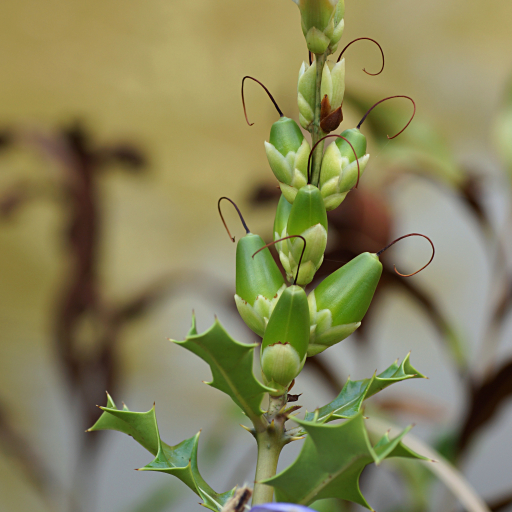
Plant Overview
Known as the "Sea Holly" or "Holly Mangrove," this resilient shrub is a master of the shoreline. Despite its name, it isn't a true holly, but it shares the same sharp, defensive foliage that makes it look like a holiday decoration lost at sea. It thrives where most plants perish—in the salty, muddy brinks of mangrove forests and tidal marshes across Southeast Asia and Northern Australia.
🔍 How to Identify
- 🍃 Serrated Foliage: The leaves are glossy, dark green, and famously edged with sharp, spine-tipped lobes. Younger plants tend to be spikier than older ones to deter herbivores.
- 🪻 Hooded Blossoms: It produces striking upright flower spikes. The blossoms are usually a beautiful pale lilac or sky blue, featuring a single large lip that invites pollinators like carpenter bees.
- 🪵 Aerial Roots: Look for small "stilt roots" emerging from the lower stem. These help the plant stay anchored in shifting mud and breathe when the tide comes in.
🏡 In Your Garden
- 🌊 Salt Specialist: This plant is a "halophyte," meaning it can handle high salt levels. It actually "sweats" salt out through its leaves; if you look closely, you may see tiny white crystals on the leaf surface.
- 💧 Bog Lover: Because it naturally grows in mangroves, it hates drying out. If kept as an ornamental, it requires heavy, wet soil and high humidity. It is an excellent choice for stabilizing pond edges in tropical climates where other plants might rot.
⚠️ Safety & Toxicity
- ⚔️ Physical Hazard: The primary danger of the Sea Holly is its mechanical defense. The leaf spines are incredibly sharp and can easily puncture skin or paws.
- 🐾 Mild Toxicity: While not considered deadly, the plant contains various alkaloids. It is generally best to keep it away from curious pets and children, as ingestion may cause stomach upset, and the spines can cause localized skin irritation.
✨ Fun Fact
In parts of Southeast Asia, Acanthus ilicifolius is known as a "bio-indicator." Its presence often signals a healthy mangrove ecosystem. Interestingly, it has been used in traditional medicine for centuries as a treatment for snake bites and skin allergies, earning it a reputation as a coastal healer.

Detailed Care Instructions
Here are some tips for growing Acanthus ilicifolius plants:
- Climate: Acanthus ilicifolius plants are native to coastal areas and prefer tropical or subtropical climates. They require high humidity, temperatures between 20-30°C (68-86°F), and protection from frost.
- Light: Place the plant in an area that receives partial shade to full sun. It should get at least 4-6 hours of direct sunlight per day.
- Soil: Acanthus ilicifolius plants prefer well-draining soil that is rich in organic matter. They grow well in slightly acidic to neutral soil with a pH range of 6-7.
- Watering: Keep the soil consistently moist but not waterlogged. Water the plant regularly, especially during the growing season. Avoid overwatering, as it can lead to root rot.
- Fertilization: Apply a balanced slow-release fertilizer during the growing season, following the instructions on the package. This will provide the necessary nutrients for healthy growth.
- Pruning: Acanthus ilicifolius plants benefit from regular pruning to promote bushy growth and remove damaged or weak stems. Prune in late winter or early spring before new growth begins.
- Propagation: Acanthus ilicifolius plants can be propagated through seeds or stem cuttings. If using seeds, sow them in a seed tray filled with well-draining soil and moisten the soil. Keep the tray in a warm and humid environment until germination occurs. For stem cuttings, take a 4-6 inch cutting from a healthy plant and remove the lower leaves. Place the cutting in a pot filled with moist potting mix and keep it in a warm and humid location until new roots form.
- Pests and diseases: Monitor the plant regularly for pests, such as aphids, mealybugs, or scale insects. If necessary, use organic insecticides or neem oil to control them. Acanthus ilicifolius plants are generally disease-resistant but can be susceptible to root rot if overwatered.
Remember to research and follow any specific care instructions for the variety of Acanthus ilicifolius plant you have, as some varieties may have specific requirements.

Place in a bright room that is sun drenched almost all day. Or directly in a south-facing window.

To properly water this plant, you should begin by ensuring that the soil is not too dry. Use a finger to poke into the soil around the plant and check for moisture content. If the soil is dry to the touch, it is time to water. When watering, it is essential to apply water to the soil directly, not to the plant's foliage. Pour water slowly and evenly over the soil until it is saturated. Stop pouring once a bit of excess water begins to drain from the bottom of the pot. Be sure not to overwater the plant, as this can lead to root rot. This plant prefers moist soil, so you may need to water it more frequently in dry or hot weather.
To fertilize this plant, use a slow-release organic fertilizer in the spring before new growth appears. Apply according to package instructions, taking care not to over-fertilize. Water the plant thoroughly after fertilizing to help distribute the nutrients throughout the soil. Repeat fertilization once or twice during the growing season.
Acanthus Ilicifolius plant prefers well-drained soil that is rich in nutrients. The soil should have a pH level between 6.5 and 7.5. It is best to use a soil that is slightly acidic to neutral. The plant prefers a loamy soil that is moist but not waterlogged. A sandy loam with good drainage can also be used. It is important to ensure that the soil is not too compact, as this can prevent the plant from taking root properly. The soil should be prepared by adding organic matter, such as well-rotted compost and leaf mould. This will help to improve the structure of the soil and increase its water-holding capacity. Additionally, the soil should be free of weeds, so that there is no competition for nutrients and water.
To propagate this plant, the first step is to choose a healthy parent plant with well-established roots. Carefully remove a stem cutting with a sharp, clean blade, making sure it is at least 6 inches long and has several leaf nodes.
Remove the lower leaves from the stem cutting, leaving only the top few leaves intact. Dip the bottom of the stem in rooting hormone powder to encourage root growth, then plant it in a well-draining potting mix.
Water the cutting thoroughly and place it in a warm, humid location with partial shade. Keep the soil consistently moist but not waterlogged.
Within a few weeks, the cutting should begin to develop roots and new growth. Once it has established a sturdy root system and several new leaves, it can be transplanted into a larger container or outdoors in a suitable location.








