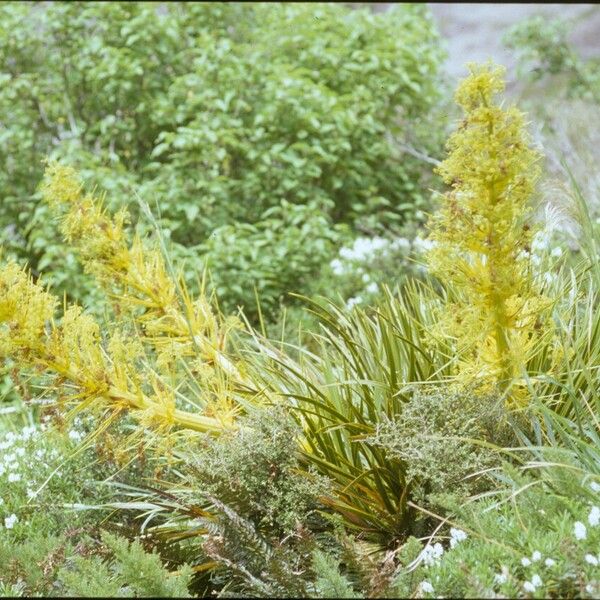
Plant Overview
Known as the Horrid Speargrass or the Giant Spaniard, this New Zealand native is the ultimate "look but don't touch" plant of the subalpine world. It forms massive, architectural rosettes of golden-green foliage that look like a burst of frozen fireworks. While it possesses a rugged, sculptural beauty, its name "horrida" isn’t an exaggeration—it was evolutionarily designed to keep even the hungriest giants at bay.
🔍 How to Identify
- ⚔️ The Foliage: Large, circular rosettes made of incredibly stiff, leathery leaves that are divided into long, narrow segments.
- 📍 The Spines: Every leaf segment ends in a needle-sharp, rigid tip capable of piercing through thick clothing or hiking boots.
- 🌻 The Flower Spike: During blooming years, it sends up a colossal, woody stalk (up to 5 feet tall) covered in dense, golden-yellow bracts and tiny flowers.
- 🎨 The Color: Primarily a deep, olive green, often blushing with striking orange or golden hues along the leaf margins and central ribs.
🏡 In Your Garden
- 🏔️ The Alpine Vibe: This plant thrives in "high-octane" drainage. If its roots sit in soggy soil, it will decline quickly; it prefers rocky, gritty, or scree-like environments that mimic the Southern Alps.
- ⚓ The Deep Anchor: Like many members of the carrot family (Apiaceae), it develops a long, thick taproot. This makes it incredibly drought-tolerant once established, but it also means it absolutely hates being moved. Pick its "forever home" carefully!
- 🌬️ Climate Needs: It loves cool summers and cold winters. It struggles in humid, tropical heat, preferring the crisp air of higher elevations or temperate coastal zones.
⚠️ Safety & Toxicity
- 🚫 Physical Danger: While not chemically toxic like a Nightshade, this plant is "mechanically dangerous." The spines are exceptionally sharp and rigid.
- 🧤 Handling: Never handle without thick, leather gardening gloves. It should be planted far away from garden paths, play areas, or spots where pets might accidentally run into it.
- 🩹 Puncture Risk: The tips can cause deep puncture wounds that may lead to secondary irritation or infection if the leaf tip breaks off under the skin.
✨ Fun Fact
Evolutionary biologists believe the Aciphylla horrida developed its fierce, dagger-like leaves as a defense mechanism against the Moa—New Zealand’s extinct, giant flightless birds. Though the Moa is long gone, the plant remains "armed and dangerous," waiting for a predator that no longer exists!

Detailed Care Instructions

Place in a bright room that is sun drenched almost all day. Or directly in a south-facing window.

Some plants require more regular watering than others, which should be done every few days. It's critical to maintain the soil moist all of the time. The water requirements of the same plant placed in pots with varying sizes will differ. Because the water in the smaller pot evaporates faster than the water in the larger pot, it will require more watering. Regardless of pot size, the surface should constantly be maintained moist.








