Plant Overview
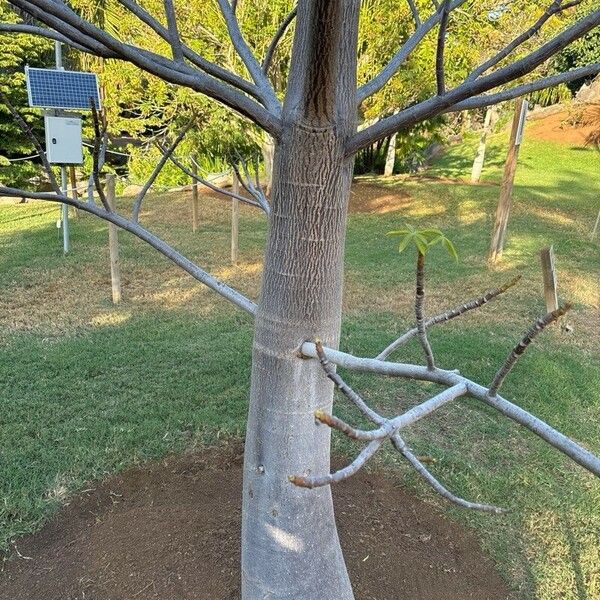
Often called the rarest of all baobabs, Adansonia perrieri is a majestic giant native only to a small region in northern Madagascar. Known as Perrier’s Baobab, this "Upside-Down Tree" is a living monument that can survive for centuries by storing massive amounts of water in its swollen trunk. In local folklore, these trees are often seen as sacred sentinels, standing as a bridge between the earth and the heavens.
🔍 How to Identify
- 🌳 The Trunk: Unlike the squat, bottle-shaped baobabs, Perrier's version features a more upright, massive, and cylindrical trunk covered in smooth, pale grey bark.
- 🌼 The Bloom: It produces stunning, large, pale yellow to creamy white flowers with long petals that stand upright rather than hanging down.
- 🍃 The Foliage: Its leaves are "palmate" (hand-shaped) with five to seven leaflets, which the tree sheds entirely during the dry season to conserve internal moisture.
🏡 In Your Garden
- ☀️ Sun Worshiper: This species requires intense, direct sunlight and a distinct dry period; it is highly susceptible to root rot if kept in soggy soil during its dormant winter phase.
- ⏳ Patience Required: Because it is a slow-growing species with a sensitive taproot, it is rarely moved once planted. Collectors often grow them as "caudiciform" bonsai specimens, though they only reach their legendary scale in frost-free, tropical landscapes.
⚠️ Safety & Toxicity
- ✅ Safe Status: Adansonia perrieri is generally considered non-toxic to humans, dogs, and cats.
- 🐘 Wild Diet: In its native habitat, many parts of the baobab—including the fruit pulp and leaves—are utilized for food and traditional medicine, though home growers should treat it strictly as an ornamental.
✨ Fun Fact
Perrier’s Baobab has a very specific "nightlife." Its giant flowers open at dusk and emit a strong scent to attract fruit bats and lemurs, who act as the tree’s primary pollinators under the cover of darkness!

Detailed Care Instructions
Adansonia Perrieri, also known as Perrier's Baobab, is a rare and endangered species of baobab tree found only in Madagascar. Growing Adansonia Perrieri can be a challenging task due to its specific habitat requirements and slow growth rate. However, here are some tips on how to grow and care for this plant:
- Climate: Adansonia Perrieri thrives in hot and dry climates with plenty of sunlight. It cannot tolerate frost or cold temperatures, so make sure to provide it with a warm and protected location.
- Soil: The baobab tree prefers well-draining, sandy soil with a pH of 6 to 7.5. Make sure the soil is not waterlogged as this can cause root rot.
- Watering: Adansonia Perrieri is drought-tolerant and does not require frequent watering. Water the plant sparingly, allowing the soil to dry out between waterings.
- Fertilization: Baobabs are not heavy feeders and do not require frequent fertilization. You can fertilize the plant with a balanced fertilizer once a year in the spring.
- Propagation: Adansonia Perrieri can be propagated from seeds, which should be soaked in water for 24 hours before planting. Plant the seeds in well-draining soil and keep them in a warm, sunny location.
- Pruning: Baobab trees do not require extensive pruning, but you can trim any dead or damaged branches as needed to maintain the plant's shape.
- Protection: Protect the young baobab tree from strong winds and sunburn by providing some shade during the hottest part of the day.
- Patience: Growing Adansonia Perrieri requires patience as the tree is slow-growing and may take several years to reach maturity. Be patient and provide the plant with the care it needs to thrive.
Overall, growing Adansonia Perrieri requires specific care and attention to ensure the plant's long-term health and success. By following these tips and providing the plant with the right conditions, you can successfully grow this unique and beautiful baobab tree.
Adansonia Perrieri plants should be watered deeply but infrequently. Allow the soil to dry out slightly between waterings to prevent root rot. When watering, thoroughly saturate the soil until water runs out of the drainage holes at the bottom of the pot. It is important to ensure that the soil has good drainage to prevent water from pooling around the roots. Watering should be reduced during the plant's dormant period to mimic its natural growing conditions. You can also mist the leaves occasionally to increase humidity levels around the plant.
To fertilize the Adansonia Perrieri plant, you can use a balanced liquid fertilizer diluted to half strength. Apply the fertilizer once a month during the growing season, which is typically in the spring and summer months. Be sure to water the plant thoroughly before and after applying the fertilizer to help distribute the nutrients evenly. Avoid over-fertilizing as this can lead to nutrient burn and damage the plant.
Adansonia Perrieri plants thrive best in well-draining soil that is rich in organic matter. A sandy loam or sandy clay soil mixture with a pH level between 6.0 and 7.0 is ideal for these plants. It is important to avoid soil that retains too much water, as this can lead to root rot. Additionally, adding some perlite or sand to the soil mixture can help improve drainage and prevent waterlogging. Overall, a nutrient-rich, well-draining soil will help promote healthy growth and development of Adansonia Perrieri plants.
Adansonia Perrieri plants can be propagated through various methods such as seed propagation, cutting propagation, and air layering.
For seed propagation, collect seeds from mature fruits and allow them to dry for a few days. Plant the seeds in well-draining soil and keep them moist until they germinate.
For cutting propagation, take a cutting from a healthy, mature plant and plant it in a pot with well-draining soil. Keep the soil moist and place the cutting in a warm, bright location to encourage root growth.
Air layering is another method of propagation where a branch is partially removed from the plant and a rooting hormone is applied to the exposed area. The branch is then wrapped in moist sphagnum moss and covered with plastic wrap to create a humid environment for root development. Once roots have formed, the branch can be cut off and planted in a pot with well-draining soil.
Overall, Adansonia Perrieri plants are easy to propagate and can be successfully grown from seeds, cuttings, or air layering.







