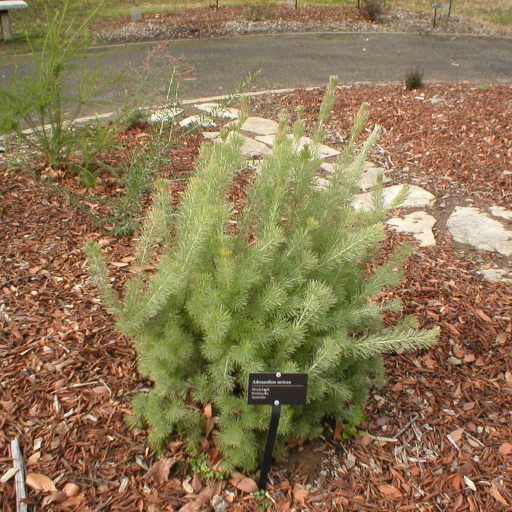
Plant Overview
Known affectionately as the "Woolly Bush," this Australian native is a master of sensory disguise. While it looks like a prickly, silver-toned conifer from a distance, one touch reveals its secret: it is incredibly soft, feeling more like velvet or a rabbit's ear than a garden shrub. Originating from the coastal dunes of Western Australia, it brings a misty, dreamlike texture to any landscape it inhabits.
🔍 How to Identify
- 🌿 Feather-Soft Foliage: The leaves are divided into fine, needle-like segments that are deeply lobed. Unlike a pine tree, these "needles" are supple and silk-like to the touch.
- 🎈 Silvery Glow: The entire plant has a distinct grey-green or silver sheen. This is caused by millions of tiny, fine hairs that cover the surface to help the plant retain moisture and deflect harsh sunlight.
- 💄 Hidden Blooms: Look closely among the branches to find small, tubular, ruby-red flowers. They aren't "showy" in the traditional sense, but they provide a beautiful contrast against the pale foliage.
🏡 In Your Garden
- 🧪 The Phosphorus Trap: As a member of the Proteaceae family, the Woolly Bush has specialized "proteoid" roots designed to scavenge every bit of nutrient from poor soils. Because of this, standard fertilizers can actually "overdose" the plant; always use a phosphorus-free, native-specific fertilizer.
- 🏖️ Drainage is Non-Negotiable: Coming from sandy coastal regions, this plant hates "wet feet." If planted in heavy clay or boggy soil, it will likely succumb to root rot. It thrives in Mediterranean climates with sandy or gravelly soil.
- ✂️ Shapeable Texture: It is highly versatile and responds well to pruning. It can be kept as a soft, billowy hedge or even shaped into a topiary.
⚠️ Safety & Toxicity
- 🐾 Safe for Residents: The Woolly Bush is generally considered non-toxic to humans, cats, and dogs. It is a "friendly" plant for high-traffic areas because it lacks the thorns or sharp edges found on many similar-looking shrubs.
- 🧤 Minor Irritation: While the plant itself isn't toxic, its dense, woolly foliage can trap dust or pollen. Those with high sensitivity to environmental allergens might experience slight skin or eye irritation after heavy pruning.
✨ Fun Fact
In its native Australia, the Adenanthos Sericeus is often used as a sustainable "Living Christmas Tree." Its natural conical shape and soft needles make it the perfect indoor-outdoor holiday guest that won't prick your fingers while you hang the ornaments!

Detailed Care Instructions
| Humidity | Dry |
| Lighting | Full Sun |
| Toxicity | Poisonous |
| Difficulty | Medium |
| Hibernation | Cold Period |
| Hardiness Zones | 9 - 11 |
Growing Adenanthos sericeus, also known as the Albany woollybush or the silver-leafed mountain bush, can be done by following a few key steps:
- Climate and soil requirements: Adenanthos sericeus is native to Western Australia and is well-suited to Mediterranean climates. It prefers sandy or gravelly well-draining soils with a pH range of 6-8.
- Planting: Choose a sunny location with well-draining soil. Dig a hole twice the size of the root ball and place the plant in the hole, making sure that the soil level remains the same as it was in the pot. Fill the hole with soil, gently firming it around the plant.
- Watering: Adenanthos sericeus is drought-tolerant once established, but as a young plant, it requires regular watering. Water deeply, allowing the soil to dry out slightly between waterings.
- Mulching: Apply a layer of organic mulch, such as straw or wood chips, around the plant to help retain moisture in the soil and suppress weed growth. Avoid placing mulch directly against the base of the plant.
- Pruning: Regular pruning is not required for Adenanthos sericeus, but it can be beneficial to prune to maintain a compact and bushy shape or remove any dead or damaged branches. Prune in late winter or early spring before new growth appears.
- Fertilization: Adenanthos sericeus generally does not require fertilization. However, if the plant appears stunted or lacks vigor, you can apply a slow-release, low-phosphorus fertilizer in spring.
- Pest and disease control: Adenanthos sericeus is generally resistant to pests and diseases, but keep an eye out for common garden pests like aphids or spider mites. If detected, treat with an appropriate insecticidal soap or oil.
Remember to check if the plant is suitable for your specific region before attempting to grow it.

Place in a window with dappled sun or a spot in the middle of a room. Or directly in a window facing west or east.

Adenanthos Sericeus is a plant that needs regular and consistent watering. However, it is important to let the soil dry out partially between waterings to prevent root rot.
When watering, it is important to water deeply and thoroughly, ensuring that the root zone is soaked. This will encourage healthy root growth and prevent the plant from becoming stressed.
It is also important to avoid getting water on the leaves of the plant, as this can encourage fungal growth and disease. To prevent this, water at the base of the plant, or use a watering can with a long spout to direct the water directly onto the soil.
In general, the frequency of watering will depend on factors such as temperature, humidity, and soil type. It is important to monitor the soil moisture regularly and adjust your watering schedule accordingly.
Adenanthos Sericeus plants require proper fertilizing to ensure healthy growth and development. Here are some instructions for fertilizing this plant:
- Use a slow-release fertilizer specifically formulated for native plants.
- Apply the fertilizer evenly around the base of the plant, avoiding contact with the foliage.
- Water the plant well after fertilizing to allow the nutrients to be absorbed by the root system.
- Repeat the fertilizing process every three to four months during the growing season (spring and summer).
- Avoid fertilizing during the winter months when the plant is dormant.
Remember to always follow the manufacturer's instructions when using fertilizers, and avoid over-fertilizing, as this can damage the plant.
Adenanthos Sericeus plant requires a well-draining soil that is rich in nutrients. A sandy loam or sandy clay soil is ideal for this plant. The soil pH for this plant should be slightly acidic to neutral, ranging from 5.5 to 7.0. To ensure good drainage, add perlite or coarse sand to the soil mixture. This plant prefers moist but well-draining soil, so avoid overwatering or allowing the soil to become too dry. It's better to water this plant deeply and less frequently than to water it frequently with small amounts of water. Regular fertilization is recommended during the growing season to provide the necessary nutrients for optimal growth.
Adenanthos Sericeus is a plant that can be propagated through stem cuttings. First, select a healthy stem that has several sets of leaves. Use a clean, sharp pair of scissors or pruning shears to make a diagonal cut just below the lowest set of leaves. Remove any leaves that will be below the soil line.
Next, dip the cut end of the stem in rooting hormone powder to promote root growth. Shake off any excess powder. Plant the stem in moist soil, making sure to bury it up to the lowest set of leaves. Water the soil thoroughly and place the pot in a warm, bright location.
Keep the soil moist but not soaked, and mist the leaves regularly to increase humidity. After about six weeks, gently pull on the stem. If there is resistance, roots have developed and the new plant can be transplanted into its own pot.








