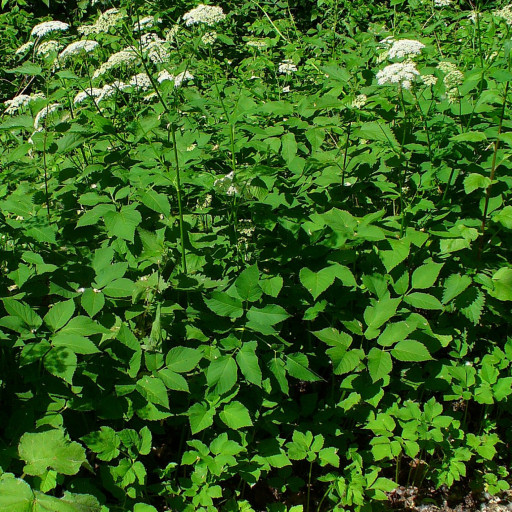
Plant Overview
Known as Ground Elder or Goutweed, this persistent perennial has traveled across continents since the Roman era. Originally cultivated as both a medicinal herb and a hardy leafy vegetable, it eventually earned the nickname "Bishop's Weed" because it was frequently found growing in the gardens of old monasteries. Today, gardeners view it as either a charming, variegated groundcover or a nearly invincible botanical foe.
🔍 How to Identify
- 🌿 The Leaf Shape: The leaves are compound and divided into three groups of three leaflets, bearing a striking resemblance to the foliage of an Elder tree.
- 🌼 Lacy Blooms: In early summer, it sends up tall stalks topped with delicate, flat clusters of tiny white flowers known as "umbels," typical of the carrot family.
- 👟 The "Goat’s Foot": If you examine the base of the leaf stalk, it has a distinct shape said to resemble a goat’s hoof—which is exactly what the Latin name Aegopodium translates to.
🏡 In Your Garden
- 🌱 The Great Conqueror: This plant is famous for its "underground army." It spreads via aggressive rhizomes, and even a tiny fragment of root left in the soil can regenerate into a full plant, making it incredibly difficult to eradicate once established.
- ⛅ Shade Specialist: It is a master of the "difficult corner." It thrives in dappled shade and poor soil where other ornamental plants might wither, providing a dense green (or white-edged) carpet that chokes out smaller weeds.
⚠️ Safety & Toxicity
- 🐾 Pet Status: It is generally considered non-toxic to cats, dogs, and horses, making it a safe choice for a pet-friendly yard.
- 🚫 The Deadly Double: While the young leaves are historically edible for humans (tasting somewhat like parsley or celery), you must exercise extreme caution. It looks remarkably similar to Poison Hemlock and Water Hemlock, both of which are deadly if ingested. Never forage this plant unless you are an expert.
✨ Fun Fact
In the Middle Ages, this plant was dedicated to St. Gerard, the patron saint of those suffering from gout. Monks would cultivate it in "physic gardens" specifically to create poultices for the painful joints of the clergy—hence the common name Goutweed.

Detailed Care Instructions
| Color | White |
| Soil Ph | Acid, Neutral, Alkaline |
| Invasive | Weed |
| Lighting | Part Sun |
| Toxicity | Poisonous |
| Soil Type | Well-Drained |
| Bloom Time | Summer |
| Plant Type | Herbaceous, Perennial |
| Mature Size | Flowering Stems Can Grow To Be Up To 1M Tall |
| Native Area | Europe, Asia |
| Sun Exposure | Full Sun, Partial Shade, Full Shade |
| Hardiness Zones | 4-9 |
To grow Aegopodium Podagraria, also known as Bishop's Weed or Goutweed, you can follow these steps:
- Choose a suitable location: Aegopodium Podagraria prefers partial shade to full shade and can tolerate a variety of soil types. However, it tends to grow aggressively and can become invasive, so it is advisable to choose a location where it can be easily contained.
- Prepare the soil: Ensure the soil is well-drained and work in organic matter, such as compost or aged manure, to improve fertility and moisture retention.
- Planting: You can start Aegopodium Podagraria from seeds or by planting nursery-bought seedlings. If starting from seeds, sow them directly into the prepared soil in early spring or fall. If using seedlings, dig a hole slightly larger than the root ball, place the plant in the hole, and backfill with soil. Space the plants about 18 inches apart, as they will spread quickly.
- Watering: Water the newly planted Aegopodium Podagraria thoroughly after planting and keep the soil consistently moist until the plants are established. After that, they can tolerate moderate drought conditions, but regular watering during dry spells will keep them looking lush.
- Mulching: Apply mulch around the plants to suppress weed growth, retain soil moisture, and regulate soil temperature. A layer of organic mulch, such as wood chips or straw, about 2-3 inches thick, will be beneficial.
- Maintenance: Aegopodium Podagraria requires minimal care once established. However, it tends to spread rapidly, so regular maintenance is necessary to prevent it from taking over other garden areas. This includes regular weeding and thinning out any unwanted growth.
- Containment: If you want to contain the spread of Aegopodium Podagraria, consider installing a physical barrier such as metal or plastic edging buried at least 12 inches deep to prevent the rhizomes from spreading into unwanted areas.
- Harvesting: If you are growing Aegopodium Podagraria for culinary purposes, the young leaves and tender shoots can be harvested. However, make sure to properly identify the plant before consuming it, as it resembles some toxic plants.
Note: It is important to keep in mind that Aegopodium Podagraria is considered invasive in many regions and can be difficult to eradicate once established. Ensure it is legal to grow in your area and take precautions to prevent it from escaping into natural areas.

Place in a window with dappled sun or a spot in the middle of a room. Or directly in a window facing west or east.

To water this particular plant, it is important to keep the soil consistently moist. This can be achieved by watering deeply once every week or so, depending on the weather conditions and the moisture level of the soil. It is essential to avoid Waterlogging the soil to prevent the roots from rotting. If the top inch of soil is dry, it is time to water the plant. Depending on the size of the plant, watering can be done using a watering can or a hose attachment with a gentle spray to avoid damaging the plant. It is important to water the base of the plant and avoid directly watering the foliage. Watering should be done in the early morning or late evening to avoid evaporation and ensure that the plant has enough time to soak up the water before the heat of the day.
To fertilize this plant, begin by selecting a balanced, slow-release fertilizer. Follow the instructions on the package for dosage and application timing, being careful not to over-fertilize. Apply the fertilizer evenly around the plant, taking care not to contact the leaves or stem directly, and water thoroughly to help distribute the nutrients. Repeat fertilization every 4-6 weeks throughout the growing season to promote healthy growth and robust foliage.
The ideal soil type for this plant would be one that is well-draining and has a neutral pH level. It should also be rich in organic matter and nutrients to support healthy growth. A loamy soil that is a mixture of sand, silt, and clay would be ideal. The soil should be kept moist, but not waterlogged, to prevent root rot. It is important to avoid using heavy soils or soils that are too acidic or alkaline as these can be detrimental to the plant's growth. Adding compost or well-rotted manure to the soil can help improve its structure and fertility.
To propagate this plant, you can divide its root system in the early spring or fall. Carefully dig up the root clump and separate it into smaller sections, making sure each section has a healthy amount of roots and shoots. Replant these sections in well-draining soil, water thoroughly, and keep the soil consistently moist until new growth appears. Alternatively, you can take stem cuttings from mature plants in the summer, rooting them in moist soil or water until they develop roots. Once rooted, transplant the cuttings into pots or the ground and continue to care for them as you would any other new plant.
Common pests of the ground elder include Spider mites, thrips, larvae. Make a habit of checking your ground elder frequently for pests so that any infestations can be caught and managed early.








