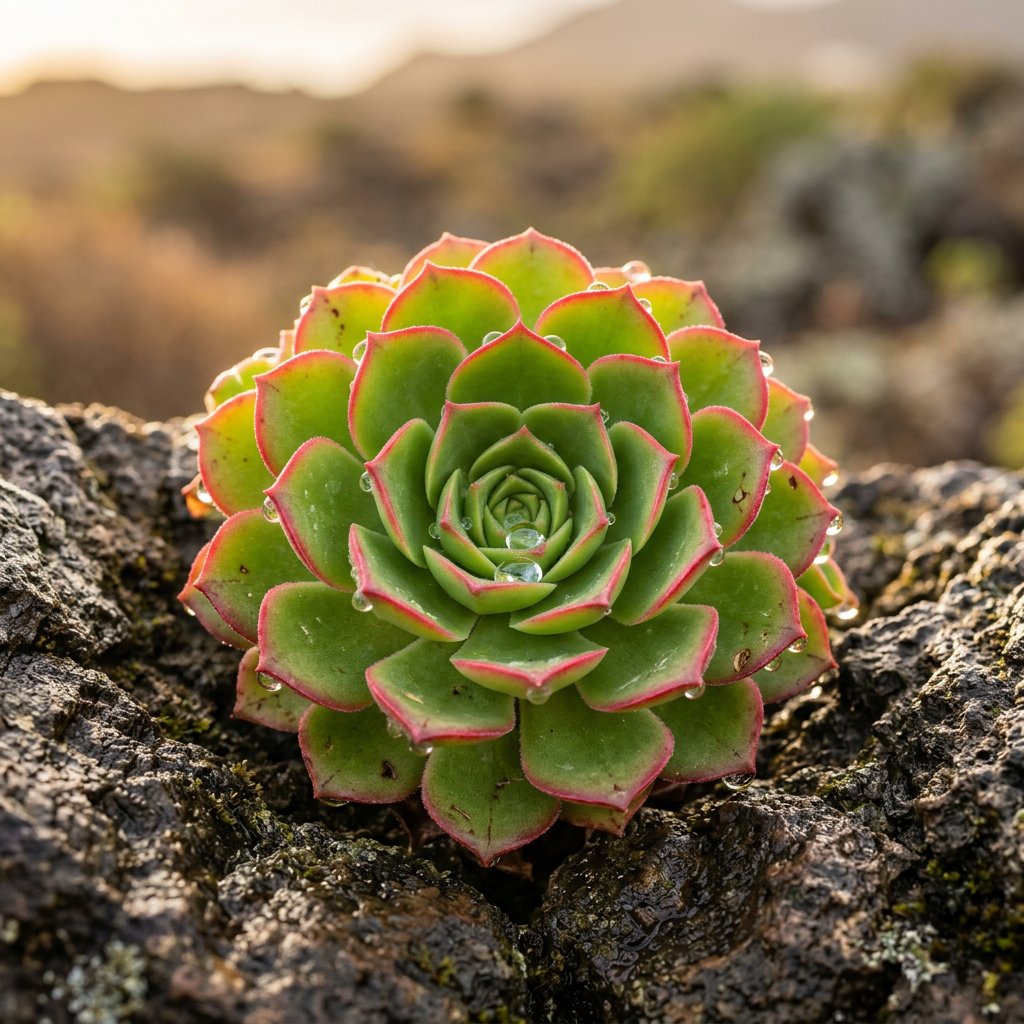
Plant Overview
Known as the Pinwheel Aeonium, this charming succulent forms intricate, architectural rosettes that look like frozen green fireworks. Native to the rocky cliffs of the Canary Islands, it has become a global favorite for its ability to transform from a tiny cutting into a sturdy, bonsai-like shrub with minimal effort. Its geometric precision makes it a living piece of art for any sunny windowsill.
🔍 How to Identify
- 🌀 The Rosettes: Features tight, spoon-shaped leaves arranged in a perfect spiral, usually reaching about 3–4 inches in diameter.
- 🎨 Leaf Edges: The glaucous blue-green leaves are often traced with a delicate red or pink margin, which becomes more vibrant when the plant is "stressed" by sunlight.
- 🪵 Growth Habit: Unlike many ground-hugging succulents, this species grows on thin, woody branching stems, giving it the appearance of a miniature tree.
🏡 In Your Garden
- 💤 Summer Sleepers: Unlike most garden plants, Aeoniums are winter growers and often go dormant in the peak of summer heat. If the rosettes close up into tight balls, don't overwater—they are simply resting!
- 🌬️ Aerial Roots: You might notice thin, hair-like roots growing from the stems into the air. This is normal; the plant is looking for extra stability or moisture from the coastal mist of its ancestral home.
⚠️ Safety & Toxicity
- ✅ Pet & Child Safe: This plant is generally considered non-toxic to cats, dogs, and humans, making it an excellent choice for households with curious explorers.
- 💧 Sap Sensitivity: While not poisonous, the sap can occasionally cause mild skin irritation for those with very sensitive skin. It’s always a good idea to wash your hands after pruning.
✨ Fun Fact
Most Aeonium species are "monocarpic," meaning the entire plant dies after it blooms. However, Aeonium haworthii is a lucky exception! It is polycarpic, meaning it can produce its pale-yellow flowers year after year without the main plant reaching the end of its life.

Detailed Care Instructions
| Humidity | Dry |
| Lighting | Full Sun |
| Toxicity | Non-Toxic |
| Difficulty | Easy |
| Temperature | 18°C - 24°C |
| Hardiness Zones | Min 9A |
To grow Aeonium Haworthii, also known as Aeonium Zwartkop, you can follow these steps:
- Choose the right location: Select a location that receives bright, indirect sunlight. Aeonium Haworthii prefers warm temperatures between 60-75°F (15-24°C).
- Soil: Use well-draining soil that is slightly acidic. You can create a suitable mix by combining equal parts of potting soil, peat moss, and perlite or coarse sand.
- Container: Plant the Aeonium in a pot or container with sufficient drainage holes. It's recommended to choose a pot that is slightly larger than the root ball of the plant.
- Watering: Water the plant thoroughly but allow the soil to dry out between waterings. Overwatering can cause root rot, so ensure the excess water drains completely from the pot. During winter, reduce watering as the plant enters dormancy.
- Fertilization: Feed the Aeonium Haworthii with a balanced, water-soluble fertilizer every two weeks during the growing season (spring and summer). Follow the instructions on the fertilizer package for proper dilution ratios.
- Pruning: Trim any leggy or dying leaves to maintain the plant's shape and appearance. Aeonium Haworthii typically grows in a rosette shape, so regular pruning can help keep the plant compact.
- Propagation: Aeonium Haworthii can be propagated through stem cuttings. Allow the cuttings to dry for a day or two before planting them in a well-draining soil mix. Keep the soil slightly moist until new growth appears.
- Dormancy: Aeonium Haworthii goes dormant during winter, meaning it slows down its growth. During this period, reduce watering and provide lower light conditions to help the plant rest.
Remember that Aeonium Haworthii is a tender succulent and cannot tolerate frost or extreme cold temperatures. Protect it from freezing conditions, and if possible, bring it indoors during winter or provide frost protection if kept outside.

Place in a bright room that is sun drenched almost all day. Or directly in a south-facing window.

To properly water this plant, it is important to consider its soil moisture level and the environment it is growing in. The first step is to wait until the top inch of soil has dried out before watering. Overwatering can lead to root rot and other diseases, so it is important to avoid saturating the soil too frequently. When watering, slowly add water until it drains out the bottom of the container, then wait until the soil has fully absorbed the water before adding more. Depending on the climate and humidity levels, this may require watering every few days or even just once a week. In general, it is better to underwater than to overwater this plant, as it can tolerate drought better than excess moisture.
To properly fertilize this type of plant, you should use a balanced fertilizer with equal amounts of nitrogen, phosphorus, and potassium. It is recommended to fertilize once every two weeks during the active growing season, which typically falls between spring and fall. During the dormant season, which is usually during the winter months, fertilizing should be stopped altogether. Before applying fertilizer, make sure the soil is moist and never fertilize a dry plant. Care should be taken not to over-fertilize, as this can lead to burning of the leaves and damage to the plant.
A suitable growing medium for the plant in question should have good drainage, as the plant is especially sensitive to over-watering. A mix of loam, sand, and perlite is recommended to achieve the ideal balance of water retention and drainage. It is also important to ensure that the soil is slightly acidic, with a pH level between 6.0 and 6.5. Additionally, incorporating some organic matter, such as compost or peat moss, can help to promote healthy root growth and provide essential nutrients to the plant.
To propagate this plant, you can start by taking stem cuttings. Choose a healthy stem that is at least 4 inches long and has several leaves. Gently remove the leaves from the lower 2 inches of the stem. Dip the cut end of the stem in rooting hormone and plant it in a well-draining soil mix. Water lightly and keep the soil slightly moist. Place the cutting in a bright, indirect light and keep it warm. Over time, roots will form and new growth will emerge from the top of the stem. Once the new plant is established, you can repot it into its own container or plant it in the ground.
Common pests of the pinwheel include Mealybugs, aphids, thrips. Make a habit of checking your pinwheel frequently for pests so that any infestations can be caught and managed early.








