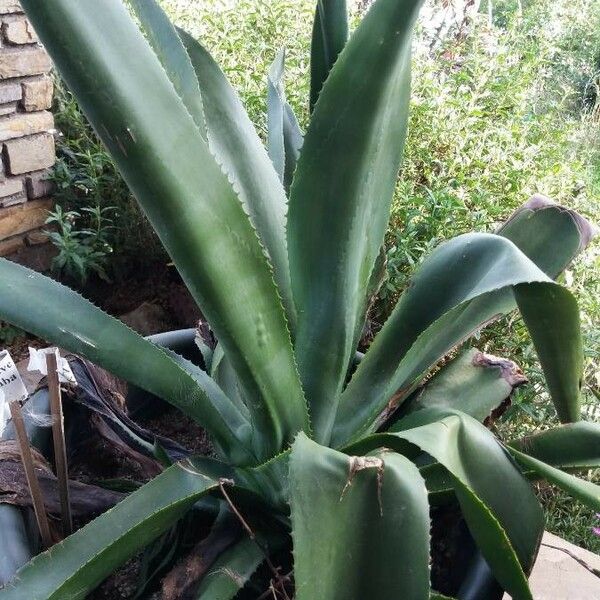
Plant Overview
Hailing from the sun-drenched islands of Hispaniola, Agave antillarum is a resilient sentinel of the Caribbean landscape. Known for its structural elegance and rugged endurance, this agave has spent centuries adapting to rocky terrains and salty sea breezes. In its native Dominican Republic and Haiti, it is often seen clinging to limestone cliffs, acting as a natural, prickly barrier against the elements.
🔍 How to Identify
- 🌵 Leaf Structure: Features stiff, sword-shaped leaves that form a tight, symmetrical rosette. The leaves are typically a deep emerald to grayish-green.
- 🦷 Marginal Teeth: The leaf edges are lined with prominent, sharp, reddish-brown "teeth" that provide a striking color contrast against the succulent flesh.
- 🌼 Sky-High Blooms: Once the plant reaches maturity (which can take a decade or more), it sends up a towering, woody flower stalk that can reach several meters high, topped with vibrant yellow blossoms.
🏡 In Your Garden
- 🪨 Rocky Roots: Because it naturally grows in limestone crevices, this agave demands exceptional drainage. It thrives in gravelly or sandy soils and is highly susceptible to root rot if left in standing water.
- ☀️ Sun Seeker: To maintain its compact, architectural shape, it requires intense, direct sunlight. If grown in too much shade, the leaves will become "leggy" and lose their characteristic structural strength.
⚠️ Safety & Toxicity
- ⚔️ Physical Hazard: The terminal spines at the tips of the leaves are needle-sharp and can cause puncture wounds. It is best planted away from narrow walkways or areas where children and pets play.
- 🧪 Skin Irritant: The sap contains calcium oxalate crystals. If the leaves are cut or crushed, the sap can cause "Agave Dermatitis"—a painful, itchy skin rash. Always wear gloves and long sleeves when pruning.
✨ Fun Fact
In traditional Caribbean culture, the tough, structural fibers found inside the leaves of Agave antillarum were historically harvested and twisted into incredibly strong cordage and ropes, used for everything from fishing to construction.

Detailed Care Instructions
To grow Agave Antillarum, also known as the Caribbean Agave, you can follow these steps:
- Climate: Ensure that you live in a region with a suitable climate for Agave Antillarum. It thrives in warm, dry, and sunny environments. It is native to the Caribbean islands and prefers temperatures between 70-90°F (21-32°C), although it can tolerate some frost.
- Soil: Agave Antillarum prefers well-draining soil with excellent drainage. It can tolerate poor soil conditions, including rocky or sandy soils. Mix sand or gravel into the soil to enhance drainage if needed.
- Watering: This succulent plant is drought-tolerant and prefers infrequent watering. Wait until the soil is completely dry before watering, then water deeply, allowing the excess water to drain away. Avoid overwatering as it can lead to root rot.
- Sunlight: Agave Antillarum requires full sun to thrive. Provide it with at least six hours of direct sunlight per day. If you are growing it indoors, place it near a sunny window.
- Planting: Select a location in your garden where the plant can receive adequate sunlight. Ensure that the soil is well-draining. Dig a hole slightly wider and deeper than the plant's root ball. Gently place the Agave Antillarum in the hole and backfill with soil, patting it down firmly but not compacting it.
- Maintenance: Agave Antillarum is a low-maintenance plant. Remove any dead or decaying leaves regularly to keep the plant healthy and clean. Fertilization is generally not necessary; however, you can apply a balanced fertilizer once or twice during the growing season to promote healthy growth.
- Propagation: Agave Antillarum can be propagated from offsets or pups that develop around the base of the mature plant. Gently remove the offset with a sharp, sterile knife and plant it in a separate container with well-draining soil. Allow it to establish before transplanting it to a permanent location.
Remember, Agave Antillarum is a slow-growing plant, so be patient with its growth. With proper care and suitable conditions, it can thrive and add beauty to your garden.
Agave Antillarum is a desert plant that requires minimal watering. To properly water this plant, it is important to follow a few guidelines. First, always water the soil directly at the base of the plant. Avoid getting water on the leaves or stem as this can lead to rotting. Second, only water the plant when the soil feels completely dry to the touch. This is usually once every two weeks during the growing season and once a month during the dormant season. Finally, use a well-draining soil mix to prevent water from accumulating in the roots.
To fertilize this plant, use a balanced fertilizer specifically designed for succulent plants. During the growing season, fertilize once a month, diluting the fertilizer to half-strength before applying it. Fertilize sparingly during the dormant season. Always make sure the soil is moist before fertilizing.
The Agave Antillarum plant prefers well-draining soils that are rich in organic matter. A sandy loam mixture is ideal, with a balanced pH level of around 6 to 7. It is important to avoid heavy clay soils, as these can retain too much moisture and cause root rot.
To improve drainage, it is recommended to add perlite, pumice or coarse sand to the soil mixture. This will ensure that water does not accumulate around the roots and cause damage.
In terms of fertilization, the Agave Antillarum plant does not require frequent feeding. A slow-release fertilizer can be added to the soil once per year, in early spring.
Overall, the soil should be well-aerated, loose, and have good drainage, to promote healthy growth and development of the Agave Antillarum plant.
To propagate this plant, you will need to use the offsets or "pups" that grow at the base of the parent plant. These can be carefully dug up and separated from the main plant using a sharp, clean knife or garden shears.
Once you have removed the offsets, allow them to dry out for a few days or up to a week to callus over any open wounds. This will help to prevent disease and ensure successful rooting.
Next, prepare a potting mix of well-draining soil that is low in organic matter, such as a cactus or succulent mix, and fill a small pot with the mix. Make a small hole in the center of the potting mix and plant the offset, firming the soil around it.
Water the newly planted offset sparingly, allowing the potting mix to dry out slightly between waterings. Provide bright, indirect light and protect from direct sunlight until the offset has established a strong root system.
Over time, the Agave Antillarum will form a rosette of its own and can be transplanted to a larger pot or into the ground in a sunny, well-draining location. With proper care, it will continue to propagate and grow into a mature plant.








