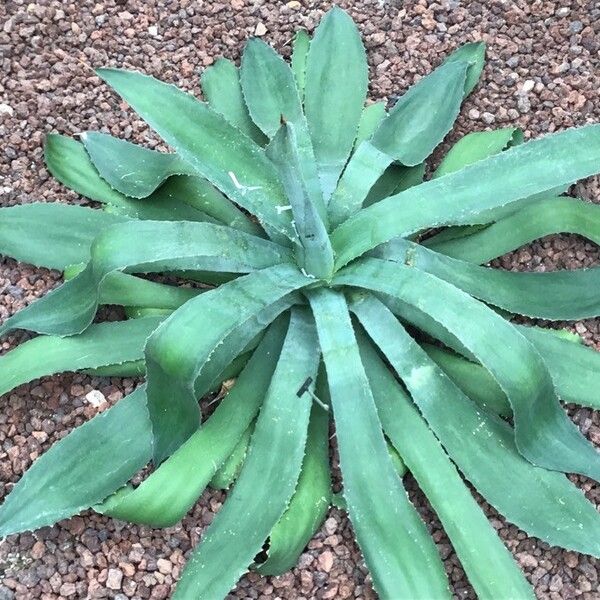
Plant Overview
Often called the Mescal Ceniza or "Silver Leaf Agave," this Mexican beauty looks like a living sculpture carved from cold stone. Native to the coastal regions of Sonora, it is beloved by landscapers for its compact size and dramatic, ashy-blue leaves that seem to glow under the desert moonlight. In folklore, agaves are symbols of long-lasting endurance, standing firm through decades of harsh sun before their singular, spectacular bloom.
🔍 How to Identify
- 🎨 The "Bud Prints": Perhaps its most striking feature; deep, wavy imprints are visible on the back of each leaf. These are "shadows" left behind by the pressure of neighboring leaves when the plant was still a tight, developing bud.
- 🦷 Dark Serration: The leaf edges are lined with sharp, prominent, dark brown or charcoal-gray teeth that provide a fierce, beautiful contrast against the pale blue foliage.
- 📐 Compact Rosette: It maintains a very symmetrical, cabbage-like shape. Unlike some sprawling agaves, Agave colorata stays relatively contained, usually reaching about 2 to 4 feet in width.
🏡 In Your Garden
- ☀️ Sun-Kissed Mineralist: While it craves full sun, this species is slightly more sensitive to extreme inland heat than its larger cousins. In scorching climates, it appreciates a bit of afternoon shade to prevent its "silver skin" from burning.
- 💧 The Drainage Rule: It evolved in rocky, coastal soils where water moves quickly. It hates "wet feet," so if your garden has heavy clay, plant it on a slight mound or in a gritty cactus mix to ensure the roots stay dry and oxygenated.
- 🌱 Patience in a Pot: Because it is slow-growing and stays compact, it is one of the best agave species for large decorative containers. It will eventually produce "pups" (offsets) at the base, which can be harvested to start new plants.
⚠️ Safety & Toxicity
- 🗡️ Sharp Armor: The terminal spines at the tips of the leaves are needle-sharp and rigid. To avoid injuries, it is best planted at the back of a flower bed, away from walkways where children or pets might brush against it.
- 🧪 Sappy Defense: The internal sap contains calcium oxalate crystals. If a leaf is broken, the sap can cause "agave dermatitis"—a stinging, itchy rash on the skin. It is toxic if ingested by pets or humans, leading to mouth irritation and stomach upset.
✨ Fun Fact
The specific epithet colorata (meaning "colored") doesn't refer to the blue leaves, but to the beautiful, reddish-brown hues that appear on the marginal teeth and spines as they age, making the plant look like it has been detailed with dark ink!

Detailed Care Instructions
To grow Agave Colorata plant, follow these steps:
- Choose a suitable location: Agave Colorata prefers full sun but can tolerate some shade. Ensure that the location has well-draining soil to prevent root rot.
- Prepare the soil: Agave Colorata thrives in rocky or sandy soil. Improve drainage by adding some gravel or sand to the soil if necessary. Avoid heavy clay soil.
- Dig a hole: Dig a hole in the prepared soil that is slightly larger than the plant's root ball.
- Planting: Gently remove the plant from its container and place it in the hole, ensuring that the top of the root ball is level with the ground. Backfill the hole with soil and gently press down to secure the plant.
- Watering: Water the plant thoroughly after planting to help the roots settle. Afterward, allow the soil to dry out between watering to avoid overwatering.
- Mulching: Apply a layer of organic mulch around the plant to help retain moisture and suppress weed growth. Leave a gap between the mulch and the stem to avoid rot.
- Pests and diseases: Agave Colorata is generally resistant to pests and diseases. However, watch out for common succulent pests such as mealybugs and scale insects. Treat any infestations promptly.
- Fertilization: Agave plants are generally low maintenance and do not require frequent fertilization. However, if you choose to fertilize, use a slow-release, low-nitrogen fertilizer in spring or early summer.
- Propagation: Agave Colorata can be propagated by division or by collecting offsets produced by the plant. Wait until the plant has matured before attempting to propagate.
- Cold protection: Agave Colorata is fairly cold-hardy but can be damaged by severe frost. If you live in a cold climate, protect the plant during winter by covering it with a frost cloth or moving it indoors.
Remember, Agave Colorata is a slow-growing plant, so be patient and give it time to establish. Enjoy the beautiful blue-green foliage and the unique architectural form of this agave species.
To properly water this plant, you should first determine the type of soil it is planted in. If the soil is well-draining and porous, you can water this plant deeply, allowing the water to penetrate several inches into the soil. However, if the soil is heavy and retains moisture, you should water this plant sparingly, allowing the soil to dry out between waterings. When watering, aim to water the soil around the plant rather than directly onto the leaves or center of the plant. During the winter months when this plant is dormant, watering should be reduced further to prevent root rot.
To fertilize Agave Colorata, begin by selecting a balanced, slow-release fertilizer with a nutrient ratio of approximately 10-10-10. Follow these step-by-step instructions:
- Choose a mature Agave Colorata plant that is actively growing and established in the ground or a well-draining container.
- Apply fertilizer during the active growing season, typically from early spring to mid-fall.
- Start by preparing the fertilizer according to the package instructions. Dilute it in water if necessary.
- Gently sprinkle the diluted fertilizer around the base of the Agave Colorata, ensuring that it is evenly distributed.
- Be cautious not to let the fertilizer come into direct contact with the plant's leaves or stem as this may cause damage.
- Water the Agave Colorata thoroughly after applying the fertilizer to help it absorb the nutrients effectively and prevent any potential burning of the roots.
- Monitor the moisture level of the soil regularly. Agave Colorata prefers a slightly dry environment, so avoid overwatering.
- Repeat the fertilization process every four to six weeks during the growing season, adjusting the amount and frequency based on the plant's response and fertilization instructions.
Remember to always read and follow the specific instructions provided by the fertilizer manufacturer to ensure the correct application and avoid any potential harm to the Agave Colorata plant.
Agave Colorata requires a well-draining soil that is rich in nutrients and organic matter. The soil should be slightly acidic with a pH level between 6.0 to 7.0. It is important to avoid using heavy clay soils, as they can suffocate the roots and prevent proper drainage. Sandy loam or rocky soil with good drainage is recommended for optimal growth. Additionally, it is essential to ensure the soil is consistently moist but not waterlogged, as this can cause root rot and other fungal diseases. Adding perlite or coarse sand to the soil mix can improve drainage and prevent waterlogging.
Agave Colorata is a succulent plant that can be easily propagated through various methods. Here is a detailed guide on how to propagate this plant:
- Select a suitable parent plant: Look for a healthy and mature Agave Colorata plant to use as the parent plant for propagation. Ensure that the plant has well-developed offsets (also known as "pups") growing around its base.
- Prepare a suitable pot and soil: Choose a well-draining pot or container that has several drainage holes. Fill it with a well-draining soil mix specifically formulated for succulents or cacti. You can also create your own by mixing equal parts of regular potting soil, Perlite, and coarse sand.
- Gently remove the offsets: Carefully dig around the base of the parent plant to expose the offsets. Use a sharp and clean knife or secateurs to cut the offsets from the parent plant. Make sure each offset has some root material attached to it.
- Allow the offsets to callous: After removing the offsets, place them in a dry and shaded area for a few days to allow the cut ends to callous over. This drying process helps prevent rotting when the offsets are planted.
- Prepare the offsets for planting: Once calloused, you can proceed to plant the offsets. Each offset should have well-developed roots or a calloused base. If the roots are long, you can trim them slightly to encourage healthy root growth.
- Planting the offsets: Make small holes in the prepared soil mix using your fingers or a dibber. Place the offsets in the holes, ensuring that they are upright and the roots are spread out. Gently press the soil around the base of each offset to secure them in place.
- Watering and care: After planting, water the offsets lightly, allowing the soil to get thoroughly moist but not overly saturated. It is crucial to avoid overwatering, as succulents are prone to root rot. Place the potted offsets in a bright location with indirect sunlight.
- Establishing new growth: Over the next few weeks, the offsets will gradually develop new roots and establish themselves. Ensure the soil is kept slightly moist during this period, but refrain from overwatering. Once the offsets start showing signs of new growth and roots, gradually reduce the frequency of watering.
- Transplanting: After a few months of growth, when the offsets have developed a healthy root system and appear well-established, you can consider transplanting them into their permanent containers or a suitable outdoor location.
Remember to provide adequate sunlight, not exceeding the plant's tolerance, and avoid extreme temperature variations during the propagation process. Regularly monitor the offsets for any signs of pests or diseases and provide appropriate care accordingly. With patience and proper care, you can successfully propagate and grow Agave Colorata plants.








