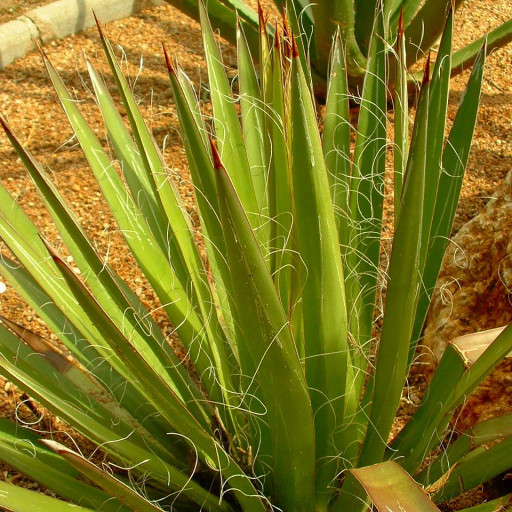
Plant Overview
Often called the Thread Agave, this Mexican native is a living piece of geometric art. It earns its name from the delicate, curly white filaments that peel away from its leaf margins, giving the plant a uniquely "hairy" and textured appearance. A favorite among succulent collectors, it is prized for its perfectly symmetrical rosette and its rugged ability to thrive in harsh, arid environments.
🔍 How to Identify
- 🌿 The Rosette: It forms a dense, spherical cluster of stiff, sword-shaped leaves that grow upward and outward, typically reaching about 1 to 2 feet in diameter.
- 🧵 Leaf "Threads": The most striking feature is the white, hair-like fibers that unravel naturally from the edges of the dark green leaves.
- 🗡️ Terminal Spine: Each leaf tip is armed with a singular, very sharp, dark brown or grey needle-like point.
🏡 In Your Garden
- 🏜️ Drainage is King: This plant has a sensitive root system that cannot tolerate "wet feet." It thrives in gritty, rocky soil and will rot quickly if the medium holds onto moisture for too long.
- ☀️ Sun Seeker: To keep the rosette tight and the white markings vivid, it needs bright, direct sunlight. However, in scorching desert climates, a little afternoon shade prevents the leaves from yellowing.
- 🕰️ The "Hands-Off" Approach: It is a slow grower that hates being moved. Frequent repotting can stress the plant and break the delicate threads that give it its character.
⚠️ Safety & Toxicity
- 🐾 Mildly Toxic: The sap contains calcium oxalate crystals which can cause skin irritation in humans and mouth swelling or digestive upset if nibbled by pets.
- 🧤 Physical Hazard: While the "threads" look soft, the terminal spines are incredibly sharp and can cause painful puncture wounds. It is best planted away from narrow walkways or areas where children play.
✨ Fun Fact
- 🕯️ A Grand Finale: The Thread Agave is "monocarpic," meaning it spends its entire life (10–20 years) storing energy for a single event. It eventually sends up a spectacular 10-foot tall flower spike, blooms once, and then gracefully dies, usually leaving behind small "pups" at the base to start the cycle anew.

Detailed Care Instructions
| Humidity | Normal |
| Lighting | Full Sun |
| Difficulty | Medium |
| Hibernation | Cold Period |
| Hardiness Zones | 5 - 11 |
To grow Agave Filifera, also known as the Thread Agave, you can follow these steps:
- Choose the right location: Agave Filifera prefers full sun to partial shade. Select a spot in your garden that receives at least 6 hours of sunlight per day.
- Prepare the soil: Agave Filifera thrives in well-draining soil. Before planting, amend the soil with organic matter such as compost to improve drainage and fertility. Avoid clayey or compacted soils.
- Planting: Dig a hole that is slightly wider and deeper than the nursery pot. Gently remove the plant from its container and place it in the hole. Fill the hole around the plant with soil, firming it gently with your hands. Leave enough space for the plant to grow.
- Watering: After planting, water the Agave Filifera thoroughly to settle its roots. Then, water it sparingly, allowing the soil to dry out between waterings. Agave Filifera is a drought-tolerant plant and prefers dry conditions.
- Mulching: Apply a layer of organic mulch around the plant to conserve moisture and suppress weed growth. Make sure to leave a gap between the mulch and the base of the plant to prevent rot.
- Fertilizing: Agave Filifera does not require much fertilization. However, if desired, you can provide a slow-release fertilizer formulated for succulents during the spring growing season.
- Pruning: Agave Filifera does not typically require pruning. However, if you notice any damaged or dead leaves, you can trim them close to the base of the plant using sanitized pruning shears.
- Winter care: Agave Filifera is hardy in USDA zones 9-11. In colder regions, protect the plant from frost or freezing temperatures by covering it with a frost cloth or moving it indoors. Ensure it has good air circulation and minimal watering during winter.
Remember, Agave Filifera can take several years to reach its mature size, so be patient while it establishes and grows.

Place in a bright room that is sun drenched almost all day. Or directly in a south-facing window.

To successfully water this plant, it is important to understand its growing conditions. Agave Filifera is a succulent plant that requires well-draining soil and infrequent watering. When watering, it is important to not overwater the plant, as this can lead to root rot and other health issues.
The best way to water Agave Filifera is to wait until the soil is completely dry before watering. This can easily be tested by sticking your finger into the soil about an inch deep - if the soil feels dry, it is time to water. When watering, slowly pour water over the soil, ensuring that water reaches the roots.
It is important to avoid getting water on the leaves or in the center of the plant, as this can lead to rot and other problems. Additionally, it is important to avoid watering too much in the winter months, as the plant's growth slows down during this time.
Overall, Agave Filifera is a low-maintenance plant that requires infrequent watering. By providing well-draining soil and avoiding overwatering, this plant can thrive in a variety of growing conditions.
To fertilize this plant, it is recommended to use a water-soluble fertilizer that is low in nitrogen and high in phosphorus and potassium. It is important to dilute the fertilizer to half the recommended strength and apply it to the soil around the base of the plant once a month during the growing season. Avoid getting the fertilizer on the foliage or stems to prevent damage. Additionally, it is important to water the plant thoroughly before and after fertilizing to prevent root burn.
Agave Filifera plant prefers well-draining soil that is sandy or gravelly in texture. The soil should have a pH level that ranges from slightly acidic to slightly alkaline. The use of too much organic matter in the soil can lead to root rot and may negatively impact the plant's growth and development.
A good soil mix for Agave Filifera can be created by blending cactus mix, perlite, and coarse sand in equal proportions. This combination allows for proper drainage and aeration of the roots while still providing enough nutrients to support healthy growth.
When planting Agave Filifera, it is important to ensure that the soil around the roots is firmly packed to prevent air pockets which can cause the roots to dry out. Additionally, the plant should be given enough water to keep the soil moist but not waterlogged. Overwatering can cause the roots to rot and ultimately kill the plant.
Overall, Agave Filifera requires soil that is well-draining, sandy or gravelly in texture, and slightly acidic to slightly alkaline in pH. So, the right soil mix is crucial for its growth and survival.
To propagate this plant, you will need to carefully remove the offsets (new, smaller plants that grow at the base of the parent plant) from the main plant using a clean, sharp knife. Make sure to not damage the roots of either plant in the process. Once you have your offsets, let them dry out for a day or two before planting them in a well-draining soil mixture. Water the soil sparingly, keeping it moist but not saturated, until the plant establishes itself and begins to grow. After a few weeks, you can increase the watering frequency and start treating the new plant as a mature plant.
Common pests of the thread agave include Scale insect, mealybugs. Make a habit of checking your thread agave frequently for pests so that any infestations can be caught and managed early.








