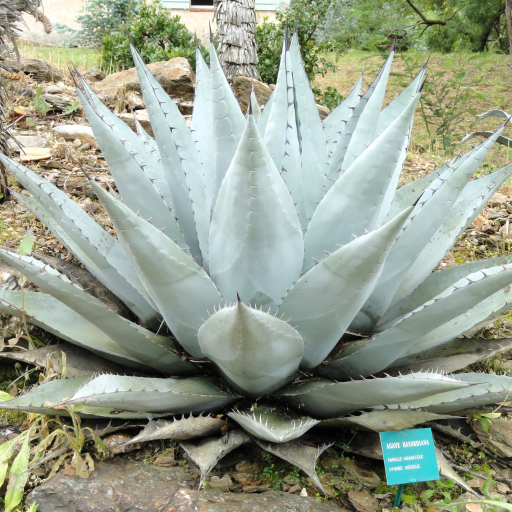
Plant Overview
Known as the "Havard’s Century Plant," this desert icon is a tough-as-nails survivor native to the high-altitude grasslands and mountains of the Big Bend region. Named after Valery Havard, a French-American army surgeon and botanist, it forms a stunning, architectural "artichoke" of steel-blue leaves. While it takes decades to bloom rather than a full century, the finale is a spectacular, towering yellow flower stalk that serves as a beacon for desert pollinators.
🔍 How to Identify
- 🍃 Rosette Form: It grows in a tight, symmetrical, globe-like shape, typically reaching about 2 to 3 feet in height and width.
- 🎨 Color & Texture: Features thick, fleshy leaves that range from a dusty silver-blue to a pale sea-green, often showing "bud imprints" where the leaves were pressed tightly together before unfurling.
- ⚔️ Spines: Each leaf is armed with prominent, dark brown or black teeth along the edges and a formidable, needle-sharp terminal spine at the very tip.
🏡 In Your Garden
- 🏜️ Extreme Hardiness: This is one of the most cold-tolerant agaves in existence, capable of surviving temperatures down to -10°F (-23°C). This makes it a favorite for "high desert" or northern rock gardens where other succulents would perish.
- 🪨 The Drainage Rule: While it is cold-hardy, it cannot tolerate "wet feet" during the winter. It thrives in lean, rocky soil with almost no organic matter. If planting in a garden, consider a raised mound to ensure water sheds away from the base.
- ☀️ Light Requirements: To maintain its signature compact, "closed" look and vibrant blue color, it needs as much direct sun as possible. In low light, the plant will stretch out and lose its structural beauty.
⚠️ Safety & Toxicity
- 🌵 Physical Hazard: The terminal spines are incredibly sharp and sit at a height that is dangerous for children and pets. Many gardeners "tip" the plant by clipping the very ends of the spines with pliers for safety.
- 🧪 Sap Irritation: Like many agaves, the sap contains calcium oxalate crystals. If you prune the plant, wear gloves; the juice can cause a burning, itchy rash known as "agave dermatitis."
- 🐾 Pet Warning: While the thorns usually keep curious pets away, the plant is considered toxic if chewed or swallowed, leading to mouth irritation and digestive upset.
✨ Fun Fact
- 🦅 The Last Hurrah: The Havardiana is "monocarpic," meaning it blooms only once in its lifetime. After decades of storing energy, it sends up a massive stalk that can grow several inches in a single day. Once the seeds are set, the mother plant dies, but it usually leaves behind "pups" (small clones) at its base to start the cycle over.

Detailed Care Instructions
| Lighting | Full Sun |
To grow Agave Havardiana, follow these steps:
- Select a suitable location: Agave Havardiana thrives in full sun to partial shade. Choose a well-draining area with sandy or rocky soil. This plant is native to mountainous regions, so it can tolerate cooler temperatures and even some frost.
- Prepare the planting area: Clear any weeds or grass from the designated planting area. Loosen the soil with a garden fork or shovel to improve drainage.
- Plant the agave: Dig a hole slightly larger than the root ball of the plant. Place the agave in the hole, ensuring the top of the root ball is level with the ground. Backfill the hole with soil and gently firm it around the plant.
- Watering: Water the plant immediately after planting to help settle the soil. Agave Havardiana is drought-tolerant, so only water it when the soil is completely dry. Overwatering can lead to root rot.
- Mulching: Apply a layer of organic mulch around the base of the plant to help conserve moisture and prevent weed growth. Keep the mulch a few inches away from the stem to prevent rot.
- Pruning: Agave Havardiana does not require regular pruning. However, if any dead or damaged leaves appear, you can remove them by cutting as close to the base as possible.
- Fertilizing: Agave Havardiana is adapted to poor soils and does not typically require fertilizer. However, if you notice slow growth or yellowing leaves, you can apply a balanced slow-release fertilizer once or twice a year.
- Winter protection: In colder climates, protect the plant from freezing temperatures by covering it with a frost cloth or bringing it indoors during the winter months.
- Propagation: Agave Havardiana can be propagated by collecting and planting the seeds or by dividing the offsets (pups) that grow around the base of the plant. Wait until the pups are approximately one-third the size of the parent plant before carefully detaching them and replanting them in a new location.
Remember that Agave Havardiana is a slow-growing plant, so be patient with its growth.

Place in a bright room that is sun drenched almost all day. Or directly in a south-facing window.

1. Agave Havardiana plants prefer well-draining soils with high amounts of mineral content.
2. The plant should be watered sparingly during the growing season, which is typically from spring to fall.
3. It is important to avoid overwatering, as this can lead to root rot and damage to the plant.
4. One way to determine when it is time to water is to check the moisture level of the soil using a moisture meter or by sticking your finger into the soil. If the soil is dry to a depth of 1-2 inches, it is time to water.
5. When watering, it is best to water deeply and slowly, allowing the water to soak into the soil and reach the roots.
6. Avoid getting water on the leaves or in the center of the plant, as this can lead to rot and other issues.
7. During the winter months, the plant should receive less frequent watering, as it will go into a dormant state and require less moisture.
8. In general, Agave Havardiana plants are drought-resistant and can survive periods of prolonged dryness. However, consistent watering can help promote healthy growth and keep the plant looking its best.
To fertilize this plant, use a balanced fertilizer with equal amounts of nitrogen, phosphorus, and potassium. Apply the fertilizer once a month during the growing season, which is typically from spring to summer. Dilute the fertilizer to half strength and water the plant thoroughly before applying. Be sure to avoid getting fertilizer on the leaves, as it can burn them. Additionally, do not fertilize during the plant's dormant period, which is usually in the fall and winter.
Agave Havardiana plant requires a well-draining soil that is sandy and rocky. The soil should not have any waterlogging issues as it can lead to root rot and damage. The pH level of the soil should be slightly acidic to neutral. It is best to mix the soil with perlite and coarse sand to improve the soil drainage. Additionally, the soil should have high nutrient content to promote healthy growth and development of the plant. Organic compost or a slow-release fertilizer can be added to the soil before planting the Agave Havardiana to provide it with the necessary nutrients.
Agave Havardiana can be propagated by removing offsets or pups that grow at the base of the parent plant. These can be carefully separated from the parent plant using a sharp and clean knife. The removed offsets should be allowed to callus or dry out for a few days to prevent rotting. Once the cut end is dry, the offset can be planted in well-draining soil in a pot or directly in the ground. It is important to avoid overwatering during the first few weeks to allow the root system to establish. The new plant will develop slowly and may take several years to reach maturity.








