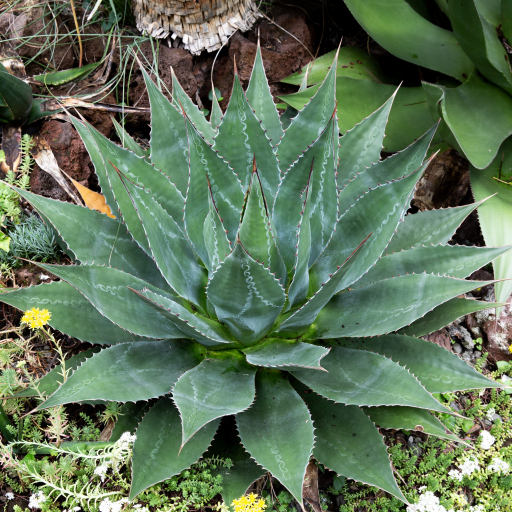
Plant Overview
Often called the "Mountain Agave," this stunning succulent is a rugged survivor from the high-altitude cloud forests of Northeastern Mexico. Unlike its desert-dwelling cousins, it thrives in cool, misty air and can even withstand a dusting of snow. Its perfectly symmetrical, artichoke-like form makes it a top-tier "architectural plant" for modern and Mediterranean landscapes alike.
🔍 How to Identify
- 🍃 The Rosette: It forms a massive, dense, and perfectly spherical head of up to 100 wide, fleshy leaves that can grow up to 4 feet wide.
- 🎨 Bud Imprints: One of its most beautiful features is the distinct "shadow" or imprint on the back of each leaf, created by the pressure of the thorns when the plant was still a tight central bud.
- 🦷 Mahogany Teeth: The leaf margins are lined with prominent, reddish-brown teeth that lead to a formidable, sharp terminal spike at the tip.
🏡 In Your Garden
- 🏔️ Cold & Moisture Tolerance: Because it hails from the mountains, it is significantly more frost-tolerant than most Agaves. It also handles winter dampness better, though it still requires excellent drainage to thrive.
- 🧘 The Lone Wolf: Unlike many Agaves that spread via underground "pups," Agave montana usually remains a solitary plant. This means it won't take over your garden, but it also means it stays a single, dramatic focal point for its entire life.
- ☀️ Sun Seeker: It prefers full sun but, unlike lowland species, it actually appreciates a bit of afternoon shade in extremely hot, inland climates to prevent leaf scorch.
⚠️ Safety & Toxicity
- ⚔️ Physical Hazard: The primary danger is the needle-sharp terminal spines. These are often at "shin height" for adults and "face height" for pets and children. Many gardeners "tip" the spines with clippers for safety.
- 🧪 Acrid Sap: The sap contains calcium oxalate crystals which can cause painful skin irritation or "Agave dermatitis." Always wear gloves and long sleeves if you need to prune or move the plant.
- 🐾 Pet Safety: While not typically enticing to eat due to the thorns, the sap is considered toxic if ingested, leading to mouth irritation and stomach upset.
✨ Fun Fact
Agave montana is "monocarpic," meaning it spends its entire life (often 20 to 40 years) store-piling energy for one single, spectacular event. It will eventually send up a massive flower spike that looks like a giant asparagus, reaching up to 15 feet tall, before the mother plant finally withers and dies.

Detailed Care Instructions
To grow Agave Montana plants, here are some steps you can follow:
- Choose a suitable location: Agave Montana prefers full sun to partial shade, so select a location with adequate sunlight exposure. Ensure the soil is well-drained and not prone to waterlogging.
- Planting: Dig a hole slightly larger than the root ball of the plant and place it in the hole. Backfill the hole with soil, gently firming it around the plant. Make sure the plant is placed at the same depth it was in its previous container.
- Watering: After planting, water the plant thoroughly. Agave Montana is drought-tolerant but requires regular watering until it establishes. After that, water sparingly, allowing the soil to dry out between waterings.
- Mulching: Apply a layer of organic mulch around the base of the plant to help retain moisture, suppress weed growth, and regulate soil temperature.
- Fertilizing: Agave Montana plants are not heavy feeders. However, you can apply a slow-release, balanced fertilizer once a year in spring to provide essential nutrients.
- Pruning: Agave Montana does not require pruning unless there are dead or damaged leaves. Remove these using clean, sharp pruning shears.
- Winter care: Agave Montana is hardy to USDA zones 7-10. If you live in a colder region, protect the plant during winter by covering it with a frost cloth or moving it indoors to a cool, sunny spot.
- Pests and diseases: Agave Montana is generally resistant to pests and diseases. However, watch out for snails, slugs, and mealybugs. Treat any infestations promptly with appropriate insecticides.
Remember to check the specific care instructions for Agave Montana plants based on your region's climate and growing conditions, as they may have slight variations.

Place in a bright room that is sun drenched almost all day. Or directly in a south-facing window.

To water this plant, you should first ensure that the soil is completely dry before watering it. This can be done by sticking your finger into the soil to a depth of about two inches. If it feels dry to the touch, it is time to water it. When watering, be sure to use a slow and steady stream of water to ensure that the soil is thoroughly moistened. Avoid getting the leaves wet, as this can lead to rot or disease. Also, make sure that any excess water is allowed to drain away from the plant's roots to prevent waterlogging. Finally, watering should be done sparingly during the winter months, as the plant goes into a dormant phase during this time.
To fertilize this plant, dissolve a slow-release fertilizer in water according to the manufacturer's instructions. Apply the solution to the soil around the base of the plant, taking care not to get any fertilizer on the leaves or stem. Repeat the fertilization process every few months during the growing season, but avoid fertilizing during the winter months.
When planting Agave Montana, it is best to use a well-draining soil that is rich in organic matter. The soil should be composed of a combination of sand and compost, with perlite or pumice added for additional drainage. Avoid using heavy clay soils or soils that retain too much moisture, as this can lead to root rot. It is recommended to amend the soil with a slow-release fertilizer, as Agave Montana plants are heavy feeders. Additionally, ensure that the plant is placed in a location that receives ample sunlight and has good air circulation to prevent fungal infections.
To propagate this plant, first choose a healthy and mature parent plant. Cut off a mature and healthy leaf from the parent plant using a sharp, clean knife. Make the cut at an angle to minimize the area of the wound and reduce the risk of infection. Allow the cut end of the leaf to callus over for a few days to a week.
Fill a well-draining container with a good quality cactus or succulent potting mix. Make a small hole in the soil large enough to accommodate the callused end of the leaf. Place the leaf in the hole and backfill with soil, pressing it down gently to ensure good contact between the soil and the leaf.
Water the newly planted leaf sparingly, only when the soil has completely dried out. Keep it in bright, indirect light, away from direct sunlight, and in a warm, dry location. Within a few weeks, roots should begin to form from the callused end of the leaf, followed by the emergence of small new leaves.
Once the new plant has grown large enough to handle, transplant it into a new container or in the garden, using well-draining soil and proper spacing requirements. With proper care, the new plant will grow into a mature and healthy specimen.
Common pests of the mountain agave include Scale insect, mealybugs. Make a habit of checking your mountain agave frequently for pests so that any infestations can be caught and managed early.








