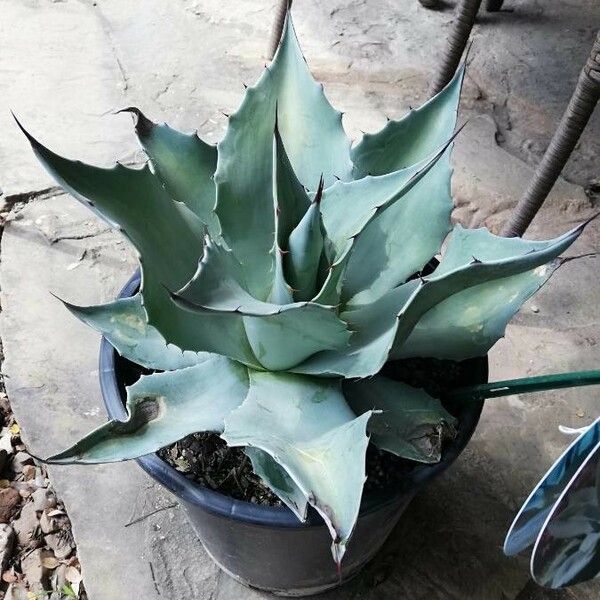
Plant Overview
Often called the Whale's Tongue Agave, this stunning succulent looks like a frozen sea creature rising from the earth. Native to the rugged, high-altitude mountains of Nuevo León, Mexico, it is prized by landscapers for its architectural symmetry and serene, frosty-blue color. Unlike many of its cousins that spread wildly, this agave remains a solitary giant, focusing its energy on one magnificent, solitary crown.
🔍 How to Identify
- 🐋 Leaf Shape: Features uniquely broad, "ovate" leaves that are deeply cupped and concave, mimicking the curve of a whale’s tongue.
- ❄️ Coloration: The foliage has a striking glaucous (powdery) finish, ranging from a pale silver-blue to a cool seafoam green.
- ⚔️ Spines: The leaf margins are lined with small, dark teeth, and each leaf is tipped with a singular, formidable terminal spine.
🏡 In Your Garden
- 🏔️ Cold Resilience: Because it hails from high-elevation habitats, it is significantly more cold-hardy than most desert agaves, making it a favorite for temperate gardens that experience occasional frost.
- 🏜️ The "Wet Feet" Rule: While it is incredibly drought-tolerant, it is sensitive to rot. It requires extremely gritty, well-draining soil to survive winter rains, as it hates sitting in damp earth.
- 🧍 Solitary Growth: This species rarely produces "pups" (offsets). This is a blessing for gardeners who want a low-maintenance focal point that won't aggressively take over the surrounding garden beds.
⚠️ Safety & Toxicity
- 🌵 Physical Hazard: The spines are very sharp and stiff. It is best planted as a "background" beauty, well away from walkways where children, pets, or shins might accidentally collide with it.
- 🧪 Sap Irritant: The sap contains calcium oxalate crystals. If a leaf is broken, the juice can cause a burning sensation or a red, itchy rash on the skin (known as agave dermatitis). Always wear gloves when pruning.
✨ Fun Fact
The Whale’s Tongue is a "monocarpic" plant, meaning it blooms only once at the very end of its life. After 10 to 20 years of growth, it sends up a massive, tree-like flower spike that can reach 15 feet in height, putting on one final, spectacular show before the main plant dies.

Detailed Care Instructions
To grow Agave Ovatifolia, also known as whale's tongue agave, follow these steps:
- Choose a suitable location: Agave Ovatifolia requires full sun to partial shade. Select a location with well-draining soil, as these plants do not tolerate wet feet. If the soil is heavy or clay-based, consider amending it with sand or perlite to improve drainage.
- Prepare the soil: Before planting, loosen the soil in the planting area by digging it with a shovel or garden fork. Remove any weeds or debris, and incorporate organic matter such as compost to enrich the soil.
- Planting: Dig a hole approximately twice the size of the plant's root ball. Carefully remove the agave from its container, being mindful not to damage the roots. Place the plant in the hole and backfill with soil, firmly tamping it down around the root ball.
- Watering: After planting, water the agave thoroughly to settle the soil. Water deeply, but infrequently, allowing the soil to dry out between waterings. Established Agave Ovatifolia plants are very drought-tolerant and can survive with minimal watering.
- Mulching: Apply a layer of organic mulch, such as wood chips or straw, around the base of the plant. Mulching helps to retain moisture, suppress weeds, and regulate soil temperature.
- Maintenance: Agave Ovatifolia generally requires minimal maintenance. However, remove any dead or damaged leaves periodically to maintain the plant's appearance. Be cautious of the spiky leaves, wearing protective gloves if necessary.
- Protection from extreme cold: Agave Ovatifolia is generally hardy in USDA zones 7-11. In colder regions, protect the plant from freezing temperatures by covering it with frost cloth or bringing it indoors during winter.
- Propagation: Agave Ovatifolia can be propagated by collecting and planting the seeds, or by removing the offsets (baby plants) that emerge around the base of mature plants. Allow the offsets to dry for a few days, then plant them in well-draining soil.
By following these steps, you can successfully grow Agave Ovatifolia and enjoy its unique and dramatic appearance in your garden.

Place in a bright room that is sun drenched almost all day. Or directly in a south-facing window.

To properly water this plant, you should wait for the soil to dry out completely before watering it again. This plant prefers well-draining soil, so make sure the pot or location where it's planted has good drainage. When watering, water thoroughly, allowing water to seep out of the drainage holes and empty the saucer underneath. Avoid getting water on the leaves as it can cause damage. In the winter, water sparingly as the plant goes through a dormancy period and does not require as much water.
Apply a balanced fertilizer formulated for succulents and cacti during the plant's active growth period, which typically occurs in spring and summer. Dilute the fertilizer to half strength and apply it to the soil around the base of the plant. Water thoroughly after fertilizing. Avoid fertilizing during the dormant period in fall and winter.
When choosing soil for this particular plant, it is important to consider factors such as drainage, porosity, acidity, and nutrient content. The soil should allow water to drain freely, as the plant is susceptible to root rot if it sits in waterlogged soil. The soil should also be porous, or loose and well-aerated, to avoid compaction and allow for proper root growth. The soil should be slightly acidic, with a pH between 6.0 and 7.0, to provide the appropriate balance of nutrients and minerals. Additionally, the soil should be rich in organic matter and nutrients to support healthy growth and development. A good recommendation would be a mixture of coarse sand, perlite, and organic matter such as compost or peat moss.
Propagation of this plant can be achieved through several methods including seeds, offsets, and stem cuttings.
The easiest and fastest way to propagate the plant is by harvesting offsets that form around the base of the mother plant. These offsets can be carefully removed from the mother plant using a sharp, sterile knife or scissors. It is important to ensure that the offset has established a root system before planting it in well-draining soil. Once planted, the offset should be watered sparingly until it has taken root and begins to grow.
Another method of propagation is by collecting the seeds produced by the mother plant. These seeds can be sown in the spring in well-prepared soil. It is important to water the seeds frequently until they have germinated and established a root and foliage system.
Finally, the plant can also be propagated by stem cuttings. This method involves cutting a section of the stem from the mother plant and allowing it to dry and callus over for several days. Once the stem has callused, it can be planted into soil and watered sparingly until it has taken root and begins to grow.
It is important to note that propagation of this plant requires care and attention to ensure that it is successful. Proper soil, drainage, and watering are crucial for the plant to thrive and grow.
Common pests of the whale's tongue agave include Scale insect, mealybugs. Make a habit of checking your whale's tongue agave frequently for pests so that any infestations can be caught and managed early.








