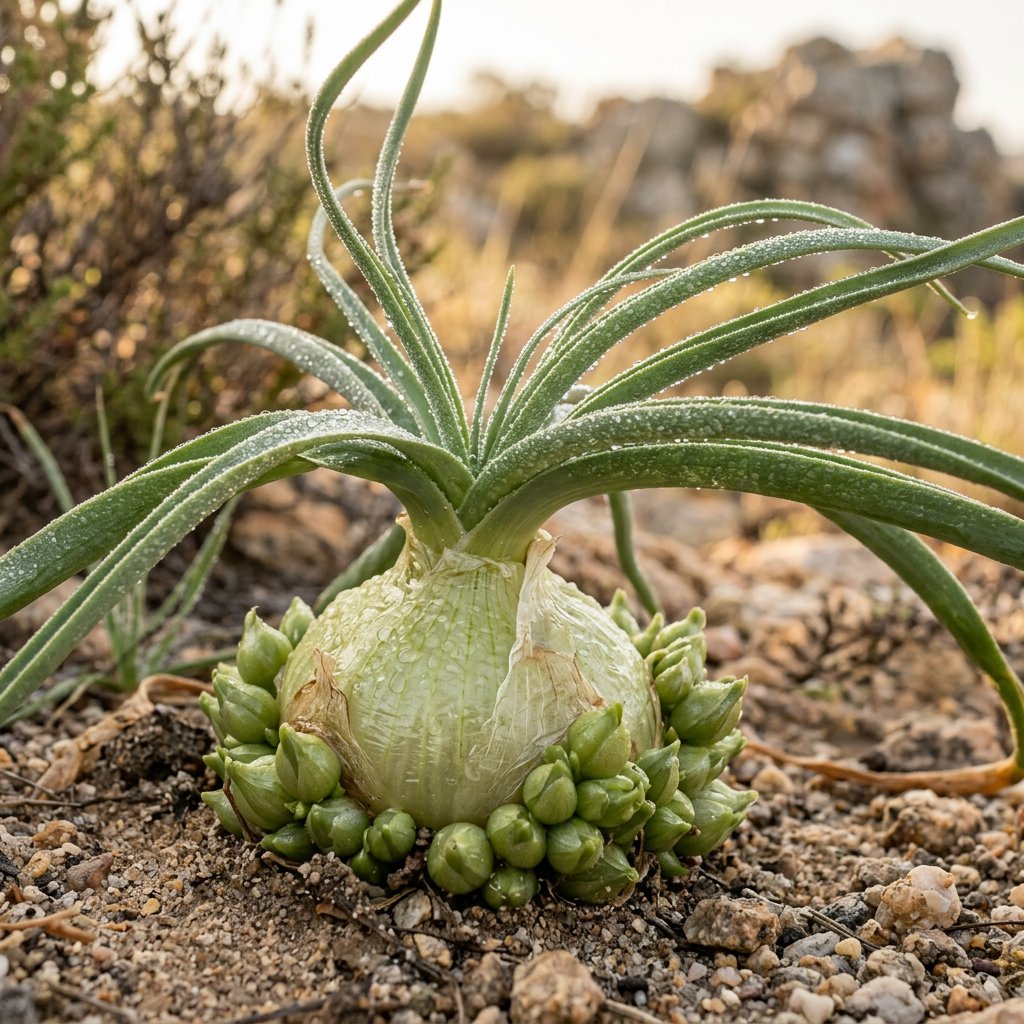
Plant Overview
Commonly known as the "Pregnant Onion" or "False Sea Onion," this South African native is one of the most curious-looking plants you can grow. It earns its nickname from the way it produces "babies" (tiny bulblets) under the translucent, papery skin of its main bulb, making it look perpetually expectant. Despite its name and onion-like appearance, it is a member of the asparagus family and offers a dramatic, arching silhouette for any sunny windowsill.
🔍 How to Identify
- 🟢 The Bulb: A large, smooth, lime-green bulb that grows entirely above the soil surface, looking like a polished stone.
- 👶 The Bulblets: Small, pea-sized bumps visible beneath the "mother" bulb's skin; these eventually break through and can be planted.
- 🍃 The Foliage: Long, strap-like green leaves that are semi-succulent and can grow up to 3 feet long, often trailing gracefully over the sides of a pot.
- 🌸 The Blooms: In spring or summer, it sends up a tall flower spike (up to 5 feet!) topped with small, fragrant white flowers featuring a signature green stripe.
🏡 In Your Garden
- ☀️ Light & Drainage: This plant is a sun-lover but prefers "bright indirect" light to avoid scorching its green bulb. Because it stores so much water in its bulb, it is highly susceptible to rot—always use a gritty, well-draining cactus mix.
- 🌱 Propagation Magic: It is the ultimate "passalong" plant. You can gently peel away the small bulblets once they have their own papery skin and set them on top of moist soil. They root almost effortlessly, making them a favorite for sharing with friends.
- 🪴 Container Choice: It actually prefers being slightly root-bound. Choose a sturdy pot, as the heavy bulb and long leaves can sometimes tip over lightweight plastic containers.
⚠️ Safety & Toxicity
- 🚫 Status: Toxic to humans, cats, and dogs.
- 🧴 Details: The plant contains cardiac glycosides. If ingested, it can cause vomiting and lethargy. Furthermore, the sap contains raphides (calcium oxalate crystals) which can cause skin irritation or a rash. It is best to wear gloves when handling the bulb or "babies" and keep it out of reach of curious pets.
✨ Fun Fact
Despite its name, the "Pregnant Onion" is not an onion at all! While it looks like something you’d find in a kitchen, it is actually more closely related to Hyacinths. In its native habitat, it is often found tucked into rocky crevices, using its exposed bulb to soak up every bit of available sunlight.

Detailed Care Instructions
| Humidity | Normal |
| Lighting | Part Sun |
| Toxicity | Poisonous |
| Difficulty | Medium |
| Temperature | 10°C - 24°C |
| Hardiness Zones | Min 9A |
To grow Albuca bracteata, also known as the "Slime Lily," follow these steps:
- Select a suitable location: Albuca bracteata prefers full sun or partial shade. Choose a spot with well-draining soil, as the plant does not tolerate wet or waterlogged conditions.
- Propagation: Albuca bracteata can be propagated from seeds or bulbs. If starting from seeds, sow them in a well-draining seedling mix and keep them slightly moist. If using bulbs, plant them in the desired location about 3-4 inches deep, with the pointed end facing upwards.
- Watering: During the growing season (spring and summer), water the Albuca bracteata regularly to keep the soil slightly moist. However, avoid overwatering, as it can cause root rot. Reduce watering during the dormant period in winter.
- Fertilizer: Apply a balanced, slow-release fertilizer in early spring to encourage healthy growth. Follow the recommended dosage on the fertilizer packaging.
- Mulching: Cover the soil around the plant with a layer of organic mulch, such as bark chips or compost. This will help retain soil moisture and suppress weed growth.
- Pests and diseases: Albuca bracteata is generally pest-resistant but can occasionally be affected by aphids or mealybugs. Regularly inspect the plant and use organic pest control methods if necessary.
- Pruning: Remove any yellow or withered leaves regularly to maintain a neat appearance and prevent the spread of pests or diseases.
- Dormancy: In colder climates, Albuca bracteata may go dormant in winter. During this period, reduce watering and provide protection from freezing temperatures, either by moving the plant indoors or covering it with a frost cloth.
Remember that Albuca bracteata is a mild-toxic plant, so keep it away from children and pets to avoid ingestion. With proper care and conditions, your Albuca bracteata should grow and thrive.

Place in a window with dappled sun or a spot in the middle of a room. Or directly in a window facing west or east.

To water this plant, it is recommended to first check the soil moisture level by sticking your finger about an inch deep into the soil. If the soil feels dry, it is time to water the plant. Use room temperature water and water the soil directly around the plant, being careful not to get water on the leaves or stem. Allow the water to soak in and drain out of the bottom of the container. It is important not to over-water this plant, as it can lead to root rot and other problems. Only water when needed and make sure the soil is well-draining.
To fertilize the Albuca Bracteata plant, use a balanced fertilizer with a ratio of NPK 10-10-10. Dilute the fertilizer according to the package instructions and apply it to the soil around the plant once a month during the growing season (spring and summer). Be careful not to get any fertilizer on the leaves or bulbs of the plant, as it can cause burning or damage. Water the plant after fertilizing to help distribute the nutrients evenly throughout the soil.
Albuca bracteata, a plant that belongs to the family Asparagaceae, has specific soil requirements. The ideal soil for this plant should be a well-draining mix of sand, perlite and peat moss. The pH level of the soil should be slightly acidic, with a range of 6.0 to 6.5. This plant prefers a rich, nutrient-dense soil with good drainage to prevent waterlogging. The soil should be kept moist but not excessively wet, as too much moisture can lead to root rot. It is recommended to fertilize this plant regularly with a balanced, water-soluble fertilizer during its growing season. The choice of soil can greatly influence the health and growth of the Albuca bracteata plant and should be carefully considered.
Albuca Bracteata can be propagated by several methods, including division, bulb offsets, and seed sowing.
- Division: To propagate the plant through division, gently dig out the adult plant from the soil using a garden fork. Separate the offsets from the adult plant using a sharp knife, ensuring each offset has roots. Plant the separated offsets into individual pots filled with a well-draining potting mix.
- Bulb offsets: Bulb offsets are tiny bulbs that form around the mother bulb of the plant. Wait for the bulb offsets to mature fully before separating them from the mother bulb. Plant the separated bulb offsets into individual pots filled with a well-draining potting mix.
- Seed sowing: Collect the seeds from the mature Albuca Bracteata plant. Sow the seeds in a well-draining potting mix and keep the soil moist. Place the pot in a warm and well-lit area, as the seeds require warmth and light to germinate.
After propagation, the pots should be placed in a bright but indirect light and kept moist, but not overwatered. The soil should have good drainage to prevent root rot. Transplant the young plants, once they have matured, into individual pots or in the garden.








