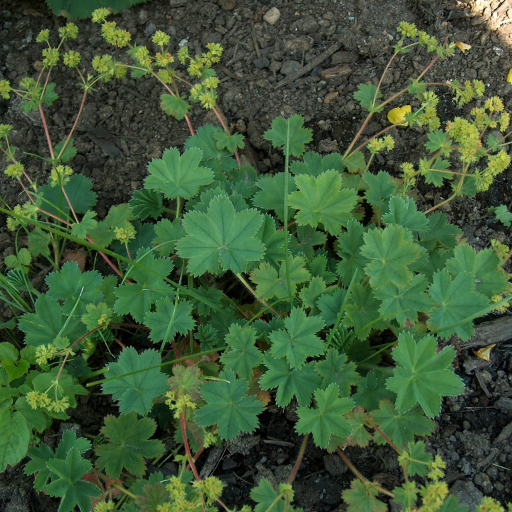
Plant Overview
Known as the Small Lady’s Mantle, Alchemilla glaucescens is like a silver-tinted, miniature version of its more famous garden cousins. Its name is steeped in mystery, and legend says its pleated leaves resemble the folds of a medieval cloak. This hardy perennial is beloved by gardeners for its ethereal foliage and its magical ability to "hold" the morning dew in shimmering droplets.
🔍 How to Identify
- 🍃 The Leaves: Look for small, fan-shaped leaves with 7 to 9 shallow lobes. Unlike other varieties, these have a distinct bluish-grey (glaucous) tint and are covered in a soft, velvety down of fine hairs.
- 🌼 The Flowers: In early summer, the plant erupts in frothy, cloud-like clusters of tiny, star-shaped chartreuse (yellow-green) flowers that seem to float above the foliage.
- 💧 Guttation: This plant is famous for "beading." Because of its unique leaf structure and hairs, water doesn't soak in; instead, it forms perfect, spherical diamonds of dew or rain in the center of the leaf.
🏡 In Your Garden
- 🌱 Soil & Drainage: This species is a specialist for well-drained, lime-rich (alkaline) soils. While it is incredibly hardy, it thrives best in rock gardens or at the edges of stony paths where it won't be crowded by taller, thirstier plants.
- 🌿 Growth Habit: It has a polite, mounding habit and is much less aggressive than the common Alchemilla mollis. It is an excellent choice for "softening" hard edges or filling in gaps between stepping stones without taking over the entire garden.
⚠️ Safety & Toxicity
- ✅ Safe for All: Alchemilla glaucescens is considered non-toxic to humans, dogs, and cats. It is a very "friendly" plant to have in a family backyard.
- 🍵 Historical Use: Historically, members of this genus were used in traditional herbal teas. However, you should never consume garden plants unless you are 100% certain of the identification and the soil's purity from chemicals.
✨ Fun Fact
🧪 The Alchemist's Secret: The name Alchemilla comes from the word "alchemy." Medieval alchemists believed the dew collected from these leaves was the purest form of water on Earth. They gathered these "heavenly droplets" to use in their mystical experiments to turn base metals into gold!

Detailed Care Instructions
To grow Alchemilla Glaucescens plant, follow these steps:
- Planting: Choose a location with well-draining soil and partial shade. Dig a hole slightly larger than the rootball of the plant.
- Soil preparation: Enrich the soil by adding compost or organic matter to improve drainage and fertility. Mix it well with the native soil.
- Transplanting: Carefully remove the plant from its nursery container and gently loosen the roots. Place the plant in the prepared hole and backfill with soil, making sure not to bury the crown of the plant.
- Watering: Water the plant deeply after planting to settle the soil and ensure good root contact. Afterward, keep the soil consistently moist but not waterlogged. Alchemilla Glaucescens prefers slightly moist soil.
- Mulch: Apply a layer of organic mulch, like wood chips or straw, around the plant to retain moisture, prevent weed growth, and regulate the soil temperature.
- Maintenance: Keep the area around the plant free of weeds and regularly water it during dry spells. Avoid excessive fertilization, as Alchemilla Glaucescens is generally not a heavy feeder.
- Propagation: Alchemilla Glaucescens can be propagated from seeds or division. Seeds should be sown in a well-prepared seedbed in early spring. To divide the plant, carefully separate the offsets or new growth from the main plant in early spring or fall.
- Pruning: Deadheading spent flowers can encourage the growth of new blooms. The plant may also benefit from a light trimming in early spring to remove any damaged or leggy growth.
- Protection: If your area experiences severe cold or frost, provide winter protection by covering the plant with a layer of mulch or using a plant cover.
By following these steps and providing the proper care and conditions, you can successfully grow Alchemilla Glaucescens plant.

Place in a window with dappled sun or a spot in the middle of a room. Or directly in a window facing west or east.

To properly water this plant, it is important to first assess the soil moisture level. One way to do this is by sticking your finger about an inch into the soil and feeling for any moisture. If the soil feels dry to the touch, it is time to water.
When watering, it is best to do so deeply and thoroughly, allowing the water to fully penetrate the soil. It is important to avoid getting the foliage wet, as this can lead to disease or damage.
This plant prefers moist but well-drained soil, so it is important not to overwater or allow standing water around the roots. As a general rule, it is better to underwater slightly rather than overwater.
During periods of high heat or drought, it may be necessary to water more frequently to ensure the plant stays healthy and hydrated.
The best time to carry out fertilization for this plant is during the spring season. Make use of a slow-release fertilizer that is safe for plants, and apply it in small amounts around the plant's base. Avoid applying too close to the stem to prevent burning. Water the plant immediately after fertilization to help the nutrients get to the roots quickly. Repeat the process once every two to three weeks during the growing season, and reduce fertilization during the winter season.
Alchemilla Glaucescens plant prefers well-draining soil with a neutral to slightly acidic pH level. It grows well in soil that is rich in organic matter, such as compost or aged manure. The soil should be kept consistently moist, but not waterlogged, to prevent root rot. A mixture of sand, peat moss, and perlite can also be added to improve drainage. It is also important to ensure that the soil is aerated and that the roots have room to grow. Fertilizer can be applied sparingly in the growing season, as the plant is not a heavy feeder.
The propagation process for this plant involves taking stem cuttings from a mature plant, preferably during its active growing season. The cuttings should be about 4 to 6 inches long and should have at least 2 to 3 sets of leaves.
The stems should be cut just below a node, and any leaves on the lower part of the stem should be removed. The cuttings can then be dipped in rooting hormone to encourage root development.
The cuttings should be planted in a pot filled with moist potting soil and placed in a warm, bright location. The soil should be kept moist but not waterlogged, and the cuttings should be misted regularly to keep the humidity levels high.
After a few weeks, roots should start to develop, and the cuttings can be transplanted to larger pots or planted directly into the ground in a suitable location. It is important to keep the young plants well-watered and protected from harsh weather conditions during their first few months of growth.








