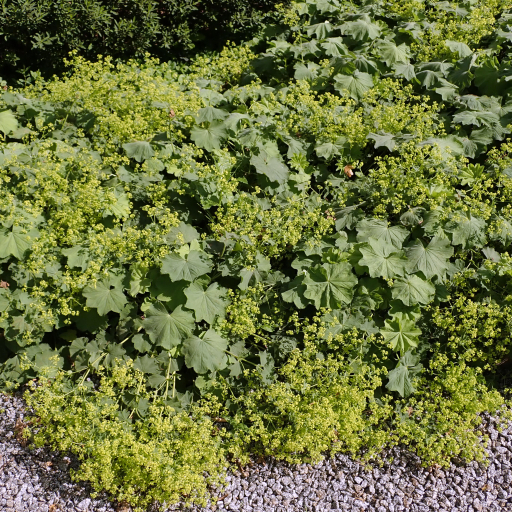
Plant Overview
Often called the Intermediate Lady’s Mantle, this charming perennial is a staple of cottage gardens and woodland edges across Europe. It earned its name from its soft, pleated leaves that resemble a medieval lady’s cloak, and it is famous for the way it "magically" collects morning dew in its center. Historically, this plant was beloved by alchemists who believed the crystalline water gathered on its leaves was the purest form of water on Earth.
🔍 How to Identify
- 🍃 The Leaf Shape: Features broad, fan-shaped leaves with 9 to 11 shallow, scalloped lobes. Each leaf is finely serrated along the edges, giving it a delicate, ruffled appearance.
- ☁️ The Texture: The leaves and stems are covered in a fine layer of soft, velvety hairs. This "fuzz" is what allows water droplets to bead up and roll around like mercury rather than soaking in.
- ✨ The Flowers: In early summer, it produces frothy, airy clusters of tiny, star-shaped flowers. They are a unique chartreuse (yellow-green) color that complements almost any neighboring bloom.
🏡 In Your Garden
- 💧 The "Dew Drop" Effect: This plant is best placed near the front of a border or along a path where you can appreciate its water-repelling properties. It is a moisture-lover and thrives in soil that stays consistently damp but not waterlogged.
- 🌱 Growth & Spreading: While it is a polite clumper, it can be a prolific self-seeder. If you want to keep it from taking over your garden, simply shear off the flower heads once they start to turn brown in late summer.
- ✂️ Low Maintenance: If the leaves start to look tired or scorched in the summer heat, you can cut the entire plant back to the ground; it will quickly reward you with a fresh flush of soft, new foliage.
⚠️ Safety & Toxicity
- ✅ Status: Generally considered non-toxic and safe for home gardens.
- 🐾 Pets & Kids: There are no known toxic effects for cats, dogs, or horses. In fact, various species of Alchemilla have a long history of use in traditional herbal medicine for humans, though you should never ingest garden plants without professional guidance.
✨ Fun Fact
The name Alchemilla is derived from the Arabic word "Al-kemelych" (alchemy). Alchemists believed the "celestial water" found on the leaves was a key ingredient needed to turn base metals into gold or to create the "Philosopher's Stone."

Detailed Care Instructions
To grow Alchemilla xanthochlora, also known as the Lady's Mantle plant, you can follow these steps:
- Choose a suitable location: Lady's Mantle plants prefer a partially shaded area with well-draining soil. It can tolerate full sun but may require more water in such conditions.
- Prepare the soil: Loosen the soil in the planting area and amend it with organic matter, like compost, to improve drainage and fertility.
- Planting: Dig a hole slightly larger than the root ball of the plant. Place the plant in the hole and backfill it with soil, firming it gently around the roots. Make sure the crown (the area where the stems meet the roots) is level with the soil surface.
- Watering: Lady's Mantle plants prefer consistently moist soil. Water the plant deeply after planting and regularly thereafter, keeping the soil moist but not waterlogged.
- Mulching: Apply a layer of organic mulch around the base of the plant to help retain moisture, suppress weeds, and regulate soil temperature.
- Maintenance: Lady's Mantle plants don't require much maintenance. However, to promote healthy growth, you can remove spent flowers (known as deadheading) to encourage new blooms. Additionally, if the plant becomes too dense, dividing it every few years can help rejuvenate it.
- Fertilization: Lady's Mantle plants generally don't require heavy fertilization. However, if the soil is poor, you can feed them with a balanced, slow-release fertilizer in early spring.
- Pest and disease control: Lady's Mantle plants are generally resistant to pests and diseases. However, you should monitor for any common issues such as aphids, slugs, or powdery mildew, and take appropriate measures if necessary.
By following these steps, you should be able to successfully grow and enjoy your Alchemilla xanthochlora plant.

Place in a bright room that is sun drenched almost all day. Or directly in a south-facing window.

To water the plant in question, it is important to first ensure that the soil is dry to the touch before watering. When watering, it is best to use room temperature water and to water the soil around the plant rather than the leaves or flowers. Make sure to water thoroughly, but avoid overwatering as this can lead to root rot. It is also important to allow the soil to dry slightly between watering to avoid waterlogged soil. Additionally, it is recommended to water early in the day to allow the plant to dry off before cooler temperatures at night.
For optimal growth, apply a balanced fertilizer to the soil around the plant in early spring, just as new growth begins. Repeat the application every 4-6 weeks throughout the growing season. Water the plant thoroughly after fertilizing to encourage absorption. Avoid over-fertilizing, as it can lead to excessive growth and poor plant health. Always follow the instructions on the fertilizer label and wear gloves and protective clothing as needed when handling chemicals.
Alchemilla Xanthochlora plant grows best in well-draining soil with a neutral pH level. It prefers soil that is rich in organic matter and nutrients. A mixture of peat moss, perlite, and coarse sand is recommended for optimal growth. The soil should be kept moist but not waterlogged, as the plant is susceptible to root rot. It is also recommended to avoid using heavy clay soils, as they can hold too much moisture and lead to plant stress or death. Adding a layer of mulch to the soil surface can help retain moisture and regulate soil temperature.
Alchemilla Xanthochlora plant can be propagated through division or by taking cuttings. For division, select a well-established plant and carefully dig it up, ensuring to keep the roots intact. Divide the plant into smaller sections, each with a healthy amount of roots, using a sharp, clean knife. Replant the divided sections in well-draining soil and keep them moist until they become established.
For cuttings, select a healthy stem with a few leaves and take a cutting that is approximately 5-6 inches long. Remove the lower leaves from the stem and dip the cutting into rooting hormone. Plant the cutting into a pot filled with moist soil and cover with a plastic bag to create a humid environment. Keep the soil moist and in a bright, indirect light. Once the cutting has developed roots, it can be transplanted into a larger pot or the garden.
It is important to note that the propagation method chosen may vary depending on the plant’s growth habit and individual needs. Observation and research on the specific plant will be critical to its successful propagation.








