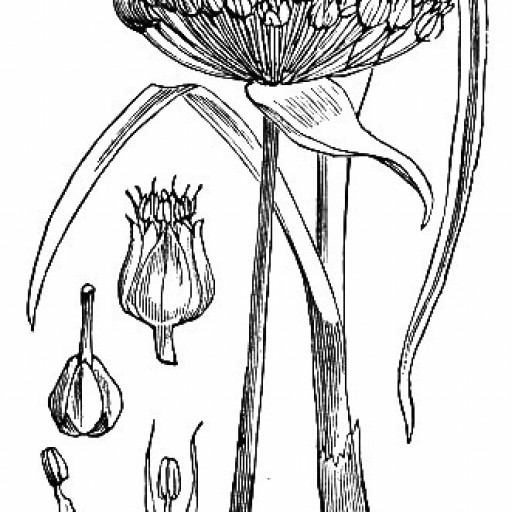
Plant Overview
Commonly known as the Wild Leek or Elephant Garlic, Allium ampeloprasum is the impressive ancestor of many kitchen staples we know today. Native to the Mediterranean and Middle East, this plant has been a traveler’s companion for millennia, following ancient trade routes across Europe. Whether it is producing giant garlic-like bulbs or tall, architectural flowers, it is a versatile giant in the world of onions.
🔍 How to Identify
- 🍃 The Foliage: Unlike the hollow straws of common chives, these leaves are flat, broad, and slightly keeled (V-shaped), similar to a standard leek but much larger.
- 🌸 The Flower Head: It produces a striking, spherical "umbel" that can reach the size of a grapefruit. These are packed with hundreds of tiny star-shaped flowers ranging from pale pink to deep purple.
- 📏 The Stature: This is a skyscraper in the garden; the flowering stalk can easily reach heights of 3 to 6 feet, towering over other spring perennials.
🏡 In Your Garden
- 🌱 Planting Nuance: While it is often grown as "Elephant Garlic," it is technically a leek. It produces large "corms" or cloves that prefer deep, loose soil. If the soil is too heavy or waterlogged, the bulb may rot before it has a chance to shine.
- ☀️ Sun & Space: It craves full sun to develop that massive flower head. Give it plenty of elbow room; because of its height, it can shade out smaller neighboring plants if you aren't careful.
- 🔄 Naturalizing: In many regions, it is a hardy perennial that will return year after year, slowly forming clumps that can be divided and shared with friends.
⚠️ Safety & Toxicity
- 🐾 Pet Warning: Like all members of the Allium family (onions, garlic, chives), this plant is toxic to dogs and cats. Ingesting it can cause damage to their red blood cells, leading to anemia.
- 🍽️ Human Consumption: It is perfectly edible for humans and has a milder, more onion-like flavor than true garlic. However, always ensure a 100% positive identification before foraging, as some poisonous "look-alikes" like Death Camas exist in the wild.
✨ Fun Fact
Despite its name and look, Elephant Garlic is more closely related to the common leek than to "true" garlic (Allium sativum). This is why its flavor is much more subtle and "buttery" when roasted!

Detailed Care Instructions
To grow Allium Ampeloprasum, commonly known as wild leek or elephant garlic, follow these steps:
- Choose a suitable location: The plant prefers well-draining soil with full sunlight exposure. Make sure the area has good air circulation.
- Prepare the soil: Loosen the soil using a garden fork or tiller. Remove any weeds or grasses and add organic matter like compost to improve soil fertility.
- Planting time: Allium Ampeloprasum is usually planted in the fall, between September and November, or in early spring. The plant requires a chilling period for proper bulb development.
- Planting depth: Plant the bulbs 3 to 4 inches (7.5 to 10 cm) deep and around 6 to 8 inches (15 to 20 cm) apart. Plant them with the pointed ends facing upwards.
- Watering: Water the newly planted bulbs thoroughly just after planting. Afterward, water regularly, aiming for moist but not soggy soil. Avoid overwatering, as it can cause root rot.
- Fertilization: Apply a balanced slow-release fertilizer during planting or use organic fertilizers like manure or compost. Repeat applications every 4 to 6 weeks during the growing season.
- Mulching: Apply a layer of organic mulch, such as straw or leaves, around the plants to help retain moisture and suppress weed growth.
- Regular maintenance: Remove weeds regularly, as they can compete for nutrients and water. Monitor the soil moisture and water whenever it appears dry.
- Harvesting: Allium Ampeloprasum can be harvested at various stages. The leaves can be harvested when they reach about 8 inches (20 cm) in length, similar to chives. The bulbs are generally harvested in late summer when the leaves have started to yellow and wither.
- Storage: After harvesting the bulbs, allow them to dry in a well-ventilated, shaded area for about two weeks. Once fully dried, store them in a cool, dark, and dry place.
Remember to research the specific growing requirements for the variety of Allium Ampeloprasum you have, as different cultivars might have slightly different needs.

Place in a bright room that is sun drenched almost all day. Or directly in a south-facing window.

The Allium Ampeloprasum plant should be watered regularly, ensuring that the soil is kept consistently moist. However, it is important to avoid overwatering, as this can lead to root rot. The plant prefers well-draining soil and should not be allowed to sit in standing water. When watering, it is best to water the soil directly rather than the leaves, to avoid promoting disease. Additionally, it is recommended to water in the morning or evening when the sun is less intense, to prevent the plant from experiencing heat stress.
To fertilize this plant, you should use a balanced fertilizer in the spring when new growth starts to emerge. Be careful not to over-fertilize, as this can lead to excessive foliage growth and reduced flower production. Apply fertilizer according to the package instructions and water thoroughly after the application. Consider using organic fertilizers such as compost or well-aged manure for a more natural approach. In addition, fertilize again in late summer or early fall to help the plant prepare for the winter months.
When planting Allium Ampeloprasum, it is important to use a soil that is well-draining, but also has good water retention. A sandy loam soil is ideal, as it allows for both drainage and moisture retention. It is also important to ensure that the soil is rich in nutrients, so adding compost or fertilizer to the soil before planting is recommended. Additionally, Allium Ampeloprasum prefers a soil with a pH level between 6.5 and 7.5, so it can be beneficial to test the soil pH before planting and adjust it if necessary. Finally, it is important to ensure that the soil is weed-free and has good aeration for optimal root growth and overall health of the plant.
To propagate this plant, one can start by collecting the seeds from mature plants in the fall. The seeds should be stored in a cool, dry place until the following spring. In the spring, the seeds can be sown directly into the ground or started indoors and transplanted later.
To transplant, one should choose a location with well-draining soil and full sun exposure. The soil should be amended with compost or other organic matter. The seeds should be planted at a depth of about ¼ inch and spaced about 6 inches apart.
Once the plants have established themselves, they can be divided in the fall or spring. To divide, carefully dig up the plant and separate the bulbs. Plant the new bulbs at the same depth as the original plant.
The plant can also be propagated by stem cuttings. Take stem cuttings from healthy, mature plants in the spring or summer. Cuttings should be about 4 inches long and include at least one node. Remove the lower leaves and dip the cut end in rooting hormone. Plant the cutting in damp soil and keep it moist until roots have formed.








