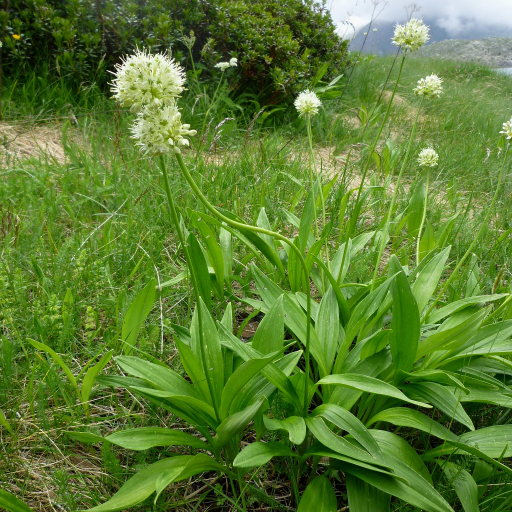
Plant Overview
Known to history as the "Victory Onion," Allium victorialis is a rugged mountain dweller found across the alpine reaches of Europe and Asia. Unlike its slender-leaved supermarket cousins, this plant sports broad, lush foliage that often gets it mistaken for a woodland lily. In the Middle Ages, it was prized by miners and soldiers who wore its fibrous root husks as an "invincible" amulet to protect them from wounds and evil spirits.
🔍 How to Identify
- 🍃 The Foliage: Distinctive for an onion, the leaves are broad, elliptical, and glossy, resembling the leaves of a Lily of the Valley rather than typical chive spikes.
- 🌸 The Bloom: In early summer, it produces a globose (spherical) cluster of star-shaped flowers that range from creamy white to a pale, greenish-yellow.
- 🧥 The "Victory" Tunic: The base of the plant is wrapped in a thick, net-like fibrous skin (tunic) that protects the bulb, a key identifying feature that distinguishes it from poisonous look-alikes.
🏡 In Your Garden
- 🏔️ Alpine Aspirations: Because it originates in cool, moist mountain forests, this plant thrives in partial shade and rich, humusy soil. It dislikes the sweltering heat of direct midday sun, which can scorch its broad leaves.
- ⏳ Slow and Steady: Unlike many invasive garden onions, the Victory Onion is a slow grower. It takes several years to establish a clump, so it is best left undisturbed once planted; it deeply resents being moved due to its long, persistent root system.
⚠️ Safety & Toxicity
- 🐾 Pet Warning: While highly prized as a gourmet wild edible for humans (similar to ramps), it contains thiosulfates which are toxic to dogs and cats. Keep it out of reach of curious paws.
- 🚫 The Deadly Double: CRITICAL WARNING. Before flowering, the leaves look remarkably similar to the Lily of the Valley (Convallaria majalis) and Autumn Crocus, both of which are deadly poisonous. Always crush a leaf first—if it doesn't smell strongly of garlic or onion, do not touch it.
✨ Fun Fact
The name "Victorialis" doesn't just come from its protective folklore; it refers to the "Victory" roots which were once sold in markets as charms to protect the wearer against the "alp" (a nightmare-inducing mountain demon) in Germanic mythology.

Detailed Care Instructions
To grow Allium Victorialis plants, also known as alpine leeks or broad-leaved garlic, follow these steps:
- Select a suitable location: Allium Victorialis prefers a shady or partially shaded spot with moist, well-draining soil. It thrives in cool climates.
- Prepare the soil: Mix in compost or well-rotted manure to improve soil fertility and drainage. Remove any weeds or rocks from the planting area.
- Planting: Allium Victorialis can be grown from seed, bulb divisions, or plant starts. Plant bulbs or divisions in early spring or early fall, about 6 inches apart and 1 to 2 inches deep. Ensure the pointed end of the bulb is facing upwards. If starting from seeds, sow them in prepared soil and cover lightly.
- Watering: Keep the soil consistently moist but avoid overwatering. Aim to keep the soil slightly damp but not waterlogged. Deep watering once a week should be sufficient, but adjust based on the weather conditions and moisture retention of your soil.
- Mulching: Apply a layer of organic mulch around the plants to help retain soil moisture, suppress weed growth, and maintain a cool root environment.
- Fertilizing: Allium Victorialis generally does not require frequent fertilization. However, a light application of a balanced organic fertilizer in early spring can be beneficial.
- Weed control: Regularly check for and remove any weeds that may compete with the plants for nutrients and water.
- Harvesting: Allium Victorialis foliage can be harvested in spring, when the leaves are tender and young. Cut a few leaves close to the base and leave the plant to continue growing. The edible leaves have a mild garlic flavor.
- Propagation: Allow some plants to flower and form seeds. The seeds are small and can be collected for future propagation. Alternatively, you can divide established clumps every few years to create new plants.
- Winter care: Allium Victorialis is hardy and can tolerate cold temperatures. Mulch around the plants to protect them during harsh winters.
Remember to check your local gardening guidelines and if the climate in your region suits the requirements of Allium Victorialis.

Place in a bright room that is sun drenched almost all day. Or directly in a south-facing window.

To water this plant, it is important to ensure that the soil is moist but not waterlogged. This can be achieved by watering deeply and thoroughly, allowing the water to penetrate the soil before stopping. It is important to avoid getting water directly on the leaves or flowers of the plant, as this can lead to fungal diseases. Additionally, it is best to water in the morning or evening when the sun is not as strong, as this will prevent the water from evaporating too quickly. Finally, it is important to monitor the soil moisture levels regularly to ensure that the plant is getting enough water and adjust watering frequency as needed.
For optimal growth, apply a slow-release granular fertilizer to the soil around the base of the plant in early spring. Repeat the application once every two months until late summer. Always follow the recommended dosage on the fertilizer packaging. Additionally, side-dress the plant with a nitrogen-rich organic fertilizer during the growing season. Avoid fertilizing after late summer to prevent the plant from allocating its energy towards foliage growth instead of bulb development.
For optimal growth and health of this plant, it is recommended to use a well-draining soil with a neutral to slightly acidic pH range. The soil should be rich in nutrients, particularly nitrogen and phosphorus, to support the plant's growth and development. Ideally, the soil should also be loose and loamy in texture, allowing for good aeration and optimal root development. The plant prefers moist soil conditions, but it is important to ensure that the soil is not waterlogged or excessively wet, as this can lead to root rot and other fungal diseases. To enhance soil fertility and improve plant health, it is also advisable to add organic matter, such as compost or well-rotted manure, to the soil prior to planting.
To propagate this plant, you will need to carefully dig up the rhizomes in the dormant season and carefully separate them. The rhizomes should be planted in well-draining, humus-rich soil, with the tops of the rhizomes level with the soil surface. Water regularly, keeping the soil consistently moist. Once the plants have established, they can be divided and replanted every few years to maintain vigor. It is important to avoid damaging the roots when dividing the plants, as this can lead to stunted growth and decreased yields.








