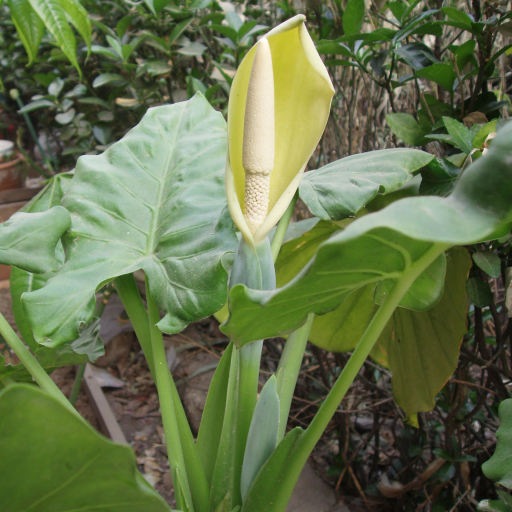
Plant Overview
Known as the "Giant Taro" or the "Upright Elephant Ear," this plant is the undisputed king of the tropical garden. With leaves that can grow large enough to act as natural umbrellas, it creates an instant jungle vibe in any space. In many Southeast Asian cultures, it is viewed as a symbol of prosperity and resilience because of its rapid, towering growth and ability to dominate its environment.
🔍 How to Identify
- 🍃 Stately Leaves: Features massive, heart-shaped (cordate) leaves that point boldly toward the sky, unlike its cousin the Colocasia, whose leaves typically droop downward.
- 📏 Thick Petioles: The leaves are supported by incredibly thick, succulent-like stalks that emerge from a central woody base, or "corm."
- 💚 Prominent Veining: The foliage is a vibrant, glossy green with deeply recessed, pale veins that give the surface a striking, ribbed texture.
🏡 In Your Garden
- 💧 The Transpiration Queen: Because of the sheer surface area of its leaves, this plant "breathes" out a lot of moisture. It craves high humidity and consistent watering but requires a well-draining mix to prevent its sensitive roots from rotting.
- ☀️ Light Balancing Act: While it looks like a sun-lover, the Giant Taro actually prefers "bright-indirect" light. Direct, harsh afternoon sun can bleach or scorch those magnificent green sails.
- 🥣 Heavy Feeder: Think of this plant as an Olympic athlete; it requires a significant amount of nutrients (fertilizer) during the spring and summer to fuel its massive leaf production.
⚠️ Safety & Toxicity
- 🚫 Toxicity Status: Toxic to humans and pets.
- 🐾 The Danger: The entire plant contains calcium oxalate crystals, which act like tiny needles. If any part is chewed or swallowed, it causes intense burning and swelling of the mouth, tongue, and throat.
- 🧤 Sap Sensitivity: The "milk" or sap can cause skin irritation or "Alocasia itch." It is always best to wear gloves when pruning or propagating this giant.
✨ Fun Fact
In its native tropical habitats, the leaves of the Alocasia macrorrhiza are so large and water-repellent that they are frequently used by travelers as emergency umbrellas during sudden monsoon rains!

Detailed Care Instructions
Alocasia stingray are large Alocasias that can grow up to 15 feet tall in their native environment! Don’t worry though - they usually top out at around 3 feet tall when grown indoors.
Can Alocasia stingray grow in water?
In general, Alocasias grow well in water for short periods of time. In fact, moving your plant to water can be a great way to revive an Alocasia that is struggling in soil. However, it is usually best to move your plant back into soil eventually as water cannot provide it with the nutrients that it requires long-term.
Should I mist my Alocasia stingray?
Misting houseplants is sometimes recommended as a way to increase humidity around the plant. However, misting the plant doesn’t actually help to increase humidity in the long term, and many plants don’t benefit from their leaves being consistently wet. Placing a small humidifier near your Alocasia stingray or growing it in a naturally humid room in your home are better ways to provide it with the humidity it craves.
| Humidity | Normal |
| Lighting | Part Sun |
| Difficulty | Medium |
| Temperature | 18°C - 29°C |
| Hardiness Zones | 9 - 12 |

Place in a window with dappled sun or a spot in the middle of a room. Or directly in a window facing west or east.

The presence of a dry surface layer of soil does not indicate that the plant requires water. Instead, stick your finger 1-2" (3-5 cm) deep in the soil to feel dampness or moisture content. If the soil seems dry, it's time to water your greens. If the soil is still moist, however, it is better not to water your plant and instead wait a day or two. Overwatering or waterlogging raises the risk of root rot. So if the soil takes longer than a week to dry, check the light conditions because it's likely that the plant isn't getting enough light. It's fine if the upper layer of soil is dry between waterings, but the deeper soil layer should always have some moisture.
These plant needs regular fertilizing during growing seasons. Fertilizing your plants in dormant state during the winter, might result in scorching or browning of the leaf tips. If mature plants display signs of nutrient insufficiency, fertilizer administration is necessary to restore the plant to its previous state.
You may use All Purpose Plant Food or Green Plant Food for your Giant Taro
Common pests of the giant taro include Mealybugs, spider mites, fungus gnats, aphids, thrips. Make a habit of checking your giant taro frequently for pests so that any infestations can be caught and managed early.








