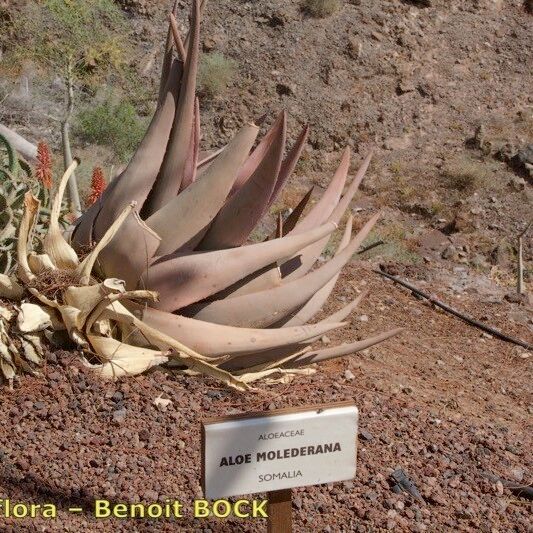
Plant Overview
Discovered in the rugged mountains of Somaliland, the Aloe molederana is a rare and striking succulent often referred to as the "Moledera Aloe." It is a true survivor, evolving to thrive in rocky crevices where other plants might wither. Because it is endemic to a very specific geographic range, owning one is like keeping a living piece of Somali botanical history in your collection.
🔍 How to Identify
- 🌵 The Rosette: It features thick, fleshy leaves that grow in a dense, stemless rosette, often reaching a diameter of about 15–20 inches.
- 🎨 Leaf Color: The foliage is a distinctive grayish-green, sometimes taking on a bronze or reddish tint when exposed to intense "stress" sunlight.
- 🦷 Marginal Teeth: The leaf edges are lined with firm, sharp, reddish-brown teeth that serve as a natural defense against thirsty herbivores.
- 🏮 The Bloom: When it flowers, it sends up a branched stalk topped with cylindrical, coral-red or orange flowers that are highly attractive to pollinators.
🏡 In Your Garden
- 🪨 Rocky Roots: In its native habitat, it grows among limestone rocks. To mimic this, use a very gritty, mineral-heavy soil mix with plenty of pumice or perlite. It hates "wet feet" and will quickly suffer from root rot if kept in standard potting soil.
- ☀️ Sun Seeker: This Aloe craves bright, direct light. While it is incredibly drought-tolerant, it appreciates a deep watering once the soil is completely dry, followed by a long period of neglect.
- 🌬️ Fresh Air: It thrives in breezy environments. If kept indoors, ensure it isn't tucked away in a humid corner; it prefers the dry, circulating air of a sunny windowsill or a well-ventilated patio.
⚠️ Safety & Toxicity
- 🐾 Pet Warning: Like many members of the Aloe family, Aloe molederana contains saponins and anthraquinones. If ingested by cats or dogs, it can cause vomiting, diarrhea, and lethargy.
- 👶 Human Safety: While the inner gel is generally considered non-toxic to touch, the sharp marginal teeth can easily scratch curious hands. It is best placed out of reach of small children.
✨ Fun Fact
The Aloe molederana is so localized that it is only found in a tiny area of the Moledera Mountains. Because its wild population is so small, it is considered a high-priority species for succulent conservationists!

Detailed Care Instructions








