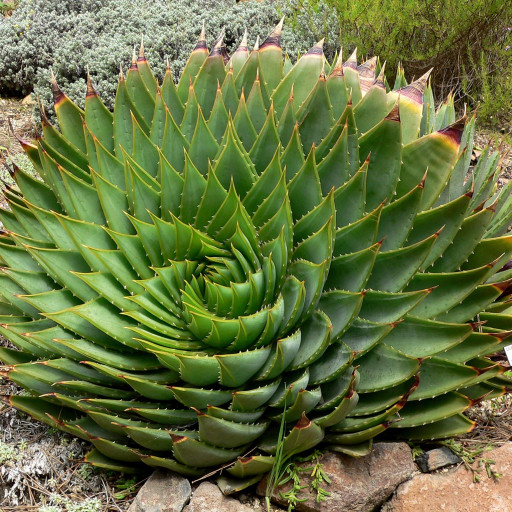
Plant Overview
The "Living Fibonacci" is a botanical masterpiece, famous for its perfectly symmetrical, clockwise or counter-clockwise spiral. Native to the high, basaltic peaks of the Maloti Mountains in Lesotho, it thrives in cool, rocky altitudes where most succulents would struggle. It is highly prized by collectors for its hypnotic geometry and its status as a protected mountain treasure.
🔍 How to Identify
- 🌀 The Spiral: Adult plants develop exactly five distinct ranks of leaves that twist into a tight, mathematical spiral.
- 📐 Leaf Structure: The leaves are fleshy, triangular, and gray-green, often ending in a sharp, purple-tinged tip with small teeth along the margins.
- 🌱 Solitary Growth: Unlike many other aloes that form clumps, the Spiral Aloe usually grows as a single, large rosette, making its geometric form even more striking.
🏡 In Your Garden
- 🏔️ Mountain Origins: Because it lives in the mountains, this aloe hates "wet feet" and stagnant, humid air. It requires extremely gritty, well-draining soil—think crushed rock and lava rather than standard potting mix.
- 🌡️ Temperature Needs: This is one of the few succulents that actually prefers cool nights and can tolerate light frost or snow. However, it struggles in extreme desert heat; if the roots get too hot, the plant can "collapse" quickly.
- 💧 Watering Nuance: It needs more frequent watering than a typical desert aloe, but the water must move through the soil rapidly. It loves the feeling of a mountain rainstorm followed by a drying breeze.
⚠️ Safety & Toxicity
- 🐾 Mildly Toxic: Like many species in the Aloe genus, the leaves contain saponins and anthraquinones. If ingested by cats or dogs, it can cause vomiting, lethargy, or diarrhea.
- 🌵 Prickly Tips: The leaf tips are quite sharp and stiff. It is best to keep the plant away from narrow walkways where children or pets might accidentally brush against it.
✨ Fun Fact
Every Aloe polyphylla is "right-handed" or "left-handed." They will spiral either clockwise or counter-clockwise, and it is impossible to tell which direction a seedling will choose until it has grown at least 20 leaves!

Detailed Care Instructions
| Color | Pink, Orange |
| Soil Ph | Acidic |
| Humidity | Dry |
| Lighting | Full Sun |
| Toxicity | Toxic |
| Soil Type | Sandy, Well-Drained |
| Bloom Time | Spring, Summer |
| Difficulty | Medium |
| Plant Type | Succulent |
| Mature Size | 12 In. Tall, 24 In. Wide |
| Native Area | Africa |
| Temperature | 25°C - 32°C |
| Sun Exposure | Full, Partial |
| Hardiness Zones | 7-9 |
To successfully grow Aloe polyphylla, also known as the Spiral Aloe, follow these steps:
- Obtain a healthy plant: Purchase an Aloe polyphylla plant from a reputable nursery or online seller. Make sure the plant has several healthy, spiraling leaves.
- Select an appropriate location: Aloe polyphylla prefers a sunny location with partial shade, especially during the hottest part of the day. It is best suited for USDA hardiness zones 7-11.
- Soil requirements: Soil should be well-draining and slightly acidic. A mix of cactus or succulent potting soil with perlite or sand can provide adequate drainage.
- Planting: Choose a pot size that allows for at least a couple of inches of extra space around the base of the plant. Fill the pot with the prepared soil and gently place the plant in the center. Ensure the plant is stable and upright.
- Watering: Water the plant thoroughly after potting and then allow the soil to dry out before watering again. Aloe polyphylla is drought-tolerant and prefers infrequent watering. Overwatering can lead to root rot, so be cautious not to overwater.
- Temperature: Maintain a temperature range of around 60-80°F (15-27°C) for optimal growth. Protect the plant from extreme cold during winter months, as it is susceptible to frost damage.
- Fertilization: Apply a balanced, water-soluble fertilizer with a ratio of 10-10-10 or 14-14-14 at half strength once per month during the growing season (spring and summer). No fertilization is required during winter.
- Propagation: Aloe polyphylla can be difficult to propagate from seeds. It is recommended to propagate through offsets (pups) produced by the parent plant. Gently separate the offsets, allow them to callous for a few days, then plant them in well-draining soil.
- Rotating the plant: To maintain the beautiful spiral shape of the leaves, rotate the plant a quarter turn every few weeks to ensure even sunlight exposure.
- Pest and disease control: Aloe polyphylla is generally resilient to pests and diseases. However, inspect the plant regularly for common succulent pests like mealybugs or scale insects. If detected, remove them manually or use a mild insecticide or beneficial insects.
With proper care and attention, your Aloe polyphylla plant should thrive and grow into a beautiful specimen.

Place in a bright room that is sun drenched almost all day. Or directly in a south-facing window.

A plant that requires infrequent, deep watering to thrive is a symbol of strength and endurance. It is important to ensure that the soil is completely dry prior to each watering, as these plants do not tolerate excessive moisture. The ideal time to water is when the top layer of soil feels dry to the touch. If this is the case, water the plant deeply, ensuring that water reaches the roots of the plant. After watering, allow the soil to dry completely before watering again. Overwatering can lead to root rot and cause damage to the plant.
For optimum growth, feed your Aloe plant using a balanced water-soluble fertilizer every two weeks throughout the growing season. It's important to dilute the fertilizer according to package instructions to avoid overfeeding as it can damage the plant. During the winter months, you can reduce the frequency of fertilizer application to once a month. It's also recommended to feed your plant before watering it to ensure the fertilizer is evenly distributed in the soil. Avoid fertilizing an aloe plant that is stressed or experiencing extreme temperatures as it can exacerbate the situation.
The ideal soil for this plant should be a well-draining mix with a pH between 6.0 and 7.0. It should not be heavy or compacted, as this can lead to root rot. A recommended soil mix is a combination of coarse sand, perlite, and pumice with some organic matter such as compost or coconut coir. The soil should be kept slightly moist but not waterlogged, and the plant should be watered sparingly. The container in which it is planted should also have drainage holes to prevent water buildup.
To propagate this plant, first select a healthy mature plant with several offsets (smaller plants growing next to the main one). Carefully remove the offsets and allow them to dry for a day or two. Then, prepare a well-draining soil mix of perlite, pumice, and coarse sand.
Using a clean, sharp knife, cut the base of each offset at a slight angle to expose a fresh wound. Let the cut dry and callus over for a day or two. Then, dip the base of each offset in rooting hormone and plant it in the prepared soil mix. Water the soil just enough to keep it moist and place the new plants in a bright, cool location with indirect sunlight.
After a few weeks, the offsets should begin to develop new roots and produce new growth. It's important to avoid overwatering and direct sunlight during this time to prevent damping off and sunburn. After a few months, the new plants can be transplanted into their own pots or outdoors in a suitable garden location.








