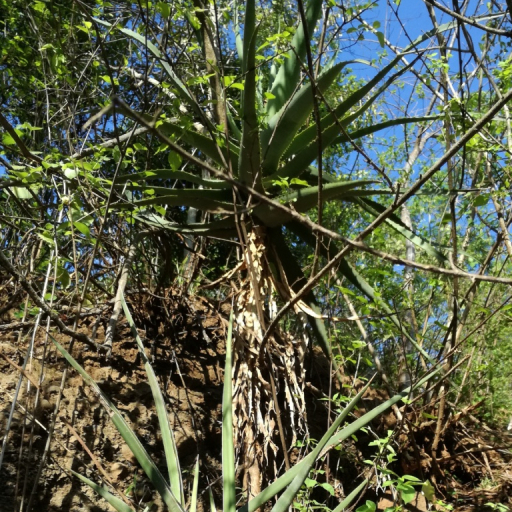
Plant Overview
Known as the "Giant Tree Aloe" of the East African plains, Aloe volkensii is a true architectural marvel. Unlike the small, rosette-shaped succulents often found on windowsills, this species grows tall and proud, eventually resembling a sturdy tree. In its native Kenya and Tanzania, it stands as a sentinel of the scrublands, serving as a vital nectar source for colorful sunbirds.
🔍 How to Identify
- 🌳 Stately Stature: It develops a thick, woody trunk that can reach heights of 12 feet or more, often clothed in a "skirt" of dried, persistent old leaves.
- 🍃 Recurved Foliage: The long, fleshy leaves are lance-shaped and curve gracefully downwards. They are typically a dusty grayish-green but can take on reddish hues when stressed by sun or drought.
- 🦷 Reddish Teeth: The margins of the leaves are lined with small, sharp, reddish-brown teeth that feel firm to the touch.
- 🗼 Towering Blooms: It produces branched flower spikes (racemes) with cylindrical flowers that are usually a vibrant orange-red, fading to a pale yellow at the tips.
🏡 In Your Garden
- ☀️ Sun Seeker: This Aloe is a high-energy plant that craves intense light. In a garden setting, it needs a spot with full sun to prevent the stem from becoming weak or "leggy" as it reaches for the light.
- 🏜️ Drainage King: Originating from rocky slopes and dry bushlands, it has zero tolerance for "wet feet." It requires a very gritty, porous soil mix; if the roots sit in damp soil for too long, the plant can collapse rapidly from root rot.
- ⏳ Slow & Steady: While it is a "set and forget" plant once established, it is a slow grower. Its vertical growth makes it an excellent focal point for xeriscapes or large Mediterranean-style gardens.
⚠️ Safety & Toxicity
- 🐾 Toxic to Pets: Like most members of the Aloe family, this plant contains saponins and anthraquinones. If ingested by cats or dogs, it can cause vomiting, lethargy, and digestive upset.
- 🌵 Physical Hazard: The sharp teeth along the leaf margins can easily scratch skin. It is best planted away from walkways or areas where children frequently play.
✨ Fun Fact
- ✨ Botanical Legacy: The species was named in honor of Georg Volkens, a 19th-century German botanist who spent years documenting the unique and diverse flora surrounding Mount Kilimanjaro.

Detailed Care Instructions
To grow Aloe volkensii, also known as the leopard aloe or Maasai aloe, follow these steps:
- Choose the right location: Aloe volkensii prefers a sunny location, so select a spot with full sun exposure. It can also tolerate light shade but may not grow as vigorously.
- Provide well-draining soil: Aloe volkensii prefers sandy or rocky soil that is well-draining. If your soil is heavy or clayey, add sand or perlite to improve drainage.
- Propagation: Aloe volkensii can be propagated through offsets or seeds. Offsets are small plants that grow around the base of the mother plant. Carefully separate them from the mother plant and plant them at their new location. Alternatively, you can sow seeds directly into the soil during spring or early summer.
- Watering: Aloe volkensii is drought-tolerant but requires occasional watering, especially during hot and dry periods. Allow the soil to dry out completely between waterings to prevent root rot. Overwatering can be detrimental to the plant's health.
- Fertilization: Aloe volkensii doesn't require frequent fertilization. Applying a balanced fertilizer, such as a 10-10-10 or 14-14-14, once or twice a year during the growing season (spring and summer) can enhance its growth.
- Pruning: Dead or damaged leaves can be removed with a clean, sharp knife or scissors. Be cautious not to cut into the plant's healthy portions.
- Protect from frost: Aloe volkensii is not frost-resistant and will not survive freezing temperatures. If you live in a colder climate, it's best to grow it in a pot so it can be brought indoors during winter or provide frost protection, such as covering the plant with a frost cloth.
- Pests and diseases: Aloe volkensii is generally resistant to pests and diseases. However, keep an eye out for mealybugs, aphids, or scale insects. If necessary, treat any infestations with an appropriate insecticide.
Remember to research the specific needs of Aloe volkensii to cater to its requirements, as conditions may vary depending on your location and climate.
When watering this plant, it is important to keep in mind the natural habitat it comes from. Aloe Volkensii typically grows in arid, hot regions with long periods of drought. Therefore, it is crucial not to overwater this plant.
To water, fill a watering can or pitcher with room temperature water and pour it slowly over the soil until it is thoroughly moistened. Be careful not to wet the leaves or stem too much as this can cause rotting.
It is best to let the soil dry out completely between watering sessions. This can take anywhere from 2 to 4 weeks depending on the size of the pot, environmental conditions, and the soil used.
During the summer months when the plant is actively growing, it may need to be watered more frequently. However, during the winter months, it may only need to be watered once a month.
Additionally, it is important to ensure that the soil used for this plant is well-draining to avoid waterlogging or root rot. A mix of cactus soil and sand is recommended.
To fertilize this plant, use a balanced fertilizer with equal amounts of nitrogen, phosphorus, and potassium. Apply the fertilizer once every three months during the growing season from spring to fall. Mix the fertilizer with water according to the package instructions and pour it onto the soil around the plant, taking care not to get any on the leaves. Avoid fertilizing during the winter months when the plant is dormant.
A good type of soil to use for Aloe Volkensii plant would be well-draining soil that consists of a mixture of sand, loam, and perlite. This will provide the plant with adequate drainage and prevent water from accumulating in the soil, which could lead to root rot. Additionally, it is important to use a soil that is low in nutrients, as this plant prefers to grow in soil that is not very nutritious. Therefore, it might be necessary to add supplements like compost or fertilizer to keep the plant healthy. It is also important to ensure that the soil is well-aerated and has a pH level of around 6.5 to 7.5, which is optimal for growth. Overall, using well-draining soil with minimal nutrients will provide the best growing conditions for the Aloe Volkensii plant.
To propagate this plant, you will need to identify and select a healthy parent plant with no signs of disease or pests.
- Start by sterilizing your tools: Use a sharp, sterilized blade or scissors to cut off a healthy leaf or shoot from the parent plant.
- Allow the cutting to dry: Leave the cutting to dry in a shaded area for a few days or until the cut surface has calloused over.
- Prepare the potting mix: In the meantime, prepare the potting mix. This should consist of well-draining soil and sand or perlite in equal amounts.
- Plant the cutting: Once the cutting has dried, plant it in the potting mix. Bury the cut end about ½ inch deep into the soil.
- Keep the cutting moist: Water the cutting gently and keep the soil moist. Do not overwater as this can cause the cutting to rot.
- Place in bright, indirect light: Place the newly planted cutting in a bright, indirect light location. Direct sunlight can scorch the delicate leaves.
- Wait for roots to develop: Over the next few weeks, new roots will begin to develop from the cut end of the stem.
- Transplant: Once the roots have developed and the cutting has started to grow, it can be transplanted to its final location.
Remember to provide the plant with adequate amounts of sunlight, water, and nutrients to promote healthy growth.








