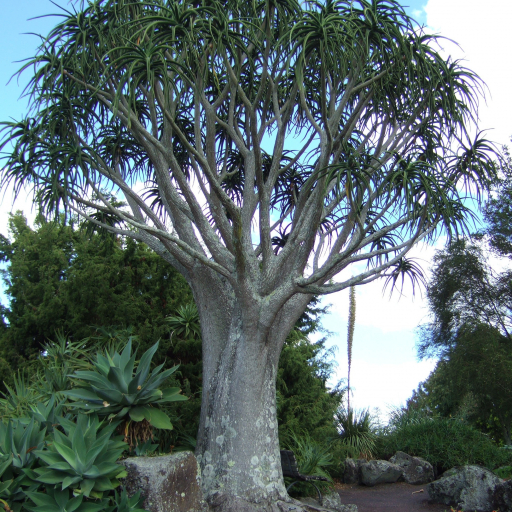
Plant Overview
The Aloidendron barberae, widely known as the Tree Aloe or Giant Aloe, is Africa's largest succulent and a true botanical skyscraper. Reaching heights that rival traditional trees, this prehistoric-looking marvel acts as a living sculpture in any landscape. It was famously named after Mary Elizabeth Barber, a pioneering naturalist who sent specimens of the plant to the Royal Botanic Gardens at Kew.
🔍 How to Identify
- 🌳 Growth Habit: Unlike typical ground-dwelling aloes, this species forms a massive, thick trunk with a distinctive gray, corky bark that peels slightly.
- 🍃 The Foliage: Long, dark green leaves are arranged in dense, graceful rosettes at the ends of the branches. The leaves curve downward and feature small, harmless teeth along the edges.
- 🌸 Winter Blooms: During the colder months, it produces tubular, rose-pink to orange flowers that are a magnet for nectar-seeking birds.
🏡 In Your Garden
- 🏗️ Architectural Space: Because it can grow up to 60 feet tall, it needs plenty of room. Avoid planting it near swimming pools or underground pipes, as its powerful, expanding base and root system can eventually crack concrete.
- ☀️ Sun & Drainage: This giant thrives in full sun and requires exceptionally well-draining soil. It stores vast amounts of water in its trunk and leaves, making it prone to "wet feet" or root rot if left in standing water.
- 🌬️ Wind Resistance: While it looks top-heavy, its bifurcating (Y-shaped) branching pattern makes it surprisingly resilient against wind, though young plants may need staking until their trunk thickens.
⚠️ Safety & Toxicity
- 🐾 Mildly Toxic: Like many members of the Aloe family, the sap contains aloin. If ingested by pets or children, it can cause stomach upset, tremors, or a laxative effect.
- 🧴 Skin Sensitivity: While not as medicinal as Aloe vera, the sap is generally harmless to touch, though individuals with sensitive skin might experience mild redness or itching.
✨ Fun Fact
The Tree Aloe is a slow starter but a fast finisher. Once its root system is established in the ground, it can grow up to 12 inches per year, making it one of the fastest-growing succulent trees in the world!

Detailed Care Instructions
| Lighting | Full Sun |
| Toxicity | Non-Toxic |
To grow Aloidendron barberae, also known as the tree aloe or quiver tree, follow these steps:
- Choose the right location: Aloidendron barberae thrives in full sunlight, so select a spot in your garden that receives at least 6-8 hours of direct sunlight per day. Also, ensure that the area has well-draining soil.
- Prepare the soil: Adequate drainage is crucial for this plant. You can amend the soil by adding sand or grit to improve drainage. Mix it well with the existing soil.
- Propagation: There are two common methods for propagating Aloidendron barberae: from seeds or cuttings. Seeds can be sown in a well-draining soil mix, and the process might take time. However, propagating from cuttings is more reliable and faster. Take stem cuttings from the mature plant, allow them to dry for a few days to form a callus, and then plant them in a well-draining soil mix.
- Watering: Aloidendron barberae is drought-tolerant and prefers infrequent watering. Water deeply and thoroughly, allowing the soil to dry out between waterings. Avoid overwatering, as it can lead to root rot.
- Fertilization: Aloidendron barberae is not heavy feeder, but you can apply a slow-release fertilizer once or twice a year during the growing season (spring and summer). Alternatively, you can use a liquid fertilizer diluted to half strength and apply it every 2-4 weeks during the growing season.
- Pruning: It is not necessary to prune Aloidendron barberae regularly. However, you can remove any dead or damaged leaves using clean, sharp pruning shears. Be cautious as the sap from the plant can be irritating to the skin.
- Protection: Aloidendron barberae is a hardy plant, but it can be prone to pests like scale insects. Inspect your plant regularly, and if any pests are present, treat them with an appropriate insecticide or by wiping them off manually.
- Frost protection: Aloidendron barberae is relatively cold-tolerant, but young plants might need some protection from frost. Cover them with blankets or bring them indoors during extreme cold temperatures.
By following these steps, you can successfully grow Aloidendron barberae and enjoy its beautiful structure and unique form in your garden.

Place in a bright room that is sun drenched almost all day. Or directly in a south-facing window.

To properly water this plant, you should first ensure that the soil is completely dry before watering. This species is sensitive to overwatering, so it is important to allow the soil to dry out completely between watering sessions.
When watering, be sure to water deeply and slowly, ensuring that the water reaches the roots of the plant. Once the water has penetrated the soil, allow any excess water to drain away, as standing water can cause root rot in this species.
During the winter months, it is important to reduce watering to avoid waterlogged soil, as the plant will be in a period of dormancy. In the spring and summer, you may need to water more frequently if the weather is particularly dry or hot.
It is also important to avoid getting water on the leaves of the plant, as this can cause them to rot or develop fungal infections. Instead, aim to water the soil directly at the base of the plant.
Overall, this plant requires infrequent but deep watering to thrive, and it is important to be cautious and avoid overwatering to prevent damage to the plant's roots.
To fertilize this plant, use a balanced liquid fertilizer designed for succulent plants. Dilute the fertilizer to half strength and apply it to the soil every two weeks during the growing season. Do not fertilize during the dormant period. Always water the plant first before applying the fertilizer to prevent burning the roots.
Aloidendron barberae requires well-draining soil with a sandy or gravelly texture. It is important to avoid using heavy soil that retains too much moisture, which can lead to root rot. A mix of equal parts coarse sand, perlite, and potting soil is a good choice for planting this species. Additionally, it is important to ensure that the soil is slightly acidic with a pH level between 6 and 7. Maintaining proper soil moisture levels is also important, as overwatering can cause the roots to become waterlogged and lead to plant stress or death.
A method to propagate this plant is by using stem cuttings. First, choose a healthy stem from the parent plant that is about 4-5 inches long. Then, using a clean, sharp knife or shears, cut the stem just below a leaf node. Remove the lower leaves from the stem, leaving only a few at the top. Allow the cutting to dry for about a day to prevent rotting.
Next, prepare a well-draining soil mix, such as a combination of perlite and peat moss, in a container. Make a hole in the soil and insert the cutting, ensuring that the bottom of the stem is in contact with the soil. Firmly press the soil around the cutting to ensure it is standing upright.
Water the soil lightly but avoid overwatering. Place the container in a warm, brightly lit area but out of direct sunlight. The cutting will take a few weeks to root and may require misting to prevent drying out.
Once the cutting has established roots and new growth appears, it can be transplanted into a larger pot or in the ground.








