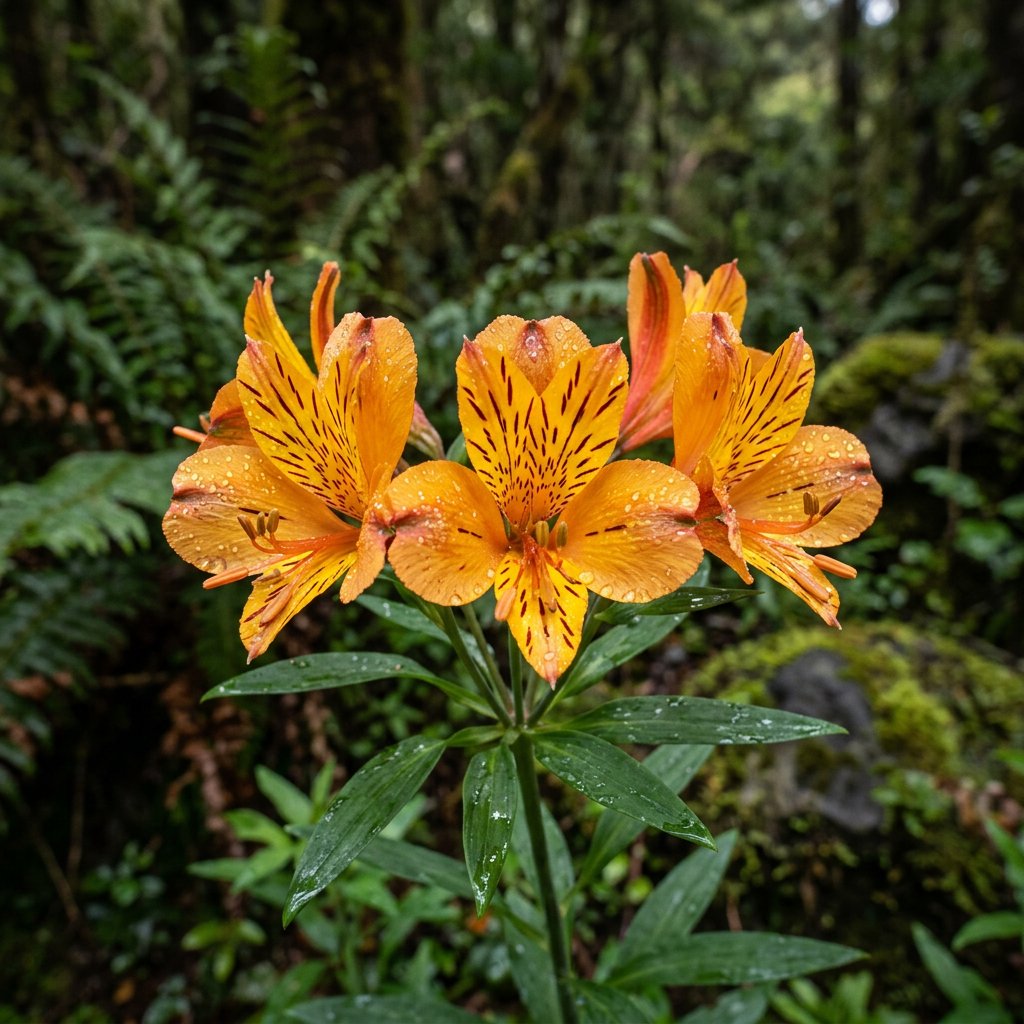
Plant Overview
Known widely as the Peruvian Lily or Lily of the Incas, Alstroemeria aurea is a vibrant burst of sunshine that originated in the cool, moist forests of Chile and Argentina. Its golden-orange petals and hardy nature have made it a favorite in Victorian-style gardens and modern floral bouquets alike. It is a plant that tells a story of endurance, symbolizing long-lasting friendship and devotion through its exceptionally long vase life.
🔍 How to Identify
- 🌸 The Blooms: Funnel-shaped flowers appear in brilliant shades of yellow or deep orange. The three inner petals are typically narrower and distinctively marked with dark, mahogany-colored streaks or "whiskers."
- 🍃 Twisted Leaves: One of its most fascinating traits is resupination. The narrow, lance-shaped leaves actually twist at the base so that the underside faces upward—a rare botanical "flip" that is easy to spot upon close inspection.
- 📏 Growth Pattern: It grows in dense, upright clumps from fleshy underground rhizomes, reaching heights of 2 to 3 feet with multiple flower heads atop each sturdy stem.
🏡 In Your Garden
- 🌞 Sun and "Cool Feet": This lily loves to bask in the sun but is happiest when its roots are kept cool. A thick layer of mulch around the base helps mimic its native forest floor, keeping the soil moist and the temperature stable.
- 🏃 A Persistent Traveler: Be careful where you tuck it in! Because it spreads via underground rhizomes, Alstroemeria aurea can be quite assertive. It doesn't like being moved once established, as its deep, brittle roots can snap easily during transplanting.
⚠️ Safety & Toxicity
- 🐾 Pet Sensitivity: While not nearly as dangerous as "True Lilies" (which are deadly to cats), Alstroemeria contains tuliposide, which can cause digestive upset, drooling, or vomiting in cats and dogs if chewed.
- 🧤 Skin Irritation: The sap can cause "Alstroemeria dermatitis" in some individuals—a mild red rash or itchiness. If you are planning to cut a bunch for a vase, wearing gloves is a smart precaution.
✨ Fun Fact
The Alstroemeria was named by the "Father of Taxonomy," Carl Linnaeus, in honor of his close friend and student, Baron Klas von Alströmer. The Baron discovered the seeds during a trip to South America in 1753 and sent them back to Europe, where they have been a garden staple ever since!

Detailed Care Instructions
| Humidity | Normal |
| Lighting | Full Sun |
| Difficulty | Medium |
| Hibernation | Cold Period |
| Temperature | 10°C - 30°C |
| Hardiness Zones | Min 5A |
To grow Alstroemeria Aurea (also known as Peruvian lily) successfully, follow these steps:
- Purchase a healthy plant or obtain seeds from a reliable source.
- Choose a suitable location for planting. Alstroemeria Aurea thrives in full sun or partly shaded areas with well-drained soil.
- Prepare the soil by loosening it with a garden fork and removing any weeds or debris.
- Dig a hole slightly larger than the root ball of the plant or sow the seeds at a depth of 1/4 inch.
- Place the plant or seeds in the hole, making sure the crown (where the roots meet the stem) is level with the soil surface.
- Water the plant thoroughly after planting and keep the soil moist but not waterlogged during the growing season.
- Alstroemeria Aurea benefits from a regular feeding schedule. Apply a balanced, slow-release fertilizer or a water-soluble fertilizer once a month during the growing season.
- Mulch around the plant with organic matter like compost or straw to help retain moisture and suppress weed growth.
- Provide support for the tall stems of the plant by placing stakes or cages around them as they grow.
- Pinch or cut back faded flowers regularly to encourage continuous blooming and prevent the plant from expending energy on seed production.
- In cold climates, protect the plant from frost by covering it with a layer of straw or moving it indoors during winter.
- Divide the plant every 2-3 years in early spring or late fall to maintain its health and promote vigorous growth.
- Monitor the plant for any signs of pests or diseases. If necessary, treat them promptly with appropriate organic or chemical methods.
By following these guidelines, you can successfully grow Alstroemeria Aurea and enjoy its beautiful blooms.

Place in a bright room that is sun drenched almost all day. Or directly in a south-facing window.

To water this plant, it is important to ensure that the soil is always moist but not waterlogged. Water should be applied directly to the soil, avoiding getting water on the leaves. The plant should be watered regularly, especially during hot and dry weather. It is important to allow the soil to dry out slightly between waterings to prevent overwatering. In addition, it may be helpful to mulch around the base of the plant to retain moisture in the soil.
To fertilize this plant, apply a balanced fertilizer with equal amounts of nitrogen, phosphorus, and potassium in the spring and summer months. Use a slow-release fertilizer or a liquid fertilizer diluted to half-strength and apply once a month during the growing season. Do not over-fertilize as it can lead to a buildup of salts in the soil and damage the plant's roots. It is best to water the plant well before applying fertilizer to avoid burning the roots.
The recommended soil for growing this plant is a well-draining soil with a pH level of 6.0 to 7.5. The soil should also be nutrient-rich and should have a good amount of organic matter. It is important to avoid using heavy clay soil or soil that retains too much moisture, as this can lead to root rot. A mix of sand, perlite, and peat moss is a good option for creating a well-draining soil that will provide the optimal growing conditions for this plant. It is also important to ensure that the soil is not too acidic, as this can affect the plant's ability to absorb nutrients properly. Adding lime to the soil can help to raise the pH level and create a more balanced growing environment for this plant.
To propagate this particular plant, you will need to carefully remove a healthy and mature rhizome from the parent plant. It is important to make sure the rhizome has several healthy buds and roots attached to it.
Prepare a container or pot with well-draining soil mix and plant the rhizome horizontally at a depth of around 4 inches. Make sure to keep the soil moist but not waterlogged.
Place the container or pot in a warm and bright location, but not under direct sunlight. Within a few weeks, new shoots should start emerging from the rhizome.
Once the plant has grown strong and healthy, it can be transplanted into a larger container or planted directly into the ground.
Common pests of the peruvian-lily include Spider mites, aphids, thrips, snails. Make a habit of checking your peruvian-lily frequently for pests so that any infestations can be caught and managed early.








