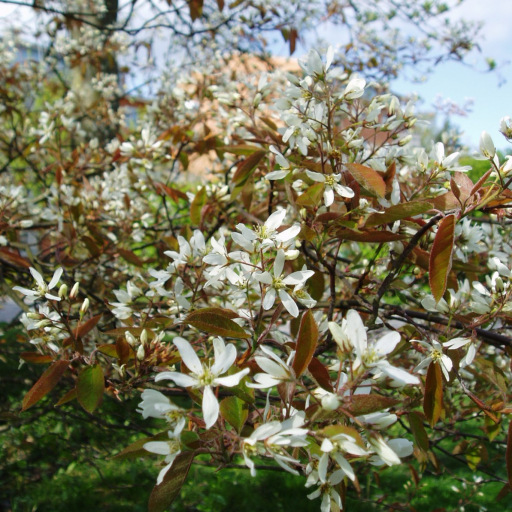
Plant Overview
Known affectionately as the Snowy Mespilus or Juneberry, this elegant shrub-like tree is a true garden masterpiece celebrated for its "four-season interest." In early spring, it erupts into a cloud of starry white blossoms just as the young bronze leaves emerge, creating a stunning copper-and-white contrast. By autumn, it puts on one of the most fiery displays in the landscape, with foliage turning brilliant shades of orange and crimson.
🔍 How to Identify
- 🌼 Starry Blossoms: Look for delicate, five-petaled white flowers that appear in pendulous clusters (racemes) during April and May.
- 🍂 Shifting Foliage: The oval leaves emerge a distinct coppery-bronze color in spring, mature into a lush deep green in summer, and finish with a spectacular orange-red glow in the fall.
- 🍒 Summer Berries: It produces small, round fruits that transition from green to red, eventually maturing into a deep purple-black hue that resembles a blueberry.
🏡 In Your Garden
- 🌳 Soil & Resilience: While it thrives best in moist, well-drained acidic soil, it is remarkably resilient. It is often used as a "focal point" tree because it stays relatively compact and doesn't have invasive roots.
- 🐦 Bird Buffet: The berries are a high-energy snack for songbirds. If you intend to harvest them for jams or pies, you will need to protect the tree with netting, as birds will often strip the branches the moment the fruit ripens.
- ✂️ Pruning Nuance: This plant hates "hard" pruning. Because it blooms on the previous year's wood, heavy winter cutting will result in a loss of flowers the following spring. It is best left to grow in its natural, multi-stemmed graceful shape.
⚠️ Safety & Toxicity
- ✅ Edible Fruit: The berries are perfectly safe and delicious for humans, offering a sweet flavor with a subtle hint of almond.
- 🐾 Seed Caution: Like many members of the Rose (Rosaceae) family—such as apples and cherries—the seeds contain trace amounts of cyanogenic glycosides. While the fruit is safe for pets and children, consuming massive quantities of crushed seeds should be avoided.
✨ Fun Fact
🕯️ The name "Serviceberry" has a somewhat somber but fascinating origin in colonial New England. It was said that when these trees bloomed in early spring, it was a signal that the ground had finally thawed enough for the traveling preachers to perform "services" for those who had passed away during the frozen winter months.

Detailed Care Instructions
| Lighting | Full Sun |
| Hardiness Zones | 4A - 8B |
To successfully grow an Amelanchier lamarckii plant, also known as Juneberry, follow these steps:
- Choose an appropriate location: Amelanchier lamarckii can grow in full sun to partial shade. Make sure the chosen spot has well-draining soil.
- Planting: Dig a hole that is slightly larger than the plant's root ball. Place the plant in the hole, making sure the crown is level with the surrounding soil. Backfill the hole and gently firm the soil around the roots.
- Watering: Water the plant deeply after planting. Afterward, water regularly but avoid overwatering, as Amelanchier lamarckii prefers moist but not waterlogged soil.
- Mulching: Apply a layer of organic mulch around the base of the plant. This will help retain moisture, suppress weeds, and provide nutrients as it breaks down.
- Pruning: While Amelanchier lamarckii generally requires minimal pruning, it is advisable to remove any dead, damaged, or diseased branches. Prune in late winter or early spring before new growth appears.
- Fertilizing: If your soil is lacking in nutrients, you can fertilize Amelanchier lamarckii in early spring with a balanced slow-release fertilizer. Follow the package instructions for application rates.
- Protecting from pests and diseases: Occasionally, Amelanchier lamarckii may face issues with pests or diseases such as leaf spot, aphids, or caterpillars. Monitor the plant regularly and take appropriate action if necessary, such as using organic pest control methods or contacting a professional for advice.
Remember to be patient, as Amelanchier lamarckii can take a few years to establish fully. With proper care and attention, it will grow into a beautiful plant that produces lovely white flowers in spring and abundant berries in summer.

Place in a window with dappled sun or a spot in the middle of a room. Or directly in a window facing west or east.
Amelanchier Lamarckii is a deciduous plant that typically grows in an upright and multi-stemmed habit. It is important to water this plant frequently during the growing season, especially during periods of drought.
To water Amelanchier Lamarckii, locate the base of the plant and ensure that the soil is moist to a depth of at least 2 inches. If the soil is dry, use a watering can or hose to water the soil around the plant's base.
To avoid overwatering, ensure that the plant is not sitting in water or in a water-logged area. This can lead to root rot and other issues.
It is also important to water this plant in the early morning or late evening, as watering during the hottest part of the day can lead to water evaporating before the plant has a chance to absorb it properly.
Overall, Amelanchier Lamarckii should be watered regularly to maintain healthy growth and prevent stress from drought.
To fertilize this plant, apply a balanced fertilizer with equal amounts of nitrogen, phosphorus, and potassium in early spring before new growth emerges. Use a slow-release fertilizer and follow the manufacturer's recommended application rates. Avoid fertilizing during hot and dry conditions, as this can stress the plant and reduce the effectiveness of the fertilizer. Water the plant thoroughly after fertilizing, and continue to provide adequate moisture throughout the growing season.
When choosing soil for this particular plant, it is recommended to use a well-draining soil with a pH that is slightly acidic. The soil should be rich in nutrients and organic matter. It is best to avoid heavy clay soils, as they can retain too much moisture and lead to root rot. Additionally, if planting in a container, it is important to choose a potting mix specifically formulated for woody plants.
There are several methods for propagating this plant, including:
- Softwood cuttings: In early summer, take 4-6 inch long cuttings of new growth that is not yet woody. Remove the lower leaves and dip the end of the cutting in rooting hormone. Plant the cutting in a well-draining soil mix and keep it moist. Keep the cutting in a shaded area until it has rooted and established.
- Hardwood cuttings: In late fall or winter, take 8-12 inch long cuttings of older, woody growth. Remove any leaves and dip the end of the cutting in rooting hormone. Plant the cutting in a well-draining soil mix and keep it moist. Keep the cutting in a shaded area until it has rooted and established.
- Division: In early spring, dig up an established plant and carefully divide the root ball into smaller sections. Each section should have several stems and roots. Plant each section in a well-draining soil mix. Keep the newly planted sections moist and in a shaded area until they have established.
- Suckers: This plant may produce suckers, or shoots that emerge from the base of the plant. These can be dug up and replanted in a well-draining soil mix. Keep the newly planted suckers moist and in a shaded area until they have established.








