Plant Overview
Often hailed as the "Queen of Flowering Trees," Amherstia nobilis is widely considered one of the most beautiful trees in the botanical world. Originating from the humid rainforests of Myanmar (formerly Burma), this rare evergreen creates a breathtaking spectacle when its long, cascading clusters of orchid-like flowers drape from the branches. It is a symbol of tropical elegance, though its demanding nature makes it a prize for only the most dedicated gardeners.
🔍 How to Identify
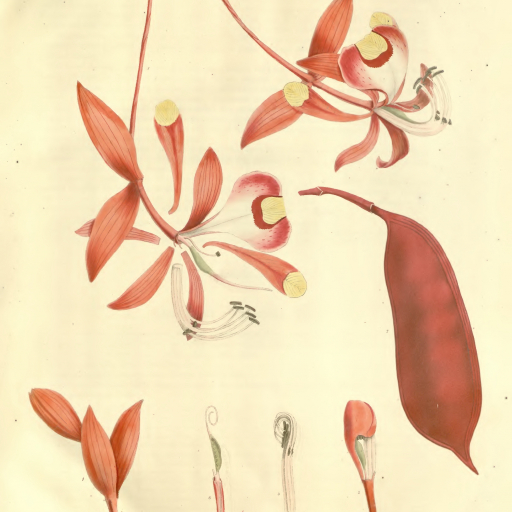
- 🌺 Orchid-like Blooms: The most striking feature is the "Pride of Burma" flower—long, pendulous sprays of fiery vermilion petals tipped with bright yellow.
- 🧤 Handkerchief Leaves: Young leaves emerge in limp, paper-thin clusters of copper, pink, or purple, hanging vertically like delicate handkerchiefs before turning green and firm.
- 🌳 Spreading Canopy: It grows into a medium-sized tree with a broad, rounded crown and dense, dark green pinnate foliage that provides deep shade.
🏡 In Your Garden
- ☁️ The Tropical Diva: This tree is extremely sensitive to its environment. It requires a true tropical climate with high humidity and temperatures that never drop near freezing. If the air is too dry, it may refuse to bloom.
- 💧 Hydration Nuance: It thrives in rich, acidic, and well-draining soil. Because of its deep taproot and sensitivity to "wet feet," it hates being moved once established—choose its permanent home carefully to avoid transplant shock.
⚠️ Safety & Toxicity
- ✅ Non-Toxic: Amherstia nobilis is generally considered safe and non-toxic to humans, cats, and dogs.
- 🧤 General Caution: As with many exotic ornamental trees, the sap might cause mild skin irritation for people with high sensitivities. It is always best to wear gloves when pruning.
✨ Fun Fact
👸 Royal Namesakes: The genus was named in honor of Lady Sarah Amherst and her daughter, who were 19th-century botanical collectors. Lady Amherst was the wife of the Governor-General of India, and she was among the first to bring notice of this "noble" tree to the Western scientific world.

Detailed Care Instructions
To grow an Amherstia Nobilis plant, also known as the Pride of Burma or the Orchid Tree, you can follow these steps:
- Climate and location: Ensure that you have the right climate for the plant. Amherstia Nobilis thrives in tropical and subtropical regions. It prefers full sun but can tolerate partial shade.
- Soil: The plant prefers well-draining soil. You can use a mix of garden soil, compost, and sand or perlite to improve drainage.
- Planting: Choose a suitable spot in your garden with enough space for the plant to grow. Dig a hole that is slightly larger than the root ball of the plant. Place the plant in the hole and backfill with the soil mixture, ensuring that the crown of the plant is level with the ground. Gently firm the soil around the plant.
- Watering: Amherstia Nobilis requires regular watering, especially during dry spells. Water the plant deeply to encourage deep root growth. However, ensure that the soil is not constantly waterlogged as it can lead to root rot.
- Fertilizing: Use a balanced organic fertilizer or a slow-release granular fertilizer in the spring and summer months to promote healthy growth and flowering. Follow the instructions on the fertilizer packaging for the correct amount to use.
- Pruning: Prune the plant to maintain its shape and remove any dead or diseased branches. It's best to prune after the flowering season to encourage new growth.
- Mulching: Apply a layer of organic mulch around the base of the plant to help retain moisture, suppress weed growth, and insulate the roots.
- Protection: Protect the plant from strong winds, as it has delicate branches and flowers.
- Propagation: Amherstia Nobilis can be propagated through seeds or by air-layering. Seeds should be soaked in warm water for 24 hours before sowing. Air-layering involves stripping a section of bark from the stem and applying rooting hormone to promote the growth of new roots.
- Pest and disease control: Monitor the plant for any signs of pests such as aphids or scales. Use appropriate organic pesticides or insecticidal soaps if necessary. Regularly inspect the plant for any signs of diseases such as fungal infections and treat them accordingly.
Remember to be patient, as Amherstia Nobilis can take several years to reach maturity and start flowering.

Place in a bright room that is sun drenched almost all day. Or directly in a south-facing window.

To properly water this plant, it is important to consider the soil type and drainage. It prefers a well-draining soil mix, with a pH level of around 6.5 to 7.5. When watering, ensure that the soil is slightly moist but not waterlogged, and avoid overwatering. Watering should be done deeply and infrequently, allowing the soil to dry out slightly between each watering session. The plant may need more frequent watering during hot weather or if grown in containers. It is important to avoid getting water on the foliage, as this can lead to fungal diseases. Instead, it is recommended to water directly around the base of the plant or use a drip irrigation system. Always monitor the soil moisture level and adjust watering frequency accordingly.
To fertilize the plant Amherstia Nobilis, you should follow these instructions:
- Choose a balanced, slow-release organic fertilizer specifically formulated for flowering plants.
- Prior to applying the fertilizer, ensure that the soil is moist but not waterlogged.
- Dilute the fertilizer according to the package instructions and mix it with water in a watering can or sprayer.
- Apply the diluted fertilizer to the soil around the base of the plant, avoiding direct contact with the stems or leaves.
- For newly planted Amherstia Nobilis, fertilize once every two months during the growing season (spring and summer).
- For established plants, fertilize every four to six weeks during the growing season, starting in early spring and ending in fall.
- Remember to adjust the fertilizer dosage based on the specific brand and instructions.
- Water the plant thoroughly after fertilizing to help the nutrients penetrate the soil and reach the plant's root system.
- Avoid over-fertilization, as this can lead to excessive growth or nutrient imbalance, harming the plant.
- Regularly monitor the plant's health and adjust the fertilization schedule or formulation if any signs of nutrient deficiency or excess are observed.
The soil that is ideal for planting Amherstia Nobilis plant is one that is well-draining and rich in organic matter. It should have a balanced pH level that ranges from slightly acidic to neutral. A fertile soil with good drainage that is enriched with compost or a slow release organic fertilizer is recommended for the plant. The soil should also retain some moisture without becoming waterlogged, as too much water can lead to root rot. A mixture of sand, peat moss, and perlite can be added to the soil to improve drainage and aeration, which helps the plant thrive. It is important to ensure that the soil is not too compacted, as roots require room to grow. Finally, it is recommended that the soil be mulched to help retain moisture and keep the soil temperature cooler.
Amherstia nobilis, a flowering plant belonging to the Fabaceae family, can be propagated through a few different methods. Here are some details on how to propagate this plant:
- Seeds: Collect ripe seeds from the plant once the seed pods dry and split open. Gently extract the seeds and remove any surrounding pulp. Soak the seeds in water for 24 hours to soften the hard outer coating. Prepare a well-draining soil mix by combining equal parts perlite and peat moss. Fill small pots or seed trays with the soil mix, and sow the seeds about 1/4 inch deep. Keep the soil consistently moist, and place the pots in a warm, shaded area. Germination may take several weeks to a few months. Once the seedlings have developed a few sets of true leaves, they can be transplanted into individual pots.
- Hardwood Cuttings: Take 6-8 inch long cuttings from semi-hardwood stems in late spring or early summer. Make clean, diagonal cuts just below a leaf node. Remove any lower leaves, leaving only a few at the top. Optionally, you can dip the cut ends in rooting hormone powder to stimulate root development. Fill a pot with a well-draining, sterile potting mix and moisten it. Insert the cuttings into the soil, leaving only a few inches of the stem above the surface. Place the pot in a warm, partially-shaded area and mist the cuttings regularly to maintain humidity. Roots should form within a few weeks to a couple of months. Once the roots are well-established, the new plants can be repotted into individual containers.
- Air Layering: This method is suitable for mature Amherstia nobilis plants with woody stems. Choose a stem that is at least pencil-thick and without any lower branches or leaves. About 12-18 inches from the tip, make a slanting cut around one-third of the way through the stem. Apply a rooting hormone to the area and wrap it with moist sphagnum moss, ensuring it covers the cut section completely. Wrap the moss layer with plastic wrap or a plastic bag to retain moisture. Secure both ends tightly with garden twine or tape. Keep the moss moist and monitor progress. After several months, roots should begin to grow from the moss layer. Once a sufficient root system has developed, cut below the air layer and plant it in a well-draining potting mix.
Remember to provide proper care and maintain suitable environmental conditions to ensure the success of your propagated Amherstia nobilis plants.