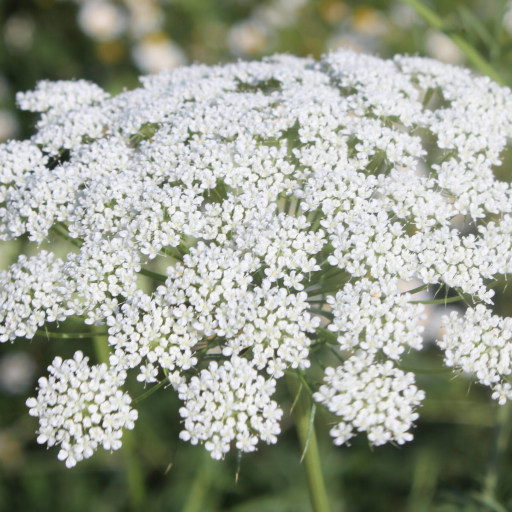
Plant Overview
Commonly known as "False Queen Anne's Lace" or "Bishop's Weed," Ammi majus is the sophisticated, airy cousin of the common meadow wildflower. Its cloud-like white blooms have graced floral arrangements for centuries, symbolizing grace and protection in various cultures. While it looks delicate enough to belong in a fairy tale, it is a hardy annual originally hailing from the Nile River Valley.
🔍 How to Identify
- ☁️ Flower Heads: Large, flat-topped clusters (umbels) made of hundreds of tiny, pure white florets that create a lacy, mist-like appearance.
- 🌿 Foliage: The lower leaves are broad and lobed, but as you move up the stem, they become finely dissected and fern-like.
- 📏 Stature: A tall, slender plant that can reach up to 4 feet in height, featuring smooth, hollow green stems that branch out near the top.
🏡 In Your Garden
- 🦋 Pollinator Magnet: This plant is a powerhouse for biodiversity. Its shallow nectar reserves are easily accessible to beneficial insects like hoverflies, tiny parasitic wasps, and honeybees.
- ✂️ The Florist’s Favorite: Unlike the wild Queen Anne’s Lace, Ammi majus lacks the single dark floret in the center and has much sturdier stems, making it one of the most popular "filler" flowers for professional bouquets.
- 🌱 Taproot Sensitivity: It develops a deep taproot quite quickly. Because of this, it hates being transplanted; it is best to sow seeds directly into the garden soil where they are intended to bloom.
⚠️ Safety & Toxicity
- ☀️ Phototoxicity Warning: The sap contains compounds called furocoumarins. If the sap gets on your skin and is then exposed to sunlight, it can cause "phytophotodermatitis"—a painful, blistering rash.
- 🐾 General Toxicity: It is considered toxic to livestock (especially sheep and cattle) and can cause skin irritation for pets and humans. Always wear gloves and long sleeves when pruning or harvesting these flowers.
✨ Fun Fact
In Ancient Egypt, Ammi majus was used as a herbal remedy to treat skin conditions like vitiligo. Remarkably, modern medicine still uses compounds derived from this plant to create "Psoralen," a medication used in UV light therapy for skin disorders today!

Detailed Care Instructions
To grow Ammi Majus (Bishop's Flower), follow these steps:
- Location: Choose a sunny spot in your garden that receives at least 6 hours of direct sunlight per day. Ammi Majus prefers well-draining soil but can tolerate a variety of soil types.
- Soil preparation: Prepare the soil by removing any weeds, stones, or debris. Loosen the soil with a fork or garden spade and add organic matter such as compost or well-rotted manure to enrich the soil.
- Sowing seeds: Ammi Majus is usually grown from seeds. Sow the seeds directly into the soil in early spring after the last frost date for your area. Scatter the seeds evenly on the prepared soil, and lightly press them into the soil with your hand. Avoid burying the seeds too deep.
- Watering: Water the seeds gently but thoroughly after sowing. Once the plants have established, water them regularly, keeping the soil moist but not waterlogged. Avoid over-watering, as it can cause root rot.
- Thinning: When the plants have grown a few inches tall, thin them out to allow proper spacing. Space the seedlings about 12-18 inches apart to ensure good air circulation and prevent overcrowding.
- Fertilizer: Ammi Majus doesn't usually require heavy fertilization. However, you can apply a balanced slow-release fertilizer once or twice during the growing season to promote healthy growth and flowering.
- Pest control: Monitor the plants for any signs of pests, such as aphids or caterpillars. If necessary, treat them with organic insecticides or try natural pest control methods like introducing beneficial insects to the garden.
- Support: As the plants grow taller, they may require support to prevent bending or breaking. Use stakes or hoop-style plant supports to keep the stems upright.
- Harvesting: Ammi Majus produces lovely white flowers in mid to late summer. Harvest the flowers when they are fully open but before the petals start to drop. Cut the stems with sharp pruners or scissors and place them in clean water immediately.
- Maintenance: Regularly remove spent flowers to encourage more blooms. Watch out for self-seeding as Ammi Majus can be a prolific self-sower. If you don't want it to spread uncontrollably, deadhead the flowers before they go to seed.
By following these steps, you should be able to grow and enjoy beautiful Ammi Majus plants in your garden.

Place in a bright room that is sun drenched almost all day. Or directly in a south-facing window.

To water this plant, you should first check the soil moisture level by sticking your finger into the soil up to your knuckle. If the soil feels dry, it's time to water. Use a watering can or hose to water the soil directly at the base of the plant, making sure not to get water on the leaves or flowers. Water thoroughly until water drains out of the bottom of the pot or soil. Avoid overwatering, as this can lead to root rot. Watering frequency may vary depending on the temperature, humidity, and sunlight conditions in your growing area. Monitor the plant's soil moisture regularly to ensure it remains at an appropriate level.
To fertilize this plant, wait until it has grown to a height of 6-8 inches. Then, apply a balanced fertilizer with equal parts nitrogen, phosphorus, and potassium. Use about one pound for every 100 square feet of planting area, or follow the instructions on the label. Water the plants after applying the fertilizer to help it absorb the nutrients. Repeat fertilization every 4-6 weeks during the growing season. Be careful not to over-fertilize, as this can result in excessive foliage growth and decreased flowering.
Ammi Majus plants thrive in well-draining, fertile soil with a pH level of about 6.5 to 7.5. A good soil mixture for these plants can include a combination of sandy loam, compost, and perlite to ensure proper drainage and aeration. Additionally, adding organic matter such as leaf mold or well-rotted manure can help improve the soil structure and provide essential nutrients for the plants to grow healthy and strong. It is important to avoid heavy clay soils, as they can lead to waterlogged conditions, which may cause root rot and other problems for the plant. Regularly testing the soil's pH level and nutrient content can help ensure that the plants have the optimal growing conditions to thrive.
Ammi Majus can be propagated through several methods, including seed germination, stem cuttings, and division. To propagate through seed germination, the seedheads should be left on the plant until they are fully matured and brown. The seeds can then be collected and sown in a mixture of sandy soil and compost. Keep the soil moist and place in a location with bright, indirect light. Germination should occur within 1-2 weeks.
For stem cuttings, select a healthy, non-flowering stem and cut it just below a node. Remove the lower leaves and dip the cut end in rooting hormone. Plant the cutting in a mixture of sandy soil and vermiculite, keeping the soil moist but not waterlogged. Cover the cutting with a plastic bag to create a humid environment and place it in a location with bright, indirect light. Roots should develop within 2-3 weeks.
Division should be done in the spring or fall when the plant is actively growing. Dig up the plant and carefully separate the roots, making sure each division has healthy roots and foliage. Replant each division in a location with well-draining soil and water regularly until established.
Common pests of the large bullwort include Spider mites, aphids, thrips, larvae. Make a habit of checking your large bullwort frequently for pests so that any infestations can be caught and managed early.








