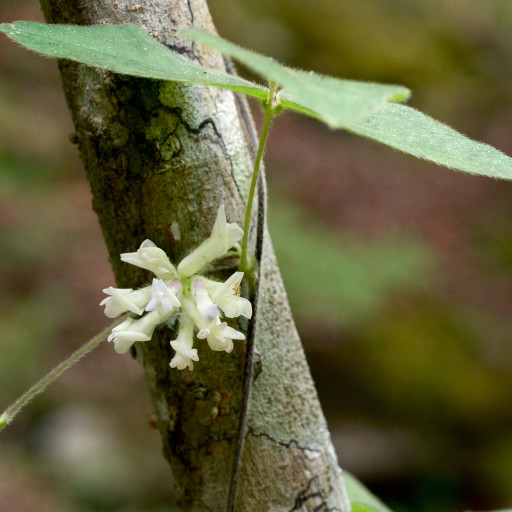
Plant Overview
The American Hogpeanut is a clever forest survivor with a double life. This delicate, twining vine is famous for its "secret" harvest, producing two distinct types of seeds—one in the air and one underground. Historically, it was a vital food source for Native American tribes and was famously "harvested" from the caches of industrious meadow mice.
🔍 How to Identify
- ☘️ Trifoliate Leaves: The plant features leaves divided into three teardrop-shaped leaflets, much like a common garden bean or clover, but with a more delicate, paper-thin texture.
- 🌸 Two-Tiered Flowers: It produces pale lilac or white pea-like flowers in clusters at the top, while inconspicuous, petal-less flowers grow at the base of the plant to produce underground seeds.
- 🧵 Twining Stems: The stems are very fine and wiry, covered in tiny downward-pointing hairs that help the vine "climb" by wrapping tightly around sturdier neighbors.
🏡 In Your Garden
- 🧪 Nitrogen Powerhouse: Like most members of the legume family, the Hogpeanut works with soil bacteria to "fix" nitrogen. This makes it a great "green manure" that naturally enriches the soil for surrounding plants.
- 🌲 Woodland Preference: It thrives in dappled sunlight and moist, rich soil. If you have a naturalized woodland edge, it provides excellent ground cover, though it can become quite "tangly" if left to roam in a small manicured garden.
⚠️ Safety & Toxicity
- 🍴 Status: Edible. The underground seeds are large and nutty (resembling peanuts), while the aerial pods contain smaller, lentil-like beans.
- 🧼 Details: While the seeds are edible when cooked, always ensure 100% identification accuracy, as the Hogpeanut often grows alongside Toxic Ivy or Virginia Creeper, which can lead to accidental contact or confusion.
✨ Fun Fact
Native Americans often didn't dig for these "peanuts" themselves. Instead, they would locate the winter burrows of voles and mice, who had already spent the autumn cleaning and storing large piles of the underground seeds, and "trade" for them!

Detailed Care Instructions
To grow Amphicarpaea bracteata plant, also known as American hog peanut, follow these steps:
- Obtain seeds: You can collect seeds from the wild or purchase them from a reputable nursery or online seed supplier.
- Choose a suitable planting location: American hog peanut prefers partially shaded areas with rich, well-draining soil. It can grow in full sun but may require extra watering.
- Prepare the soil: The soil should be loose and fertile. Amend it with compost or well-rotted organic matter to provide adequate nutrition for the plant.
- Sow the seeds: Plant the seeds in early spring, once the danger of frost has passed. Sow them directly into the ground at a depth of 1 inch (2.5 cm) and space them about 6 inches (15 cm) apart. Alternatively, you can start seeds indoors in early spring and transplant them into the garden once all frost danger has passed.
- Watering and maintenance: Keep the soil slightly moist but avoid overwatering. Watering once or twice a week should be sufficient, but adjust according to the weather conditions. Mulching around the plants will help retain moisture and suppress weeds.
- Provide support: The Amphicarpaea bracteata plant is a climbing vine, so provide a trellis, fence, or other support structure for the plant to climb.
- Fertilize if needed: If the soil is deficient in nutrients, you can apply a balanced slow-release fertilizer in early spring. Follow the instructions on the fertilizer packaging for application rates.
- Pruning: Prune the plant as needed to maintain shape and control growth. American hog peanut can become a bit invasive, so regular pruning will help keep it in check.
- Harvesting: In late summer, you can harvest the small pea-like nuts that develop underground. Dig gently to avoid damaging the plant and collect the edible nuts.
- Propagation: American hog peanut is a perennial plant, so it will come back year after year. However, if you wish to propagate more plants, you can collect the seeds from mature pods and sow them in the same manner as mentioned before.
Remember to research and familiarize yourself with any specific requirements of the Amphicarpaea bracteata plant for your particular climate zone or growing conditions.

Place in a bright room that is sun drenched almost all day. Or directly in a south-facing window.

To properly water this plant, it is important to first understand its watering needs. This plant should not be overwatered, as it prefers well-draining soil and does not tolerate standing in water. Before watering, it is recommended to check the moisture level of the soil. The plant should be watered when the top inch of soil feels dry to the touch. When watering, it is important to water around the base of the plant, taking care to avoid getting water on the leaves or stems. A thorough watering is recommended, allowing the water to soak deeply into the soil. It is also recommended to water in the morning or early evening, avoiding the hottest part of the day to prevent water evaporation and possible damage to leaves.
To fertilize this plant, you should apply a balanced, slow-release fertilizer in the spring and again in the summer. Follow the instructions on the fertilizer packaging for the correct amount to apply. Avoid over-fertilizing, as this can cause excessive growth and weaken the plant's overall health. Spread the fertilizer around the base of the plant and water well after application to ensure proper absorption.
Amphicarpaea Bracteata plant grows well in a well-drained soil rich in organic matter. It prefers a soil with a pH range of 5.5 to 6.5. The soil should be moist but not waterlogged. It grows best in soils that are deep and loamy, which allows for proper root development. The plant prefers full sun to partial shade and can tolerate a range of soil types, including clay and sandy soils. It is important to ensure that the planting area has good drainage, as the plant will not thrive in wet or poorly-draining soils. Regular fertilization with a balanced fertilizer will also help to promote healthy growth. Overall, the key to success with Amphicarpaea Bracteata plant is to choose a soil that is well-draining, rich in organic matter, and has a pH range that is suitable for the plant's growth needs.
Amphicarpaea bracteata is a plant species that belongs to the legume family. It can be propagated through seeds and vegetative methods such as stem cuttings.
To propagate Amphicarpaea bracteata through stem cuttings, follow these steps:
- Choose a healthy stem that is about six inches long and has a few leaves attached to it.
- Cut the stem with a sharp knife or scissors at a 45-degree angle just below a node.
- Remove the leaves from the bottom half of the stem.
- Dip the cut end of the stem in rooting hormone powder.
- Plant the stem in a pot filled with a mixture of peat moss and perlite or vermiculite.
- Water the soil well and cover the pot with a clear plastic bag to create a humid environment.
- Place the pot in a warm, bright location but out of direct sunlight.
- Check the soil moisture every few days and add water as needed.
- After a few weeks, roots should start to form.
- Once the roots are established, the plant can be transplanted into a larger pot or directly into the garden.
Propagation through seeds is also possible, but it requires stratification, which involves exposing the seeds to cold temperatures for several weeks to break dormancy. This process can be done by placing the seeds in a plastic bag with moist soil and storing them in the refrigerator for several weeks before planting.








