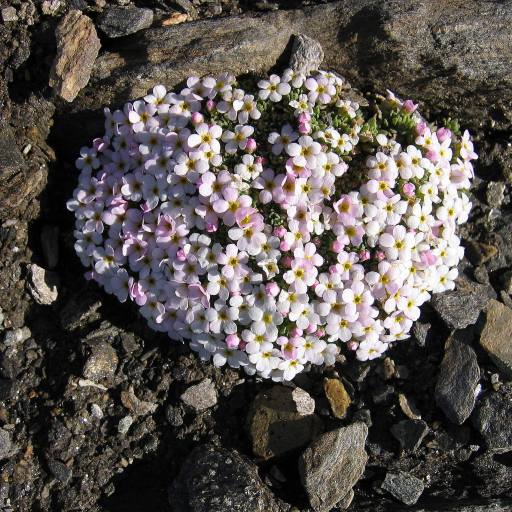
Plant Overview
Often called the "Glow of the High Alps," Androsace alpina is a resilient survivor that clings to the most inhospitable peaks of Europe. These tiny, mountain-dwelling cushions look like spilled jewels scattered across granite boulders. In high-altitude folklore, finding a blooming patch is often seen as a reward for the hardiest climbers who reach the "roof of the world."
🔍 How to Identify
- 🌸 Floral Blanket: The tiny, five-petaled flowers range from snowy white to a deep rose-pink, often appearing so densely that they completely hide the foliage underneath.
- 🧶 Woolly Rosettes: The leaves are arranged in tight, star-shaped rosettes covered in fine, silvery hairs designed to trap a layer of warm air and moisture against the freezing wind.
- 🧱 Cushion Habit: It grows in a compact, low-profile "hummock" or mound, a strategic shape that hugs the ground to avoid the shearing force of alpine gusts.
🏡 In Your Garden
- ⛰️ Granite Specialist: This plant is a "calcifuge," meaning it strictly prefers acidic, silica-rich environments. In a garden, it will struggle or die if planted near limestone or in alkaline soil.
- 💧 The Winter-Wet Warning: While it can survive extreme sub-zero temperatures, it is highly sensitive to dampness. To keep it happy, it requires a specialized alpine trough or a gritty scree bed where water can drain away instantly from its sensitive crown.
⚠️ Safety & Toxicity
- ✅ Non-Toxic Status: Androsace alpina is generally considered non-toxic to humans, cats, and dogs.
- 🧤 Fragile Nature: While it isn't poisonous, it is physically very delicate. Because it grows so slowly, any physical damage from curious pets or foot traffic can take years for the plant to repair.
✨ Fun Fact
🏔️ The Ultimate Mountaineer: Androsace alpina is one of the highest-growing flowering plants in the world. It has been recorded thriving at altitudes of over 4,000 meters (13,000 feet) in the Swiss Alps, where the growing season lasts only a few weeks.

Detailed Care Instructions
| Humidity | Normal |
| Lighting | Full Sun |
| Difficulty | Medium |
| Hibernation | Cold Period |
| Hardiness Zones | Max 5B |
To grow Androsace Alpina, also known as Alpine Rock-Jasmine, follow these steps:
- Choose an ideal location: Androsace Alpina prefers a well-drained, sunny spot. It is best suited for rock gardens, rock walls, or alpine troughs. Make sure the soil is well-draining and not overly fertile.
- Prepare the soil: Ensure the soil is slightly alkaline (pH 6-7), as this plant prefers neutral to alkaline conditions. Amend the soil with some coarse sand or grit to improve drainage.
- Sow seeds or plant seedlings: You can either sow Androsace Alpina seeds in early spring or plant seedlings in spring or fall. Sow the seeds in a fine sandy soil, covering them lightly with a thin layer of sand. If using seedlings, dig a small hole, place the plant carefully, and cover the roots with soil.
- Watering routine: These plants prefer to be kept moderately moist. Water the plant regularly, but avoid overwatering, as excessive water can lead to root rot. Moreover, try to water the soil directly rather than overhead to prevent rotting of leaves or flowers.
- Provide enough sunlight: Androsace Alpina requires full sun to thrive. Make sure the plant receives at least 6 hours of direct sunlight per day. Insufficient sunlight may cause weak growth or sparse blooming.
- Pruning: Deadhead faded flowers regularly to promote additional blooms and neaten the appearance of the plant. Pruning also helps prevent the plant from self-seeding excessively.
- Fertilize occasionally: Androsace Alpina does not usually require heavy feeding. However, you can apply a balanced slow-release fertilizer during the growing season to provide essential nutrients.
- Protect from extreme cold: If you live in an area with harsh winters, protect the plant by providing some winter mulch. This will help insulate the roots from freezing temperatures.
- Monitor for pests and diseases: Keep an eye out for common pests such as aphids or slugs, and promptly treat them if spotted. Additionally, provide good air circulation around the plant to minimize the risk of fungal diseases.
By following these steps, you should be able to successfully grow Androsace Alpina and enjoy its delicate flowers in your garden.

Place in a bright room that is sun drenched almost all day. Or directly in a south-facing window.

To water this plant, it is important to ensure that the soil is not too dry or too moist. The best way to achieve this is to water it regularly, but in small amounts. It is recommended to water the plant once a week or when the top inch of soil feels dry to the touch. When watering, it is important to avoid getting water on the leaves or stems as this may cause damage or promote fungal growth. Instead, water at the base of the plant, using a watering can or gentle shower. If the plant is potted, ensure that there are drainage holes in the bottom of the container to allow excess water to drain away.
- Choose a well-draining soil with a pH between 6.0 and 7.5.
- Fertilize during the growing season, which is typically in the spring and summer months.
- Use a balanced fertilizer with equal amounts of nitrogen, phosphorus, and potassium.
- Apply fertilizer at a rate of 1 tablespoon per square foot of soil.
- Water the plant thoroughly after applying fertilizer to prevent burning of the roots.
- Repeat fertilization every 4-6 weeks during the growing season.
- Avoid fertilizing during the dormant season, which is typically in the fall and winter months.
Androsace alpina is a plant that requires well-draining soil that is nutrient-rich. The ideal soil for this plant should have a pH level that ranges from neutral to slightly acidic. The soil should also be moist but not waterlogged or heavy as this can cause root damage and hamper growth. Using a mulch layer around the base of the plant can help maintain soil moisture and keep the roots cool during hot weather. Adding organic matter to the soil can also improve soil quality and support healthy growth of this plant. It is important to avoid using soil that is too heavy or clay-based as this can lead to waterlogging and root rot. It is recommended to test the soil before planting and making any adjustments as needed based on the results.
To propagate this plant, take stem cuttings from the plant during the growing season. Select a healthy stem that is at least 4 inches long with several leaves and no flowers. Cut the stem just below a leaf node using clean, sharp scissors. Remove the lower leaves and pinch off any flower buds.
Plant the cutting in a well-draining soil mix in a small pot or container. Make a small hole in the soil and gently insert the cutting, firming the soil around it. Water the cutting well and place the pot in a bright spot, out of direct sunlight.
Keep the soil consistently moist but not waterlogged, and mist the cutting daily to maintain humidity. After a few weeks, the cutting should begin to develop roots and new growth. Once the new plant has established roots, it can be transplanted into a larger pot or directly into the garden.








